Social Media Post Ideas to Re-Engage Inactive Followers & Customers
You had their attention once.
They followed you. They bought from you. They replied to your Stories or emails.
And then... nothing.
- Your posts still show up, but they scroll past.
- Customers who bought once don't open your emails anymore.
- Followers who used to comment have gone quiet.
If you want to win them back, you can't just keep posting as if nothing happened.
Re-engagement needs deliberate content: posts that acknowledge the drift, rebuild trust, and give people a fresh reason to care.
This guide walks through practical, repeatable social media post ideas for re-engaging inactive followers and lapsed customers - across Instagram, TikTok, LinkedIn, X, YouTube, and more.
We'll cover:
- Post formats that "wake up" quiet audiences without guilt-tripping them
- How to mix value, honesty, and offers so people feel excited (not pressured)
- Ways to segment and speak differently to ex-customers vs quiet followers
- How to use Socialmon to find and reuse re-engagement patterns that work in your niche
Treat this as a working swipe file. Pick a few ideas, ship them, measure what moves - then keep the ones that reliably bring people back.
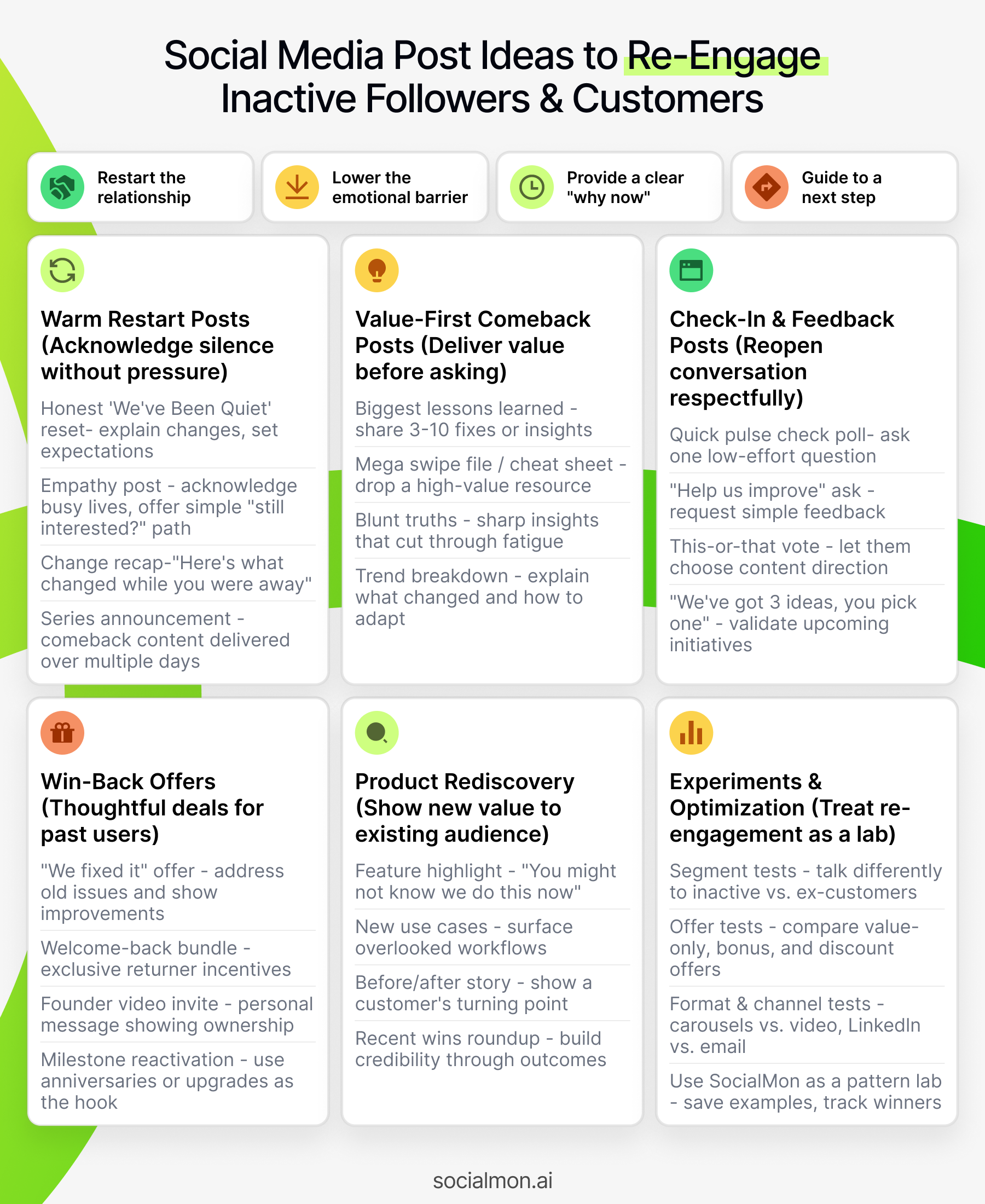
How These Post Ideas Help You Re-Engage Inactive Followers
Re-engagement content has slightly different goals from "usual" posts. You're not just trying to get views; you're trying to:
- Restart the relationship Remind people who you are, what you stand for, and why they followed you in the first place.
- Lower the emotional barrier People often feel awkward coming back after a long time. Good posts make it feel natural and welcome.
- Show a clear "why now" If they've ignored you for months, "hey, new blog post" won't cut it. They need a specific reason to pay attention today.
- Guide them to a next step Re-engagement is most powerful when it leads somewhere: a lead magnet, a new feature, a webinar, a sale, or even just "talk to us."
You can adapt these ideas for:
- Instagram / TikTok / YouTube Shorts - emotional "we're back", glow-ups, quick value hits, Story sequences
- LinkedIn / X - honest posts about changes, new direction, "here's what we've learned" threads
- Email + social combo - using email to bring people back to your socials and vice versa
💡 Pro tip with Socialmon Create separate boards like:
- Re-Engagement - Followers
- Re-Engagement - Customers / Churned
Then, any time you see:
- "We've been quiet..." posts
- "We changed direction, here's what's new" posts
- "We'd love to have you back" win-back campaigns
...save them. In a few weeks you'll have a real-world pattern library of how good brands bring people back without being cringe or desperate.
A. "We've Been Quiet" / "You've Been Quiet" Warm Restart Posts
These posts acknowledge the silence and reopen the conversation in a human way - without guilt or pressure.
1. Honest "We've Been Quiet" Reset Post
Goal: Re-introduce your brand after a hiatus and set expectations for what's coming.
How to do it:
- Be transparent: "We've been quieter here than we'd like."
- Briefly explain what changed: product work, team changes, clearer focus, etc.
- Tell people what content they can expect going forward.
- Invite a tiny, low-friction action (like replying to a Story or voting on a poll).
Example caption (IG / LinkedIn):
"We've been quieter here than we'd like. Over the last few months we've been heads down: - rebuilding our [product/offer] - talking to customers - fixing the stuff that wasn't working
Now we're back with a clearer focus: - 2x weekly posts breaking down [topic] - real examples of what's working right now - behind-the-scenes of how we ship and improve
If you're still here, thank you. Comment 👋 or reply with what you'd like help with next so we can make this worth your attention again."
Why it works:
- Acknowledges reality instead of pretending the gap didn't happen.
- Resets expectations so people know why they should pay attention now.
- Invites a micro-engagement to get the algorithm re-noticing the connection.
With Socialmon: Save examples of "we've been away" posts that don't overshare or guilt trip. Tag them restart_post. Use them to calibrate your tone: honest, calm, and forward-looking.
2. "We Noticed You've Been Quiet" Empathy Post
Goal: Speak to inactive followers/customers directly - without sounding accusatory.
Use this more in email + social together (e.g. Instagram + a re-engagement email).
How to do it:
- Phrase it empathetically: "Life got busy", "You've had a lot going on."
- Acknowledge the value of their attention.
- Offer a simple way to say "still interested" or "not for me anymore."
Example caption (paired with an email):
"You might not have seen us in a while - and that's okay.
If your feed and inbox have been noisy, we get it.
We've simplified what we do here: - one weekly deep dive on [topic] - one practical swipe file or template - occasional updates when we launch something genuinely useful
If you're still interested, hit ❤️ on this so we know you're here. If you're not, no hard feelings. You can quietly leave any time - we'll be cheering you on either way."
Pair this with an email subject like:
"Still want help with [outcome]?" or "We've changed how we show up (you might like this)"
Why it works:
- Removes pressure - people don't feel judged for being inactive.
- Gives them a gentle way back in (a like, a Story reply, a simple "yes").
- Signals respect: you're not chasing them endlessly; you're offering value and choice.
3. "Here's What Changed While You Were Away" Recap Post
Goal: Catch people up on the most important improvements so they feel like it's worth paying attention again.
How to do it:
- Use a carousel or thread titled "What's new around here".
- Include 3-7 meaningful changes: product, pricing, content format, support, etc.
- For each, add a short line on why it matters for them.
- Point to a single hub (a Notion page, blog post, or landing page) for more.
Structure:
- Slide 1 / Tweet 1: "If you haven't checked in for a while, here's what's changed."
- Slide 2-6: Each change = Change → Why it matters.
- Final slide: "If you left because [old objection], we fixed/changed it. Details → [link]."
Example:
"If you checked out a few months ago, you might have missed:
1️⃣ New free tier - so you can [do X] without paying yet. 2️⃣ Cleaner UI - we removed 3 confusing steps from onboarding. 3️⃣ Better support - live chat + actual humans helping you. 4️⃣ More real examples - we now share weekly breakdowns of what's working.
If you left because things felt clunky or unclear, we built this recap page just for you → [link]."
With Socialmon: Create a board Re-Engagement - Change Recaps and save posts where brands summarise "what's new" in a clean, visual way. When you're ready to do your own recap, you'll have structure and visual patterns ready.
4. "We're Back With a Clear Theme" Series Announcement
Goal: Give dormant followers a reason to check back in the coming days/weeks.
Instead of one lonely "we're back" post, announce a series so re-engagement is stretched over time.
How to do it:
- Pick a theme that tightly matches your audience's core problem.
- Announce a specific cadence and duration (e.g. 10 days, 4 weeks).
- Make the promise concrete ("you'll walk away with X, Y, Z").
- Encourage people to follow/turn on notifications/save the post.
Example caption:
"We're back - and we're doing something structured this time.
For the next 14 days, you'll see a daily post titled 👉 Lead-Gen Fix #1, Lead-Gen Fix #2, etc.
Each one will give you: - one tiny change to make to your content - one real example from our own tests - one prompt to try that day
If your feed has been noise, this series is your signal. Tap 'follow' or turn on notifications if you want to actually implement along with us."
Why it works:
- Makes the comeback feel intentional, not random.
- Creates anticipation and habit ("oh yeah, their day #3 fix").
- Gives inactive followers a reason to "re-follow with intent".
B. Value-First Comeback Posts (With No Immediate Ask)
If people haven't engaged in a while, they're not going to jump straight into buying or booking calls.
You often need 1-3 posts that deliver disproportionate value before you ask for anything.
These ideas are about showing up, being useful, and reminding people why they followed you in the first place.
5. "Biggest Lessons From the Last 6-12 Months" Post
Goal: Share learnings that make your time away feel productive - and genuinely helpful.
How to do it:
- Pick 3-10 lessons that tie directly to your audience's problems.
- For each, use: Lesson → What we did wrong → What we'd do now.
- Make it read like advice, not a diary entry.
Example (LinkedIn / IG carousel / X thread):
"We spent the last 6 months fixing our funnel and talking to customers. Here are 5 painful lessons that'll save you time:
1️⃣ We chased reach instead of relevance → views went up, revenue didn't. Now we optimise for leads & signups first.
2️⃣ Our trial was too long and too vague → people lost momentum. Shorter trial, clearer quick win = more upgrades.
...
If you've been in a similar messy middle, steal these and adapt them to your setup."
Why it works:
- Positions you as someone who does the work and shares from reality.
- Gives inactive followers a reason to think "ah, this is still useful; I should keep this account around."
- Plants seeds for later offers ("we fixed these things - we can help you fix them too").
With Socialmon: Save threads/carousels where founders/brands share "what we learned fixing X". Tag them lessons_post. They're some of the most trustworthy re-engagement formats.
6. "Ultimate Cheat Sheet / Mega Swipe File" Post
Goal: Drop a high-value asset that reminds your audience your content is worth their time.
You can decide whether this stays free-free, or sits behind an email wall later. For pure re-engagement, you might even give it away without an opt-in once.
How to do it:
- Choose a tight topic your quiet followers care deeply about (e.g. "hooks that sell", "questions to qualify leads", "IG Story prompts").
- Compile a big list: 20-100+ ideas, prompts, or examples.
- Present a chunk of it on social, and link to the full thing on your site if you want.
Example (carousel):
Slide 1: "27 content prompts to wake up a quiet audience" Slide 2-6: 3-5 prompts per slide ("Tell a story about your first client", etc.). Final slide: "Save this. If you want the full list of 50 prompts + examples, it's here → [link]."
Even if you don't drive them off-platform, you're re-training them to see your content as useful and generous.
Why it works:
- Over-delivers vs what people expect from a random post.
- Gets saved, shared, and referenced - which also helps re-surface your account algorithmically.
- Makes dormant followers think "okay, I should pay attention again."
With Socialmon: Create a board Big Value Posts. Save mega-threads, swipe files, and big tip carousels. Use them as structural blueprints when you want to drop a "power post" to restart relationships.
7. "Blunt Truths Your Audience Needs to Hear" Post
Goal: Cut through feed fatigue with sharp, honest insights that shake people awake (without being edgy for the sake of it).
How to do it:
- Identify opinions you genuinely hold about your niche that:
- Go against shallow advice
- Are backed by your experience
- Tie to mistakes your inactive audience might be making
- Present them as a short list of "truths" or "unpopular opinions" with context.
Example:
"3 blunt truths about why your content stopped working (that nobody wants to hear):
1️⃣ You changed who you follow, but didn't change what you post. 2️⃣ You keep 'educating' people who just want to buy. 3️⃣ You're posting more, but saying less.
I say this with love - if you've been stuck, start by fixing one of these this week."
Why it works:
- Pattern interrupt - it reads differently from soft, generic posts.
- Signals expertise and clarity.
- Can wake up lurkers who needed a jolt of honesty.
With Socialmon: Save posts that say "this will sting a bit but..." or "unpopular opinion" and actually deliver thoughtful critique. Tag them truth_teller. Use them sparingly as re-engagement tools.
8. "State of the World / Trend Breakdown" Post
Goal: Show that you're up-to-date and useful in the current landscape, not just repeating advice from years ago.
How to do it:
- Pick a current shift affecting your audience (algorithm changes, ad costs, buyer behavior, etc.).
- Explain what's changed, why it matters, and what to do about it.
- Keep it actionable: "here's what we're doing differently this quarter."
Example (LinkedIn / X / YouTube Short):
"What changed about getting clients from social in 2025 (and what to do about it): - Buyers lurk longer before reaching out. - DMs replaced contact forms for first touch. - Mini-offers beat 'book a discovery call' as a first step.
Here's how we're adapting our content and offers this quarter 👇"
Why it works:
- Reassures inactive followers that you're evolving with reality.
- Gives them a reason to come back: "this account understands the current game."
- Sets up future posts/offers as part of that adapted strategy.
With Socialmon: Use Socialmon to collect "state of the industry" posts from serious operators in your niche. Tag them trend_breakdown. When you create your own, you'll have models for tone, depth, and framing.
C. Personalized Check-In & Feedback Posts That Reopen Conversation
Sometimes the best way to re-engage inactive followers or customers is to ask them what they want - in a way that feels respectful and specific, not needy.
These posts work especially well when you already have some relationship history (past buyers, early subscribers, ex-beta users, etc.).
9. "Quick Pulse Check" Poll Post
Goal: Restart interaction with a super low-effort question that gives you data and content ideas.
How to do it:
- Use polls on Stories, LinkedIn, X, or YouTube.
- Ask one simple, outcome-focused question, like:
- "What do you need most help with this quarter?"
- "What's blocking you from using [product] more?"
- "What kind of content would actually make you stop scrolling?"
- Offer 3-4 clear options, plus an "other" or DMs option.
Example Story poll:
"Be honest: What would actually make you pay attention to our posts again? 👀
🔘 Real examples from your niche 🔘 Templates & checklists 🔘 Behind-the-scenes mistakes & fixes 🔘 Other (DM me)"
Afterwards, share the poll results and follow up with content aligned to the top choices. That shows you're listening and responding.
Why it works:
- Easy to participate (one tap).
- Gives you permission to shift content based on real data.
- Signals that you care what they want, not just what you want to broadcast.
With Socialmon: Save poll-based posts that lead into "we're changing our content based on your answers." Tag them poll_feedback. Use them as structural templates for your own pulse checks every quarter.
10. "Help Us Improve" Feedback Request (With a Tiny Bribe)
Goal: Turn lapsed followers/customers into co-creators of your next moves.
How to do it:
- Be specific about what kind of feedback you want (onboarding, content, product, support).
- Make the time commitment small (2-5 minutes).
- Offer a small thank-you:
- early access
- template pack
- discount
- invite to a private Loom breakdown
Example caption:
"If you drifted away from our content or product, we'd genuinely love to know why.
We're running 10 short feedback calls (15 mins) and 25 quick form responses to understand: - why people stopped engaging - what we could do differently - what would make us worth your attention again
As a thank-you, you'll get: - early access to what we're building next - a private 'here's what we learned' Loom - [optional small discount or bonus]
Comment 'feedback' or DM us and we'll send you the link."
Why it works:
- Makes lapsed people feel valued, not judged.
- You get qualitative insight you'd never see in analytics.
- The act of giving feedback itself re-engages them emotionally.
With Socialmon: Create a Feedback & Insight board. Save posts where brands transparently ask for honest feedback (and clearly say what they'll do with it). Great reference for tone and structure.
11. "This or That?" Content Direction Vote
Goal: Get quiet followers to "vote" on what they want next, so your upcoming content feels co-created.
How to do it:
- Offer two clear options that both align to your business goals, e.g.:
- "Deep-dive tutorials vs 'over-the-shoulder' breakdowns"
- "Lead-gen content vs sales content"
- "Beginner-friendly vs advanced strategy"
- Ask them to vote via:
- poll
- emoji in comments
- reply with A/B
Example:
"If you've been lurking but not engaging, help us shape what's next:
Which would you actually watch/read right now?
A) Deep-dive guides (10-20 mins) on building a full system B) Short breakdowns (2-3 mins) of one post or funnel
Comment A or B - we'll prioritise the winner next month."
Why it works:
- Re-engagement without any "buy now" pressure.
- People are more likely to consume content they helped choose.
- Gives you clarity on where to invest your effort.
12. "We've Got 3 Ideas, You Pick One" Post
Goal: Validate potential re-engagement plays before you build them.
How to do it:
- Draft 2-3 possible initiatives:
- a live workshop
- a lead magnet
- a mini-challenge
- a new free tool
- Summarise each in 1-2 lines.
- Ask people to vote or comment with the one they'd actually join/use.
Example carousel:
Slide 1: "Help us choose what to build for you next 👇" Slide 2: "Option 1: 5-day 'Wake Up Your Audience' content challenge (free)" Slide 3: "Option 2: Swipe file of 50 re-engagement post examples" Slide 4: "Option 3: Live teardown clinic where we fix your dormant funnel" Final: "Comment 1 / 2 / 3 and we'll build the most requested first."
Why it works:
- You don't guess what will re-engage people - they tell you.
- Anyone who votes is now a warm lead for that initiative.
With Socialmon: Tag posts like this as choose_next or co_create. They're golden for product/content direction and re-engagement at the same time.
D. Win-Back Offers & "Come Back In" Deals (Without Devaluing Yourself)
At some point you can put an offer in front of lapsed customers or dormant followers - but it needs to feel thoughtful, not desperate.
The goal: give them a better experience this time, not just a cheaper one.
13. "We Fixed It" Win-Back Offer
Goal: Bring back people who churned for specific reasons (bugs, missing features, poor support).
How to do it:
- Name the old issue honestly.
- Show what you changed (with specifics).
- Give a time-bound window to try the improved version on better terms.
Example (email + social):
"If you tried [product] before and left because it was confusing or buggy, we don't blame you.
Here's what changed in the last 90 days: - Onboarding is now 3 steps instead of 8. - We rebuilt the analytics from scratch. - You now get live chat with a real human.
For past users only, we're offering: - a 14-day 'come back' trial - 1:1 onboarding call - a guaranteed 'no questions asked' cancellation if it still isn't right for you
If you want to give it another shot, this page is just for you → [link]."
Why it works:
- Treats them like adults.
- Shows growth and responsibility.
- Makes "try again" feel safe and logical.
With Socialmon: Create a Win-Back & Churn board. Save posts and emails that openly say "we improved X since you left." These are perfect references for your own "we fixed it" campaigns.
14. "Welcome Back Bundle" for Ex-Customers
Goal: Make returning feel special and upgraded, not like they're just another new user.
How to do it:
- Define who qualifies: "used to be a customer", "joined v1 beta", etc.
- Create an exclusive bundle:
- reduced rate or
- extra support, templates, training
- extended trial or bonus
- Explain clearly this is only for returners, and for a limited time.
Example caption:
"If you've ever been a [Brand] customer or beta user, this is just for you 👇
We put together a 'Welcome Back' bundle that includes: - an extended 30-day trial - a private onboarding session - our internal swipe file of [X]
It's our way of saying thanks for believing in us early on - and giving you a better experience this time round.
If you want in, comment BACK or head to this page → [link]."
Why it works:
- Leverages nostalgia and sunk cost (they already know you).
- Rewards their past trust instead of pretending they're new.
15. "Founder / Team Video Invite" Win-Back
Goal: Re-engage with a personal, human touch instead of just discounts.
How to do it:
- Record a short, direct video from a founder/leader: 30-90 seconds max.
- Talk to lapsed people as if you were on a call:
- "Here's what we were trying to do."
- "Here's what we got wrong."
- "Here's what we've changed."
- Invite them to:
- retest
- try a new feature
- come to a live Q&A
Example script (for Reels/LinkedIn video):
"If you tried us before and left, this is for you.
I'm [Name], founder of [Brand]. When we launched v1, we overcomplicated things. Onboarding was messy, support was slow, and honestly, we hadn't nailed the core use case yet.
The last few months we've done three things: - rebuilt onboarding from scratch - focused on one main outcome: [outcome] - added real people in support, not bots
If you're willing to give us another shot, we'd love to show you around live and hear your thoughts. Link in bio / in the comments to join the next session."
Why it works:
- Personal apology & ownership build trust.
- Many people want to root for a team that clearly cares.
With Socialmon: Save emotional founder videos aimed at previous users. Tag them founder_winback. They're strong pattern references for tone and openness.
16. "Anniversary / Milestone Reactivation" Post
Goal: Use milestones as a natural excuse to reach out with a special offer.
How to do it:
- Pick a meaningful milestone:
- "3 years since launch"
- "1000 customers"
- "v2.0 release"
- Create a limited reactivation window:
- "For the next 7 days, past customers can rejoin on special terms."
- Highlight what's improved since they last engaged.
Example:
"We just passed 3 years since [Brand] launched.
A lot has changed: - [New feature] - [Better support] - [New pricing/freemium]
If you were with us at any point along the way and want to see what [Brand] looks like now, we're opening a 7-day reactivation window: - [Bonus or special terms] - [Deadline]
Details are on this page → [link]."
Why it works:
- Milestones feel celebratory, not salesy.
- Past customers are reminded they were part of the journey.
E. Product Rediscovery & "Here's What You're Missing" Posts
These posts are aimed at people who know you but no longer see you as relevant. The job here is to show them new value.
17. "You Might Not Know We Do This Now" Feature Highlight
Goal: Show lapsed users new capabilities that solve problems they care about.
How to do it:
- Identify features released since many users left:
- new integration
- new report
- new automation
- new use case
- Highlight one per post, tied to a clear outcome.
Example carousel:
Slide 1: "If you tried [Brand] before, you might have missed this 👇" Slide 2: "New: automate [painful manual task] in 3 clicks." Slide 3: "Why it matters: saves ~[X] hours per week / reduces [risk]." Slide 4: "What one customer said: [short quote]." Final: "If this would change your day-to-day, we made a quick tour: [link]."
Why it works:
- Feels like an update, not a random promo.
- Focuses on "what's in it for me now".
18. "3 Use Cases You Might Be Sleeping On" Post
Goal: Expand their mental picture of how your product or content can help them today.
How to do it:
- Choose 3 lesser-known or new use cases that are genuinely helpful.
- One short paragraph each: Who it's for → What it does → Why it's useful.
Example:
"If you haven't used [Brand] in a while, here are 3 use cases you might be sleeping on:
1️⃣ For freelancers - [one sentence benefit] 2️⃣ For in-house marketers - [one sentence benefit] 3️⃣ For founders - [one sentence benefit]
We added step-by-step examples for each on this page → [link]."
Why it works:
- People see themselves in one of the use cases.
- Reframes you from "that thing I tried once" to "toolbox I've underused."
With Socialmon: Save posts that say "3 ways our customers actually use [product]" or "If you think we're just X, read this." Tag use_cases. Great prompts for rediscovery content.
19. "Before/After Story Aimed at Lapsed Users"
Goal: Use one strong story to make lapsed people think, "I could be there too if I came back."
How to do it:
- Choose a customer whose "before" looks like your dormant audience:
- stopped using you
- stuck on old processes
- overwhelmed, inconsistent, etc.
- Tell the story with emphasis on the turning point ("they came back / tried v2 / joined the new cohort").
Example:
"When [Customer] first tried [Brand] in 2023, they bounced after 2 weeks.
Their words, not ours: 'It felt clunky and I was too busy to figure it out.'
Fast forward to 2025 - they came back after we launched [key change].
Since then: - [result] - [result] - [result]
If you relate more to their 'before' story, the full breakdown of what changed (and how we work together now) is here → [link]."
Why it works:
- Mirrors the exact psychology of lapsed users ("I tried, I bounced").
- Shows that coming back can actually work out.
20. "Recent Wins You Might Have Missed" Roundup
Goal: Show a stack of outcomes to rebuild trust and FOMO.
How to do it:
- Collect 3-7 wins from the last 30-90 days:
- screenshots
- mini quotes
- tiny case study headlines
- Put them in one visual/post with a light CTA.
Example:
"If you haven't checked in for a while, here's what's been happening with people who have stuck around: - [Result #1: 'ex-customer came back and hit X'] - [Result #2: 'campaign drove Y leads'] - [Result #3: 'new feature saved Z hours']
We collected the full stories on one page → [link]. If any of these sound like outcomes you want this year, that page is a good place to start."
Why it works:
- Stacks credibility quickly.
- Makes inactivity feel like missing out on a moving train, not just "meh".
F. Experiments, Metrics & Using Socialmon as Your Re-Engagement Lab
You don't want to guess which re-engagement posts worked. Treat it like an experiment.
21. Segment Test: Active vs Inactive vs Ex-Customers
Goal: Talk differently to different groups so messages hit harder.
Simple breakdown:
- Active followers/customers:
- still open your stuff, still buy/use.
- Inactive followers:
- still follow, rarely engage/click.
- Ex-customers / churned:
- used to pay or use your product, now don't.
How to use this:
- Create slightly different versions of your posts:
- General feed post → aimed at "inactive followers + new people".
- Email / DM / custom audience ads → aimed at "ex-customers".
- Tailor the angle:
- Inactive followers: "Here's why our content is worth your time again."
- Ex-customers: "Here's why the product is worth another look."
You don't need perfect data; even rough segments (email lists, CRM tags, custom audiences) help.
22. Offer Test: Value Only vs Bonus vs Discount
Goal: See which type of re-engagement offer works best for your audience.
Things to test over a few weeks:
- Value-only re-engagement:
- "We're back with this high-value guide / challenge / workshop."
- Bonus-based win-back:
- "Come back and get extra support/templates/training."
- Discount-based win-back:
- "Rejoin now at [X]% off" (used carefully so you don't cheapen the brand).
How to run it:
- Assign each offer type to a different group or time window.
- Use separate landing pages/UTMs:
- utm_campaign=reengage_value_only
- utm_campaign=reengage_bonus
- utm_campaign=reengage_discount
Track:
- Click-through rate
- Signups/reactivations
- Follow-on behaviour (usage, upgrades, churn)
You'll learn whether your people respond more to extra help or cheaper access - which is crucial for future campaigns.
23. Format & Channel Tests for Re-Engagement
Different groups respond to different formats. A quick test plan:
- Format variations:
- honest text posts vs carousels vs talking-head videos vs Stories
- Channel variations:
- LinkedIn vs Instagram vs email vs SMS vs DM
Example 2-week test:
- Week 1:
- Honest "we've been quiet" post on LinkedIn + email
- Big value cheat sheet post on Instagram + Stories
- Week 2:
- Founder win-back video on Instagram Reels
- Before/after customer story on LinkedIn
Track which combos actually drive:
- replies
- DMs
- site visits
- reactivations
Use that to decide where to lean more heavily for your next re-engagement push.
24. Mini Re-Engagement Dashboard
You don't need complex BI. A simple spreadsheet or Notion table is enough:
Columns to track per campaign/post:
- Date
- Platform
- Post URL
- Segment targeted (inactive, ex-customers, mixed)
- Post type (restart, win_back_offer, big_value, feedback, etc.)
- Offer type (none, value, bonus, discount)
- Reach / impressions
- Comments / replies / DMs
- Clicks
- Reactivations or signups
- Revenue or "close to revenue" (trials, calls, proposals)
Review every 30 days:
- Which post types are most likely to start conversations again?
- Which offers bring people back and keep them?
- Which formats (video, carousel, text) consistently work for your audience?
Then: do more of those, less of the rest.
25. Using Socialmon as Your Re-Engagement Pattern Lab
Socialmon can be your living library of what good re-engagement looks like.
Here's a simple workflow:
- Create a few re-engagement boards
- Re-Engagement - Followers
- Re-Engagement - Customers
- Win-Back Offers & Churn
- Lead-Gen After Re-Engagement (for the next stage)
- Save only posts that clearly do re-engagement work
- "We've been quiet..." posts
- "We fixed X since you left" posts
- "Welcome back / come back in" offers
- Polls about "what do you want now?"
- Posts with comments like "I'm coming back", "just rejoined", "signing up again"
- Tag each creative by pattern
- restart_post, lessons_post, big_value, feedback, win_back_offer, founder_video, trend_breakdown, etc.
- Also tag offer type (bonus, discount, no_offer) and format (carousel, short_form_video, story_capture, thread, email_screenshot).
- Study in batches
- Open Re-Engagement - Followers and scan 10-20 posts.
- Note:
- How they open the post.
- How (or if) they acknowledge the gap.
- Whether they ask for anything immediately or just give value.
- How they transition into offers later (workshops, lead magnets, trials).
- Turn patterns into repeatable templates
- E.g. a "we've been quiet" template, a "we fixed it" template, a "welcome back bundle" template.
- Save these templates in your internal docs.
- Use the same skeleton but swap in your own stories, metrics, and offers.
- Feed your own best re-engagement posts back into Socialmon
- Whenever one of your re-engagement posts performs well:
- Drives replies or DMs from dormant people
- Reactivates trials
- Generates repeat purchases
- Clip it, save to your board, and tag it own_account + top_performer.
- Whenever one of your re-engagement posts performs well:
Over time, Socialmon becomes your brand-specific playbook for waking up inactive followers and lapsed customers - not based on guesses, but on what you see working in the wild and in your own data.
FAQ: Re-Engaging Inactive Followers and Customers
1. Why do followers and customers go inactive in the first place?
Most of the time, inactivity is not a personal rejection. Common reasons:
- Life got busy and your content slipped out of their routine.
- Algorithms stopped showing your posts as often.
- Your positioning shifted and they're not sure if your brand still fits them.
- Their priorities changed (role, business stage, budget, niche).
- They had a bad or underwhelming first experience (confusing product, noisy emails, too generic content).
Your job isn't to "convince everyone" to come back. It's to reconnect with the right people by showing what's changed, what's improved, and why you're relevant right now.
With Socialmon, you can intentionally collect posts from other brands that openly address this ("we've been quiet", "we fixed X", "what would make us worth your attention again?") and adapt those patterns to your own reality.
2. How often should I run "re-engagement" campaigns?
Think in cycles, not one-off blasts.
A simple cadence:
- Every quarter:
- A light "pulse check" campaign
- A few big value posts aimed at lurkers and inactive followers
- 1-2 "what do you want next?" polls or menus
- 1-2 times per year:
- A more intentional win-back / reactivation push for ex-customers (improved product, welcome-back bundle, milestone campaign).
You're not trying to "fix everything" in one week. You're building a habit of returning to past relationships instead of only chasing new reach.
In Socialmon, it's easy to maintain a board called Re-Engagement Campaigns so you can revisit good patterns every time you plan a new cycle.
3. What's the difference between re-engaging followers and reactivating customers?
They're related but not identical:
- Re-engaging followers
- Goal: get them to interact, remember you, and see your value again.
- Actions: likes, comments, replies, Story taps, link clicks.
- Reactivating customers
- Goal: restart a business relationship (trial, subscription, purchase, project, retainer).
- Actions: starting a trial again, repurchasing, rejoining a program, renewing a plan.
Many campaigns do both, but:
- Posts like "we've learned a lot, here's the honest breakdown" or "big value free training" are often aimed at followers (including past customers).
- Posts like "we fixed X and rebuilt Y-here's a special come-back bundle" are more for ex-customers.
Design your content, links, and offers based on which outcome you care about most.
4. How do I know if my re-engagement posts are actually working?
Look beyond likes.
Useful metrics:
- For followers:
- Comments from people who haven't engaged in a while
- Replies to Stories, DMs, or polls
- Increased link clicks from audiences you previously considered "cold"
- For customers:
- Reactivated accounts (trials started again, subscriptions restarted)
- Repeat purchases or re-enrolled cohorts
- Calls booked or demos requested from past users
For each re-engagement push, try to answer:
"How many previously inactive people took a meaningful step closer to us?"
Use a simple sheet or dashboard with columns for:
- Campaign / post
- Segment (inactive followers, ex-customers)
- Reach
- Clicks
- Replies / DMs
- Reactivations / purchases
Then save your top-performing posts into a dedicated Socialmon board (e.g. Re-Engagement Winners) so you can model those structures again.
5. What are the biggest mistakes to avoid when trying to re-engage people?
A few common traps:
- Guilt-tripping language
- "You guys abandoned us 😭"
- "Why did you all stop engaging?"
- This pushes people away and feels emotionally needy.
- Only showing up to sell
- If you vanish for months and come back only with a "buy now" promo, it signals you're not here to help-just to extract.
- Over-discounting to "win them back"
- Aggressive discounts can devalue your brand and annoy loyal customers who paid full price earlier.
- Ignoring why they left
- If the onboarding, pricing, or product experience hasn't improved, a big "come back" campaign just brings people into the same wall.
Much better:
- Acknowledge gaps honestly.
- Lead with helpful context and value.
- Demonstrate what's changed (product, content, support).
- Offer clear, fair terms to try you again.
You can use Socialmon to collect examples of win-back posts that feel respectful instead of desperate, then follow similar tone and structure.
6. Can small accounts or early-stage businesses really re-engage people effectively?
Absolutely-and often more effectively than big brands.
Small accounts can:
- Be more personal in their posts and DMs.
- Run manual audits, calls, or feedback loops that don't scale for huge brands.
- Respond quickly to what their audience says in polls and Q&As.
For a small account, even:
- 10-20 ex-customers returning, or
- 30-50 "previously quiet" followers becoming warm leads
...can be enough to change your revenue trajectory for the quarter.
When using Socialmon, don't just copy massive creators. Filter and save small but sharp accounts that obviously do re-engagement well (you'll see comments like "back for round two", "I needed this nudge", "just rejoined"). Their playbooks are often closer to your reality.
7. How is "re-engaging inactive followers/customers" different from just "posting more consistently"?
Posting consistently is about showing up. Re-engagement is about who you're showing up for and how you talk to them.
- You can be consistent and still irrelevant to people who drifted away.
- You can be consistent and still never acknowledge that the product has changed.
- You can be consistent and still never ask, "What would make us worth your time again?"
Re-engagement content:
- Speaks directly to dormant people
- References past journeys ("you may have tried us before", "if we fell off your radar...")
- Offers clear new reasons to care now (new value, improved experience, better fit)
8. How can Socialmon specifically help with re-engagement campaigns?
Think of Socialmon as your "what actually wakes people up?" lab.
You can:
- Capture real re-engagement examples as you scroll:
- "We've been away, here's why..." posts
- "We fixed X" and "Here's what changed" posts
- Win-back offers aimed at ex-customers
- Re-activation campaigns, comeback bundles, and founder apology videos
- Big value posts clearly aimed at dormant audiences ("if you haven't seen us in a while...")
- Organize them into clear boards:
- Re-Engagement - Followers
- Re-Engagement - Customers
- Win-Back Offers
- Comeback Campaigns
- Tag them by:
- Format (carousel, short-form video, thread, story, email screenshot)
- Pattern (restart_post, big_value, founder_video, feedback, win_back_offer)
- Outcome (comments, signups, reactivations where visible)
Then, when you go to plan your next re-engagement push, you're not starting from a blank page. You:
- Open the relevant Socialmon board.
- Scan 5-10 proven examples in your niche.
- Borrow their structure (hook, narrative, CTA, offer framing).
- Adapt it to your own product, story, and audience.
Over time, you'll also add your own best re-engagement posts into those boards-so Socialmon becomes a brand-specific playbook for waking people up again, based on what's actually worked for you.
Turning "Dead" Audiences Into Quiet Assets Again
Re-engaging inactive followers and lapsed customers doesn't happen because you post one emotional message or run one big discount.
It happens when you treat it like a system:
- You acknowledge the gap honestly instead of pretending nothing happened.
- You lead with real value that makes people remember why they followed or bought in the first place.
- You invite them back into the conversation with polls, questions, feedback, and co-creation.
- You show what's changed-product, content, support, direction-so "coming back" makes sense.
- You design specific offers for returners (welcome-back bundles, fixed-onboarding trials, improved programs).
- You track what works and reuse the winning patterns instead of guessing.
Here's a simple way to act on this article:
- Pick one segment to focus on first
- Inactive followers
- Ex-customers
- Old leads who never converted
- Choose 4-6 post ideas from this guide
- 1 honest "we're back / here's what changed"
- 1-2 big value posts tailored to their current reality
- 1 feedback/poll or "help us choose" post
- 1 win-back or come-back offer (even if small)
- 1 product rediscovery or "you might have missed this" post
- Run a mini re-engagement cycle over 2-4 weeks
- Watch replies, DMs, and reactivations.
- Note which patterns actually move people.
- Save every good external example and your own winners into Socialmon
- Build boards that reflect your real goals:
- Re-Engagement - Followers
- Re-Engagement - Customers
- Win-Back Offers
- Tag them so you can quickly filter by pattern next time.
- Build boards that reflect your real goals:
Do this consistently, and your "inactive" audience stops being a graveyard and becomes a quiet asset-a group of people you can reliably wake up when it matters, because you've taken the time to understand how to talk to them again.
Use this article as your idea engine. Use Socialmon as your pattern lab.
And let your next re-engagement campaign be less about guessing and more about applying what you've already seen work-in your niche, for your people.



Get 50 viral posts for your niche (free)