68 High-Performing Post Ideas for SaaS Startups That Actually Convert

SaaS founders don't usually struggle with posting - they struggle with posting things that drive signups, expansion, and revenue.
Looking across thousands of high-performing marketing examples on Socialmon, the posts that consistently work for SaaS startups do three things:
- Make a specific audience feel seen
- Tie directly to a real job-to-be-done
- Show credible proof that your product changes an outcome
This article gives you a structured library of formats you can reuse, remix, and brief your team on - instead of starting from a blank page every week.
How to use this guide (so it actually moves metrics)
- Pick 1-2 primary growth goals right now. For most SaaS teams, that's one of: more demos, more free trials, higher activation, or expansion.
- Anchor on your ICP and their workflows. Every idea below becomes stronger the more you name the role, team size, and stack you're talking to.
- Choose 2-3 categories to lean on as "pillars". For example:
- Early-stage devtool: Acquisition & Awareness, Data & Benchmarks, Education & Playbooks
- Horizontal SMB tool: Customer Proof, Education & Playbooks, Engagement & Community
- Turn each idea into a repeatable series, not a one-off. A single post is noise. A weekly or monthly series trains the market to pay attention.
- Pair this list with real-world inspiration. Drop your niche into Socialmon, find live examples of these formats in the wild, and mirror what's clearly working in your space.
Master list of high-performing SaaS post ideas (by category)
Below is the full library of post formats, grouped into meaningful buckets. You can use these across LinkedIn, X/Twitter, Instagram, email, or your blog - just adapt the framing and depth to each channel.
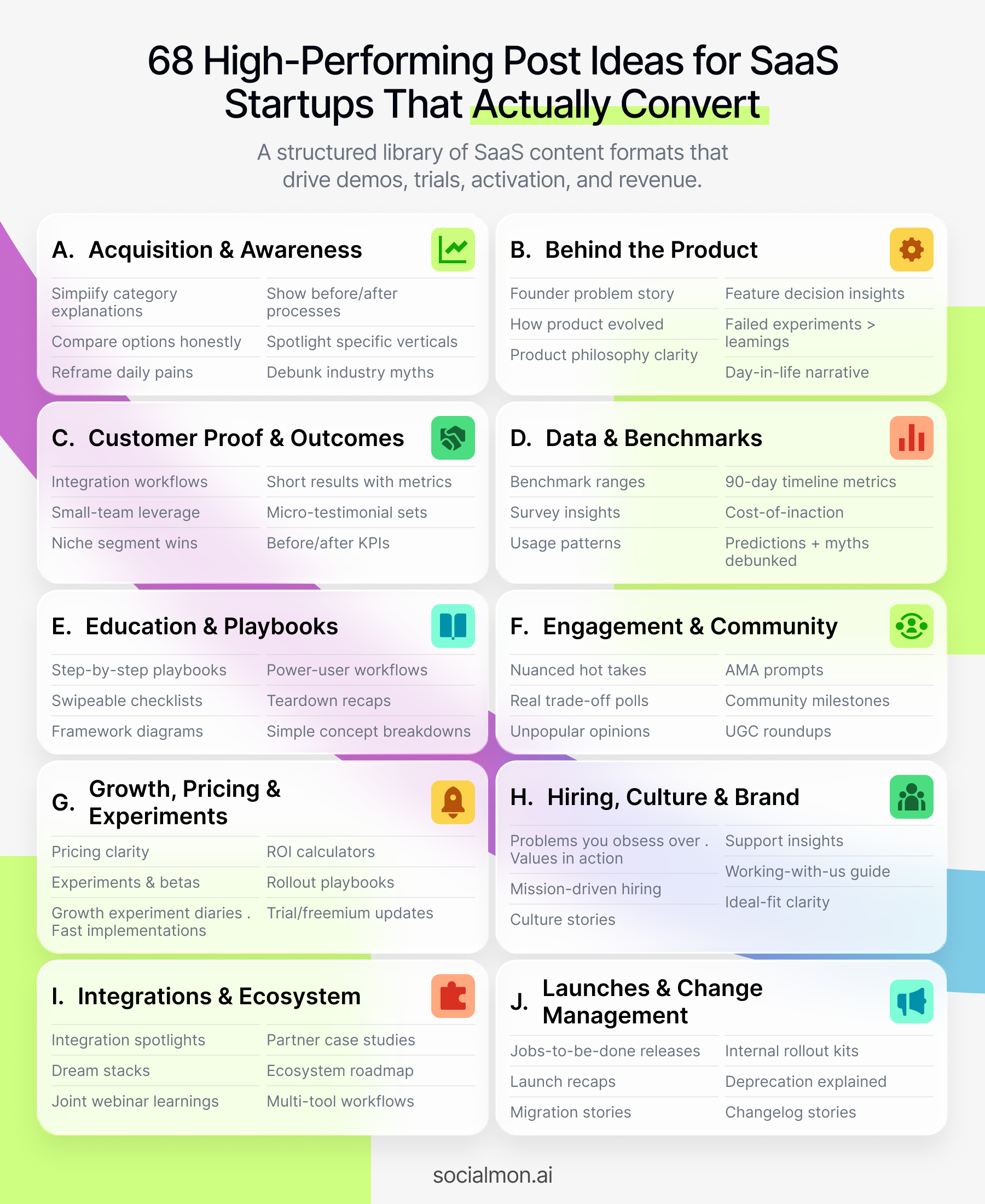
A. Acquisition & Awareness
- Problem-aware education carousel that reframes an everyday pain your SaaS solves
- Category explainer post that defines your space in simple, non-jargony language
- Teardown of a popular tool or workflow and where your product fits in the stack
- Before/after process diagram showing life with and without your SaaS
- Comparison grid post against "do nothing" and common manual alternatives
- Use-case spotlight for a specific vertical with clear outcomes
- Myth-busting post that tackles common misconceptions about your product category
B. Behind the Product
- Founder's story about why you built the product, tied to a real customer problem
- Product origin story showing early ugly prototypes versus today's UI
- Day-in-the-life post of a typical user powered by your product
- Transparent feature launch diary explaining trade-offs and decisions
- Post showing three failed experiments that led to a successful feature
- Deep dive on your product philosophy and what you refuse to build
- Roadmap sneak peek framed around customer problems, not features
C. Customer Proof & Outcomes
- Short customer win story with a single, strong metric and quote
- Carousel of micro-testimonials pulled from emails, Slack, or reviews
- Before/after KPI dashboard screenshot, redacted but still compelling
- Customer spotlight on how they integrated you into their existing stack
- Use-case case study for a tiny, scrappy team showing leverage, not vanity metrics
- Industry-specific case study for a niche segment most tools ignore
- Customer quote post that pairs a short story with a strong visual from their brand
D. Data, Benchmarks & Insights
- Industry benchmark post showing how "good" looks for your ICP's key metrics
- Original mini-survey results turned into a simple chart or carousel
- Breakdown of anonymized aggregate usage data into practical tips
- Timeline post of how metrics change in the first 90 days of using your product
- Cost-of-inaction breakdown comparing sticking with status quo vs switching
- Prediction post on where your category is going in the next few years
- Mini research thread debunking a popular but incorrect best practice
E. Education, Playbooks & How-Tos
- Step-by-step playbook using your product to achieve a specific outcome
- Swipeable checklist post for a recurring job your ICP does every week
- Template or framework visual that your audience can screenshot and reuse
- Post breaking down a workflow from a power user that others can copy
- Live teardown of a subscriber's setup with suggested improvements
- Thread turning a dense, technical concept into simple analogies for non-experts
- Weekly "office hours" Q&A recap with the three most useful answers
F. Engagement & Community
- Hot-take opinion post on a debated topic in your industry (handled with nuance)
- Poll about a real trade-off your users face, followed by a results recap post
- Unpopular opinion post that challenges a shallow industry narrative
- Founder AMA invitation with prompt suggestions to reduce friction
- Community milestone celebration highlighting specific community members
- User-generated content roundup featuring creative ways customers use your product
- Open question post asking for audience setups, tools, or workflows
G. Growth, Pricing & Experiments
- Transparent pricing explanation post with scenarios for different company sizes
- Announcement of a limited-time experiment or beta with a clear hypothesis
- Growth experiment diary sharing what you tested, what failed, and what stuck
- Post walking through how one customer successfully rolled out your tool internally
- Reverse trial or freemium change announcement with honest rationale
- Breakdown of the fastest implementation your team has ever seen and how they did it
- Post explaining how to calculate ROI for your product in under five minutes
H. Hiring, Culture & Brand
- Post about the kind of problems your team obsessively cares about (beyond perks)
- Hiring announcement that sells the mission and impact, not just the role
- Culture story aligned with how your team ships product or treats customers
- Values-in-action story showing a hard call you made that cost you in the short term
- Behind-the-scenes look at how your support or success team solves tough cases
- Post outlining your "working with us" manual for new customers or partners
- Brand manifesto-style post clarifying who your product is and isn't for
I. Integrations, Ecosystem & Partnerships
- Integration spotlight showing how you snap into a popular tool in your ICP's stack
- Post mapping out a "dream stack" where your product is one puzzle piece
- Joint webinar or co-marketing recap post with key takeaways in carousel form
- Partner case study where results clearly required both tools working together
- Post outlining your ecosystem roadmap and how customers can influence it
- Quick tip series featuring small but powerful workflows across multiple tools
J. Launches, Releases & Change Management
- Feature release post focused on the customer job it unlocks, not the UI
- Launch recap post sharing early adoption numbers and real user reactions
- Migration story showing how a customer switched from an incumbent with minimal pain
- Step-by-step internal rollout guide post your champion can forward to stakeholders
- Announcement of deprecations framed around focus and better outcomes for users
- Post sharing your changelog highlights with links to deeper docs or videos
Category A: Acquisition & Awareness
Problem-aware education carousel
Use this when your audience vaguely feels the pain but can't name it yet.
- What to post: A multi-slide carousel (or threaded post) that walks through a common, painful scenario your ICP lives with daily and ends by reframing it as a solvable, defined problem.
- How to angle it:
- Slide 1-2: "This is probably you" (describe their current workflow in specific detail).
- Slide 3-4: Show hidden costs (time, errors, stress, politics).
- Final slide: Give the problem a name and show the "new way" your category offers.
- Example: "Why your 'simple' reporting process is secretly a full-time job" for an analytics SaaS.
Category explainer post
Assume most of your market does not understand your category label.
- What to post: A simple, shareable explanation of your product category in plain language, like you're talking to a smart non-technical friend.
- How to angle it:
- Start with a familiar analogy ("It's like having a... for your...").
- Then explain when someone should care ("If you're doing X more than once a week...").
- Finish with a 2-3 step example of it in action.
- Example: "What is 'feature flagging' and when do you actually need it?" for a devtool.
Teardown of a popular tool or workflow
Borrow attention from tools and workflows that already own mindshare.
- What to post: A teardown of how a well-known product, funnel, or internal workflow works - and where your tool complements or improves it.
- How to angle it:
- Deconstruct something your ICP already uses (HubSpot workflow, Figma handoff, Notion wiki).
- Show what's smart about it first, then gently highlight gaps.
- Demonstrate how your product plugs those gaps without replacing the whole stack.
- Example: "How high-performing RevOps teams actually use Salesforce dashboards (+ where it breaks)."
Before/after process diagram
B2B buyers love clear pictures of "life after."
- What to post: A visual diagram (even a simple sketched flow) showing the old way vs new way of doing a specific job with your product.
- How to angle it:
- Left side: messy spaghetti flow with too many tools and manual steps.
- Right side: clean, linear or hub-and-spoke flow with fewer steps and tools.
- Call out reductions in steps, handoffs, or approvals.
- Example: "How we cut our security review process from 18 steps to 6."
Comparison grid post against "do nothing"
Your real competitor is inertia.
- What to post: A grid or table comparing three options: "Do nothing", "Manual workaround", and "Use [category of tool]".
- How to angle it:
- Compare by time, cost, risk, and stakeholder happiness.
- Keep it honest - acknowledge where "manual" is actually better (e.g., flexibility).
- End with a simple rule of thumb ("If you're past X size, manual stops working").
- Example: "Spreadsheet vs scripts vs monitoring platform: which one actually scales?"
Use-case spotlight for a specific vertical
The more specific, the more shareable among that vertical.
- What to post: A story or carousel dedicated to a single vertical (e.g., DTC brands, Series A fintechs, seed-stage devtools), showing how they use your product.
- How to angle it:
- Lead with a vertical-specific problem ("BFCM promos breaking your email infra").
- Show their stack and how you fit in.
- Detail one meaningful business metric that changed.
- Example: "How a 12-person health-tech startup onboarded 50 clinicians in 2 weeks."
Myth-busting post about your category
Correcting bad mental models creates trust and attracts serious buyers.
- What to post: A short list of statements starting with "You don't need..." or "It's a myth that...", each followed by a clearer, more nuanced truth.
- How to angle it:
- Focus on myths that cause under-adoption or mis-use of your product.
- Add receipts: screenshots, quotes, or quick stats.
- End with one practical next step to act on the new belief.
- Example: "No, you don't need 20 dashboards - you need one per decision."
Category B: Behind the Product
Founder's story tied to a real customer problem
The most convincing origin stories are rooted in real, painful context.
- What to post: A narrative about the moment you realized this product had to exist, framed through a customer or personal experience.
- How to angle it:
- Describe a vivid scene (who, where, what was at stake).
- Show the emotional cost, not just the operational hassle.
- Connect that moment directly to one feature or product principle today.
- Example: "The Friday night incident that made us build automated incident post-mortems."
Product origin: ugly prototypes vs today's UI
People love seeing how things evolved.
- What to post: A side-by-side of early Figma mockups, sketches, or command-line tools versus your current UX.
- How to angle it:
- Highlight what stayed the same (core idea) and what changed (implementation).
- Share one key lesson from early customer feedback that caused a pivot.
- Invite comments on what users still want changed today.
- Example: "This was our onboarding in 2021. Here's why we tore it apart."
Day-in-the-life of a typical user
Make your buyer see themselves in the story.
- What to post: A timeline-style post from wake-up to shutdown, showing how a specific persona uses your product throughout the day.
- How to angle it:
- Focus on "moments of truth" where your tool either de-risks or accelerates something.
- Keep times and activities realistic (e.g., interruptions, context switching).
- Link to a template or workflow mentioned in the story.
- Example: "A day in the life of a Head of CS managing 200 accounts with a 6-person team."
Transparent feature launch diary
Turn shipping into content.
- What to post: A behind-the-scenes story of a recent feature launch, from problem definition to rollout.
- How to angle it:
- Share 2-3 trade-offs or rejected ideas.
- Explain the constraints (time, complexity, existing contracts).
- Show early metrics or feedback and what you're adjusting next.
- Example: "We shipped audit logs in 4 weeks. Here's what we had to say no to."
Three failed experiments that led to one successful feature
Failure content is more believable than highlight reels.
- What to post: A post outlining several attempts to solve a customer problem that didn't work, and the eventually successful approach.
- How to angle it:
- For each failed attempt, note the hypothesis and why it was wrong.
- Emphasize what you learned about the customer, not just the product.
- Show how those learnings influence future roadmap decisions.
- Example: "We tried 3 different onboarding flows. Only one made activation climb."
Deep dive on your product philosophy
Explain how you think, not just what you've built.
- What to post: A manifesto-style post about core principles guiding product decisions (performance over features, defaults over options, etc.).
- How to angle it:
- Tie each principle to a real product decision (e.g., limiting integrations, opinionated defaults).
- Acknowledge who your product is not for.
- Invite feedback from power users who align with the philosophy.
- Example: "Why we will never add unlimited custom fields."
Roadmap sneak peek framed around problems
Make your roadmap feel like a shared project with your users.
- What to post: A high-level preview of upcoming quarters, grouped by customer problems, not feature names.
- How to angle it:
- Group by outcomes ("faster onboarding", "stronger governance", "less manual data work").
- For each, share rough direction, not promises.
- Add a link or CTA for customers to join early feedback groups.
- Example: "Three problems we're focusing on next quarter (and how you can help us shape them)."
Category C: Customer Proof & Outcomes
Short customer win story with one strong metric
Tiny, specific wins feel more believable than giant case studies.
- What to post: A screenshot or short paragraph featuring a single customer result and context (role, team size, segment), anchored by one clear metric.
- How to angle it:
- Specify the starting point and the timeframe of improvement.
- Note what the customer did, not just what your tool did.
- Keep it punchy enough to work as a quote graphic, tweet, or LinkedIn post.
- Example: "In 14 days, a 5-person support team dropped first-response times from 12 hours to 47 minutes."
Carousel of micro-testimonials
Many small proofs beat one massive PDF.
- What to post: A carousel of 4-8 short quotes from different customers, ideally different segments or roles, each focused on one benefit.
- How to angle it:
- Label each slide with the persona ("RevOps lead", "Solo founder", "Data engineer").
- Highlight the outcome in a bold subheadline.
- Keep quotes natural - don't over-polish.
- Example: "What our earliest customers are saying after six weeks."
Before/after KPI dashboard screenshot
Nothing hits like a chart.
- What to post: Redacted or anonymized before/after charts from your own analytics or customers', with clear callouts.
- How to angle it:
- Use arrows and annotations to show exactly what changed.
- Pair metrics with narrative context ("same headcount, same budget").
- Add a short playbook on what they changed to get there.
- Example: "Pipeline coverage before and after implementing lifecycle scoring."
Customer spotlight on stack integration
Prove you play nicely in the real world.
- What to post: A breakdown of a customer's full stack diagram, with your product highlighted and arrows showing data flow.
- How to angle it:
- Name the other tools (within reason) to attract adjacent audiences.
- Explain why this customer picked those integrations.
- Call out one workflow others can copy today.
- Example: "How a Series B startup stitched together HubSpot, Snowflake, and our analytics layer."
Scrappy-team leverage story
Show what's possible without a massive budget.
- What to post: A story featuring a small, under-resourced team that achieved outsized results with your product.
- How to angle it:
- Emphasize constraints: small team, no dedicated ops, messy data.
- Highlight exactly how your tool multiplied their efforts.
- Include a quote about what they stopped doing, not just what they started.
- Example: "How two marketers run lifecycle campaigns for 120K users without burning out."
Niche segment case study
Own a corner of the market others overlook.
- What to post: A focused narrative about a narrow segment (e.g., healthcare compliance teams, B2B marketplaces, climate tech startups) and how they work with you.
- How to angle it:
- Use their vocabulary and constraints (regulation, seasonality, on-call schedules).
- Show one adaptation you made for this segment (templates, workflows).
- Add a CTA specifically for companies in that niche.
- Example: "Why clinical ops teams at smaller hospitals are quietly adopting our tool."
Customer quote as story anchor
Build a narrative around a single powerful sentence.
- What to post: A bold pull-quote image paired with a short, two-paragraph story below it.
- How to angle it:
- Let the quote be emotionally charged ("I finally stopped dreading QBRs").
- Use the story to fill in who, what, when, and how.
- Link to a fuller case study or demo for deeper context.
- Example: "'We cut our weekly status meeting from 90 minutes to 15.' Here's how."
Category D: Data, Benchmarks & Insights
Industry benchmark post
Most teams have no idea if their numbers are "normal" - that uncertainty makes benchmarks extremely clickable.
- What to post: A simple chart or table showing realistic ranges for 3-5 key metrics your ICP cares about (activation rate, churn, response time, deployment frequency, etc.).
- How to angle it:
- Group by stage or size (e.g., "Seed vs Series B", "<20 employees vs >100").
- Make it clear where the data comes from (customer base, survey, public sources).
- Add 1-2 "so what?" insights and one concrete action per metric.
- Example: "What 'good' looks like for activation rates at B2B SaaS companies under 50 employees."
Mini survey results → chart
You don't need a massive dataset; even 50-100 responses can power strong content if the question is sharp.
- What to post: A post summarizing results from a 1-3 question survey you ran with customers, followers, or community members.
- How to angle it:
- Ask questions tied to real trade-offs ("What do you cut first when budgets get tight?").
- Visualize each answer with a single bar chart or pie chart.
- Connect the findings back to a decision your audience is wrestling with.
- Example: "62% of RevOps leaders say this is their most fragile process. Here's how to fix it."
Aggregate usage data → practical tips
You see patterns individual teams never will - share them.
- What to post: Lessons derived from how your best-performing customers use your product (e.g., common settings, frequencies, workflows).
- How to angle it:
- Contrast "top quartile" vs "bottom quartile" behaviors.
- Avoid sensitive or creepy detail; focus on configuration patterns.
- Turn the insights into a short checklist or configuration guide.
- Example: "We analyzed 300 workspaces. Here's how the best ones set up alerts."
Timeline of metrics over first 90 days
Prospects worry about ramp time. Show the journey.
- What to post: A simple timeline or graph of what typically happens in week 1, 2, 4, 8, and 12 for new customers.
- How to angle it:
- Highlight "early dips" (e.g., initial time investment) and when they pay off.
- Connect milestones to specific actions (inviting collaborators, connecting data sources).
- Offer a 90-day "fast track" checklist as a bonus.
- Example: "What happens in the first 90 days after implementing our platform."
Cost-of-inaction breakdown
Silently staying the same is often the most expensive option.
- What to post: A breakdown of direct and indirect costs of sticking to the status quo or manual workaround.
- How to angle it:
- Break cost into time, errors, missed opportunities, and morale burn.
- Use simple, believable math ("2 hours per week × 40 people × your hourly cost").
- End with a quick calculator or rule of thumb for your ICP.
- Example: "Why your weekly reporting ritual costs more than your Salesforce bill."
Category predictions
People share predictions when they can see themselves inside them.
- What to post: A clear, opinionated set of predictions about where your space is heading in 1-3 years.
- How to angle it:
- Tie each prediction to a real signal (customer behavior, macro trends, vendor moves).
- Explicitly call out what teams should start and stop doing now.
- Don't shy away from saying which tools or patterns will become obsolete.
- Example: "Five things about incident management that will look ridiculous by 2027."
Myth-debunking research thread
Use data to correct bad advice circulating in your niche.
- What to post: A thread or carousel where each slide is "Common claim" vs "What actually happens" backed by data or strong logic.
- How to angle it:
- Focus on advice that actively harms performance (not trivial myths).
- Attach screenshots or mini case studies where possible.
- Offer a "do this instead" alternative for each debunked myth.
- Example: "No, sending more alerts doesn't make your system safer. Here's what our data shows."
Category E: Education, Playbooks & How-Tos
Step-by-step outcome playbook
People don't want "tips"; they want clear, shippable instructions.
- What to post: A detailed, channel-agnostic playbook showing how to achieve one measurable outcome using your product as a core component.
- How to angle it:
- Start with the target metric and realistic timeframe.
- Break into steps with screenshots, settings, and copy examples.
- Include a stripped-down version for very small teams.
- Example: "How to reduce onboarding drop-off by 20% in 30 days using a single lifecycle play."
Swipeable checklist for recurring jobs
Checklists are low-friction; people screenshot and share them.
- What to post: A one-page checklist for a recurring task your ICP runs weekly or monthly (e.g., release prep, reporting, retros, audits).
- How to angle it:
- Make it specific to a role ("SaaS PM's pre-release checklist").
- Include 2-3 items that subtly imply your product's presence.
- Offer a downloadable or copyable version (Notion, Google Doc).
- Example: "Monthly expansion review checklist for B2B SaaS teams."
Framework / template visual
Give people a new mental model for a familiar problem.
- What to post: A simple diagram or 2×2 framework that organizes the chaos of a specific decision (prioritization, roadmap, segmentation, etc.).
- How to angle it:
- Keep the axes labelled with plain language.
- Add one real example in each quadrant.
- Show how your tool helps teams move items into the "top right."
- Example: "A simple matrix for deciding which customer requests to build next."
Power user workflow breakdown
Feature walkthroughs are boring; workflows are not.
- What to post: A breakdown of a real user's workflow that others can copy, with their permission and name if possible.
- How to angle it:
- Show the context (team size, stack, primary goals).
- Walk step-by-step through what they do in the tool and why.
- Call out "small but mighty" configuration details most users miss.
- Example: "How a single RevOps lead runs all QBR prep in one workspace."
Live teardown recap
Turn a private consult into a public masterclass.
- What to post: A recap of a teardown you did for a subscriber's funnel, system, or setup (with consent and redaction).
- How to angle it:
- Outline the "before" briefly, then focus on recommended changes.
- Show 2-3 screenshots with annotations.
- End with a list of questions readers can ask about their own setup.
- Example: "We fixed this startup's onboarding emails in 45 minutes. Here's what we changed."
Simplified explanation of complex concepts
Great B2B content helps non-experts stay in the conversation.
- What to post: An explanation of a hairy concept (data modeling, SLOs, cohort analysis) in business language a smart non-specialist can follow.
- How to angle it:
- Start with a relatable analogy (kitchen, sports, logistics).
- Give only the 20% of detail that delivers 80% of understanding.
- Provide one "if you only remember one thing, remember this" takeaway.
- Example: "SLOs explained like you're the CFO, not an SRE."
Office hours Q&A recap
Even if only 10 people show up live, the recap can reach thousands.
- What to post: A summary of the 3-5 best questions and answers from a recent office hours, webinar, or customer call.
- How to angle it:
- Use the questions as subheadings.
- Share condensed, tactical answers, not vague replies.
- Link to the full recording or docs where appropriate.
- Example: "The most useful questions from our last onboarding clinic."
Category F: Engagement & Community
Opinionated hot-take post (with nuance)
This is how you build a distinct point-of-view instead of blending in.
- What to post: A clearly stated opinion on something your ICP cares about (e.g., "NPS is overrated", "Most roadmaps are lying to you").
- How to angle it:
- Start with the spicy claim; then back it with your experience and data.
- Show where the opposite opinion does make sense, to avoid straw-manning.
- End with a practical alternative, not just a rant.
- Example: "Why 'move fast and break things' is a terrible principle for data teams."
Poll on a real trade-off
Polls work best when there is genuine tension between options.
- What to post: A short poll about a decision your audience actively wrestles with (e.g., "More features vs better docs" given limited resources).
- How to angle it:
- Keep options mutually exclusive and realistic.
- Follow up with a separate post analyzing results and your commentary.
- Tag or quote some replies that bring strong perspectives.
- Example: "What do you cut first when you lose 20% of your budget?"
Unpopular opinion as conversation starter
You'll attract the people who see the same gaps you do.
- What to post: An "unpopular opinion" statement that reveals your product philosophy and challenges lazy thinking in your category.
- How to angle it:
- Share a brief story or observation that led you to this belief.
- Invite people to disagree and share their own experiences.
- Be ready to engage constructively in the comments.
- Example: "Unpopular opinion: most dashboards should be deleted, not redesigned."
Founder AMA invitation
You're the best marketing asset in the early days.
- What to post: An invitation for your audience to ask anything about your product, roadmap, or journey, framed around topics they care about.
- How to angle it:
- Suggest 4-5 seed questions to reduce friction ("Ask me about pricing, roadmap, fundraising, scaling support...").
- Commit to answering all questions within a specific timeframe.
- Turn the best Q&As into standalone posts later.
- Example: "Ask me why we killed three features that users liked."
Community milestone celebration
Turn your growth into shared wins, not just self-congratulation.
- What to post: A celebration of a milestone (MRR, customers, community size), with the spotlight on customers, not your logo.
- How to angle it:
- Thank specific user groups, early adopters, or champions.
- Share 1-2 customer stories that symbolize the journey so far.
- Reveal one thing you're committing to improve next, as a promise to the community.
- Example: "We just crossed 500 workspaces. Here's who made it happen."
UGC / customer creativity roundup
Show off how inventive your customers are.
- What to post: A compilation of screenshots, videos, or photos showing unexpected or creative uses of your product.
- How to angle it:
- Ask for permission and tag customers where appropriate.
- Explain why each example is smart, not just "cool".
- Encourage others to share their setups for the next roundup.
- Example: "Some of the wildest ways teams are using our automation triggers."
Open question to your ICP
Done well, these become mini focus groups and community builders.
- What to post: A direct question about a process, challenge, or aspiration that invites honest answers from your target audience.
- How to angle it:
- Be specific ("How do you decide when to kill a feature?") rather than vague ("Thoughts on product strategy?").
- Share your own answer in the comments after others chime in.
- Reuse the best responses (anonymized if needed) in future content.
- Example: "What's the hardest process to change in your company right now?"
Category G: Growth, Pricing & Experiments
Transparent pricing breakdown
Pricing pages are static; pricing content can be dynamic and educational.
- What to post: A clear explanation of your pricing structure, who each tier is for, and common edge cases.
- How to angle it:
- Use real company archetypes ("3-person dev agency", "50-person PLG SaaS").
- Explain why you chose this model and what alternatives you rejected.
- Invite feedback on confusing scenarios and update the post over time.
- Example: "How to pick the right plan if you're a 10-30 person SaaS team."
Announcing an experiment or beta
Turning pricing or packaging changes into experiments builds trust.
- What to post: An announcement that you're trialing a change (reverse trial, new plan, new limit) with a clear hypothesis and success criteria.
- How to angle it:
- Explain the problem you're trying to solve for customers, not just yourself.
- Share what happens after the experiment and how you'll judge it.
- Offer early access or special help to participants.
- Example: "We're testing a new way to do usage-based pricing. Here's why."
Growth experiment diary
Show your work on go-to-market.
- What to post: A recap of a growth experiment you tried (new channel, new onboarding flow, new offer) and what you learned.
- How to angle it:
- Describe the hypothesis, setup, duration, and sample size.
- Share both numerical results and qualitative feedback.
- Spell out what you'll double down on, adjust, or kill.
- Example: "We tried a product-led demo motion. Here's what happened in 30 days."
Internal rollout playbook
Your champion cares a lot about "how do I sell this internally?"
- What to post: A practical guide for how a buyer can pitch, justify, and roll out your tool inside their company.
- How to angle it:
- Include email templates, slide outlines, and objection-handling scripts.
- Break guidance out by department (IT, security, finance, leadership).
- Offer to jump on a call for tricky rollouts.
- Example: "How to get your security and finance teams excited about adopting our platform."
Reverse trial / freemium change explainer
Changing your entry model is scary for users. Explain it like a partner.
- What to post: A post explaining any shift in free vs paid boundaries, why you're doing it, and how it benefits serious users.
- How to angle it:
- Lead with the customer benefit (faster value, clearer limits, better support).
- Be explicit about timelines and grandfathering rules.
- Add an FAQ section in-thread or carousel format.
- Example: "Why we're moving to a time-limited full-access trial (and what it means for you)."
Fastest successful implementation story
Speed-to-value is a huge sales lever.
- What to post: A story of the fastest successful implementation you've seen, including context and guardrails.
- How to angle it:
- Share exactly what they prepared in advance.
- Highlight how they avoided typical blockers (data access, approvals).
- Provide a "copy this if you want to move fast" checklist.
- Example: "How a 25-person startup fully rolled out our product in 48 hours."
Simple ROI calculator post
Make it easy for buyers to justify you.
- What to post: A simple formula or mini calculator to estimate ROI based on a few inputs (number of users, hours saved, error reduction).
- How to angle it:
- Use conservative assumptions and show your math.
- Offer a Google Sheet or embedded calculator version.
- Encourage prospects to DM or email you with their numbers.
- Example: "A 3-step way to see if our platform pays for itself in under 60 days."
Category H: Hiring, Culture & Brand
"Problems we obsess over" post
Signal your mission to both customers and candidates.
- What to post: A post that lists 3-5 specific, gnarly problems your team wants to solve in the world (not generic "make customers happy" statements).
- How to angle it:
- Describe each problem concretely, with examples.
- Show how they connect to your product and roadmap.
- Invite people who care about these problems to reach out.
- Example: "Three problems in data reliability we can't stop thinking about."
Hiring announcement with mission & impact
You're not just filling roles; you're recruiting co-builders.
- What to post: A role announcement that spends more words on why this role matters than on requirements.
- How to angle it:
- Explain what success looks like after 6-12 months.
- Share how this role will directly shape the product or customer experience.
- Offer a behind-the-scenes doc or video about working with your team.
- Example: "We're hiring our first Product Marketing Manager - here's what you'd own."
Culture story tied to shipping or support
Culture is how you act when it's inconvenient.
- What to post: A story where your team made a hard call that reflects your values (supporting a customer during an incident, delaying launch to fix a critical flaw).
- How to angle it:
- Describe the decision point and trade-offs.
- Call out the team members involved and what you learned.
- Tie it back to a value you want to be known for.
- Example: "We delayed a big launch by 2 weeks. Here's why we're still glad we did."
Values-in-action with short-term cost
These stories are magnetic for the right buyers and hires.
- What to post: An example where you walked away from money or convenience to stay aligned with your principles.
- How to angle it:
- Be specific about what you said no to.
- Share how you communicated it to the other party.
- Reflect on downstream benefits you didn't anticipate.
- Example: "Why we turned down a big customer that wanted us to build against our principles."
Support / success behind-the-scenes
Great support is a huge differentiator and under-marketed.
- What to post: A look inside how you handle complex issues, onboarding, or success planning.
- How to angle it:
- Show the tools and processes your team uses.
- Include excerpts (with permission) from helpful support threads.
- Share one change you made after a tough customer conversation.
- Example: "How our support team handles incidents at 3 a.m. without burning out."
"Working with us" manual for customers
Set expectations and reduce friction up front.
- What to post: A customer-facing "how to get the most out of us" guide, summarizing your communication norms, processes, and promises.
- How to angle it:
- Include response time expectations and escalation paths.
- Share your philosophy on bugs, feature requests, and roadmap influence.
- Invite feedback and co-creation.
- Example: "Our operating manual for customers: what you can expect from us in year one."
"Who this product is and isn't for" brand manifesto
Clarity repels the wrong buyers and attracts the right ones.
- What to post: A blunt, honest overview of ideal-fit customers and misfits.
- How to angle it:
- Describe behaviors and needs, not just company sizes.
- Highlight cases where your product will frustrate people.
- Encourage non-fit visitors to follow the content but not buy.
- Example: "If you want 500 toggles and endless customization, we're not for you."
Category I: Integrations, Ecosystem & Partnerships
Integration spotlight with popular tools
Integrations aren't features; they're growth channels.
- What to post: A post focused on one popular integration and a specific workflow it unlocks.
- How to angle it:
- Show the "before integration" steps vs "after integration" steps.
- Mention setup time and any prerequisites.
- Add a link to a deeper how-to in your docs.
- Example: "How to auto-sync churn risk signals from our platform into Slack and HubSpot."
Dream stack visualization
Help your ICP imagine the full system, not just your piece.
- What to post: A diagram of an ideal tool stack for your ICP, with your product as one component, not the center of the universe.
- How to angle it:
- Show how data flows across tools.
- Offer variants for different team sizes or maturity levels.
- Invite vendors or users in that ecosystem to comment and refine.
- Example: "A simple, scalable analytics stack for teams under 100 people."
Joint webinar / co-marketing recap
Good co-marketing has a second life as evergreen social content.
- What to post: A recap of a joint session with a partner tool, focusing on actionable takeaways, not just promotion.
- How to angle it:
- Summarize the 3-5 best ideas or tactics shared.
- Clip short video segments for social posts.
- Link to the full recording and shared resources.
- Example: "Top lessons from our session with [Partner] on building a PLG funnel that sales actually likes."
Partner case study
Show that 1+1 > 2 when tools work together.
- What to post: A case study where a customer used you and a partner tool together to unlock outsized value.
- How to angle it:
- Explain why the customer chose that combination.
- Clarify which tool owns which part of the workflow.
- Share the outcome in cross-tool terms (time saved across stack, fewer handoffs).
- Example: "How a B2B marketplace cut fraud and support tickets by pairing our platform with [Partner]."
Ecosystem roadmap overview
Position yourself as a long-term platform, not a point solution.
- What to post: A roadmap-style overview of where you're heading with integrations and ecosystem efforts.
- How to angle it:
- Group upcoming integrations by customer problem, not logo.
- Offer ways for customers and partners to influence priorities.
- Announce any public API or developer program changes.
- Example: "Where we're taking our ecosystem next and how you can build with us."
Cross-tool workflow tips
Teach people to think in workflows, not features.
- What to post: Bite-sized posts showing a multi-tool workflow (e.g., Segment → your tool → Slack → Salesforce) solving a specific problem.
- How to angle it:
- Show the end-to-end sequence in 4-6 steps.
- Include minimal code snippets or config examples where helpful.
- Encourage readers to share variations based on their stack.
- Example: "A simple workflow to route high-intent signups to the right AE in real time."
Category J: Launches, Releases & Change Management
Feature release focused on jobs-to-be-done
Most feature posts fail because they read like changelogs.
- What to post: A release post that leads with the problem this feature solves, then explains how it works.
- How to angle it:
- Start with a scenario ("You're trying to do X and keep running into Y").
- Show how the feature changes that scenario in 2-3 screenshots or gifs.
- Add a simple "try this now" starter use case.
- Example: "You shouldn't have to chase stakeholders for signoff. Our new approvals workflow fixes that."
Launch recap with early results
Don't let a launch be a one-day event.
- What to post: A follow-up post 1-4 weeks after a launch summarizing adoption, feedback, and improvements made since.
- How to angle it:
- Share usage stats or adoption rates where possible.
- Include a couple of short user quotes.
- Highlight refinements you shipped based on first-wave feedback.
- Example: "What we learned from the first 100 teams using our new reporting builder."
Migration story from an incumbent
Prospects are scared of switching costs - show it can be done.
- What to post: A detailed story of a customer moving from a well-known incumbent to you, with emphasis on migration steps and risk management.
- How to angle it:
- Share honest reasons they hesitated and how you mitigated them.
- Outline the migration timeline and who was involved.
- Include what they could do after migrating that they couldn't before.
- Example: "How a 200-person company migrated from [Big Vendor] in 30 days without downtime."
Internal rollout guide for champions
Support your internal advocates like you'd support your own team.
- What to post: A guide that a champion can forward internally to get everyone ready for a new feature, plan, or product area.
- How to angle it:
- Include a short "template announcement" they can send to their org.
- Provide a training plan and recommended first workflows.
- Add FAQ for nervous stakeholders (security, compliance, data ownership).
- Example: "A rollout kit for your CS team to start using our playbooks next quarter."
Deprecation announcement framed as focus
Killing features can build trust if communicated well.
- What to post: An announcement that a feature or old version is being sunset, with rationale framed around making the rest of the product better.
- How to angle it:
- Be transparent about why (maintenance cost, low usage, better alternative).
- Provide a clear migration path and support timeline.
- Offer direct help for edge cases.
- Example: "Why we're sunsetting our legacy reports and what you should use instead."
Changelog highlights as narrative
Changelogs can be repurposed into digestible stories.
- What to post: A monthly or quarterly "what's new" post that curates the most impactful changes into a narrative.
- How to angle it:
- Group updates by customer benefit ("Faster", "Safer", "Easier to collaborate").
- Include short gifs or screenshots where helpful.
- Link to raw changelog for power users.
- Example: "What we shipped last month to make life easier for admins."
Turning these ideas into a repeatable SaaS content engine
You don't need to ship every idea you just read. You need a small, sustainable system.
Here's a simple way to operationalize this library:
- Pick 3-5 categories as your content pillars for the next quarter (e.g., Customer Proof, Education, Data & Benchmarks, Engagement, Launches).
- Turn 5-7 ideas into named series (e.g., "Metrics Monday", "Customer Spotlight", "Stack Stories", "Launch Lessons").
- Map each idea to funnel stages:
- Awareness: Acquisition & Awareness, Engagement & Community
- Consideration: Education & Playbooks, Data & Benchmarks, Integrations
- Decision & Expansion: Customer Proof, Growth & Pricing, Launches & Change Management
Then, for each new campaign or feature:
- Choose one Awareness idea to bring in net-new eyes.
- Choose one Consideration idea that helps prospects understand the value.
- Choose one Decision or Expansion idea that pushes people to try, buy, or adopt more.
When you're ready to go from generic formats to proven, real-world examples in your exact niche, plug your topic or competitor names into Socialmon. You'll see how top SaaS teams are already using versions of these ideas across LinkedIn, X, email, and more - so you can adapt what's working instead of guessing from scratch.



Get 50 viral posts for your niche (free)