Social Media Post Ideas for Hiring & Recruiting Faster

You post a job... and hear crickets.
- Decent role, but hardly any good applicants
- The same generic CVs, clearly not your target profile
- "We're hiring!" posts that get likes, but no actual candidates
If you want better applicants (and more of them), you can't rely on one generic job post.
You need social content that makes the right people think:
"This sounds like me. I'd actually love to work there."
This guide gives you practical, reusable social media post ideas for hiring and recruiting across:
- LinkedIn & X (Twitter)
- Instagram & TikTok
- Facebook Groups & communities
- Even YouTube Shorts and Reels
We'll cover:
- Post formats that reliably attract stronger candidates
- How to talk about roles so the right people lean in
- Ways to show your culture and team without sounding fluffy
- How to use Socialmon to find and reuse high-performing recruiting post patterns in your niche
Treat this as a swipe file:
- Don't try everything at once
- Pick a few ideas that match your open roles
- Implement properly, then iterate based on who actually applies
How These Post Ideas Help You Hire Better & Faster
The goal isn't "more impressions." It's more qualified candidates and faster, better hires.
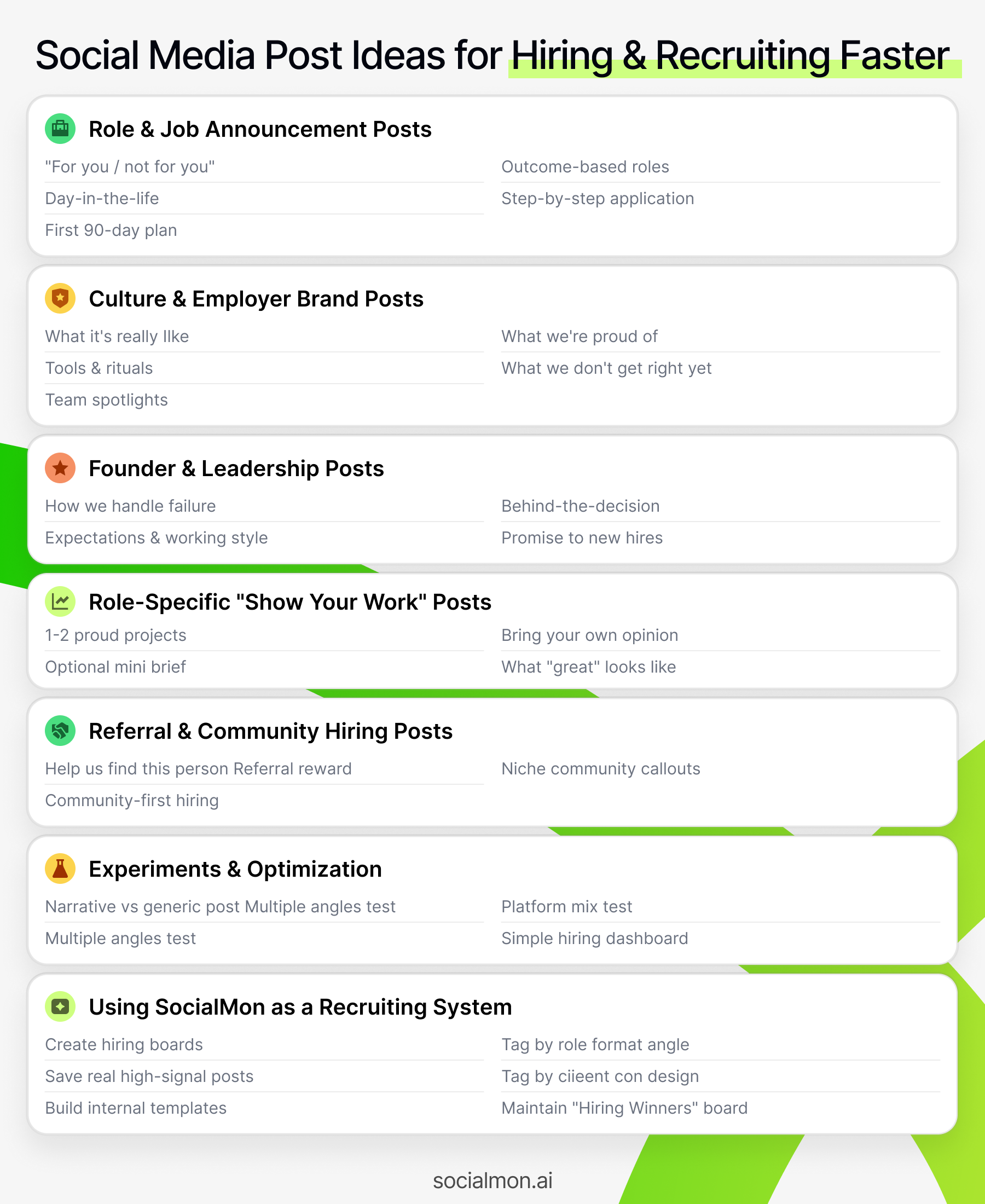
The ideas in this guide are designed to:
- Filter in the right people Posts speak directly to your ideal candidate's skills, interests, and stage of career.
- Filter out the wrong people You're clear about expectations, work style, and non-negotiables, so misaligned folks self-select out.
- Show your real culture and work Not just "we're a family," but what a day actually looks like, how you collaborate, and what success means.
- Reduce the friction to apply Clear CTAs, expectations, and timelines so good candidates don't bounce.
You can adapt these ideas for:
- Fast, direct recruiting - for specific roles you need to fill now
- Always-on employer branding - so your next hire has seen you before the job even goes live
- Niche talent pools - devs, designers, marketers, customer support, operations, etc.
💡 Pro tip with Socialmon Create boards like:
- Hiring - Role Announcements
- Hiring - Culture & Team
- Hiring - Founder & Leadership
As you browse LinkedIn, Instagram, X, or TikTok:
- Save any post where you think: "If I were a candidate, I'd seriously consider applying"
- Tag them by role type (dev, designer, marketer, ops, etc.)
Over time, you'll have a visual library of hiring posts that actually work in your niche.
A. Role & Job Announcement Posts That Attract the Right Candidates
These posts are about more than "We're hiring a [job title]." They're about clarity, specificity, and making someone see themselves in the role.
1. "Who This Role Is For / Not For" Breakdown
Goal: Attract the right candidates and gently repel the wrong ones.
How to do it:
Use a carousel, text post, or short video with two columns:
- "This role is for you if..."
- "This role is not for you if..."
Include things that actually matter in daily work:
- Level of ambiguity
- Type of collaboration
- Pace
- Type of problems they'll solve
Example structure:
Caption (LinkedIn / IG / X): "We're hiring a Product Marketing Manager.
This role is for you if: ✅ You love talking to customers and turning messy notes into clear messaging ✅ You're comfortable owning campaigns end-to-end (strategy → execution → analysis) ✅ You'd rather ship scrappy tests weekly than 'perfect' campaigns quarterly
This role is not for you if: ❌ You prefer very rigid processes and fixed scopes ❌ You want a large team to delegate to from day 1 ❌ You're not interested in learning our product deeply
If you're in the first column, here's the full JD and how to apply → [link]"
Why it works:
- Strong candidates feel seen.
- People who'd be unhappy in the role naturally step back.
- Hiring managers get fewer, more relevant applications.
With Socialmon: Save "for you / not for you" style hiring posts into Hiring - Role Announcements. When you need to create your own, open that board and copy the structure, not the exact copy.
2. "Day in the Life" Role Post
Goal: Help candidates imagine what their days would look like, so they can decide quickly if it fits them.
How to do it:
Format options:
- Carousel: "Morning / Afternoon / Weekly / Monthly" breakdown
- Short video / Reel: quick clips of real tasks (with captions)
- Thread: text-based walkthrough
Include:
- Types of tasks (not just responsibilities)
- People they collaborate with
- Tools they'll use
- How success is measured day-to-day
Carousel example outline:
- Slide 1: "A day in the life of our Customer Success Specialist"
- Slide 2: 9-11am: checking inbox, prioritizing tickets, joining standup
- Slide 3: 11am-2pm: deep dives with customers, recording Looms
- Slide 4: 2-4pm: working with product on recurring issues
- Slide 5: 4-5:30pm: updating docs, preparing for tomorrow
- Slide 6: CTA - "If this looks like your kind of day, check the full role & apply → [link]"
Tips:
- Use real screenshots (blurred where needed) and real tools you use (Notion, Figma, HubSpot, etc.).
- Avoid stock imagery; authenticity wins.
3. "What You'll Own in Your First 90 Days" Post
Goal: Attract people who like ownership and give clarity on expectations.
How to do it:
In the post, outline:
- 30-day goals → "learn and understand"
- 60-day goals → "start owning key tasks"
- 90-day goals → "deliver specific result"
Example (for a Growth Marketer):
Caption: "We're hiring a Growth Marketer.
Here's what you'll own in your first 90 days:
First 30 days:
- Deep dive into our product and existing funnel
- Audit current channels and experiments
- Talk to 5-10 customers about how they found us
Days 31-60:
- Design and launch 2-3 small paid experiments
- Set up basic tracking for key metrics (CPC, CTR, signup rate)
- Collaborate with content to ship 1-2 growth-focused assets
Days 61-90:
- Double down on one winning channel or experiment
- Present a simple growth roadmap for the next 3-6 months
If this sounds like a challenge you'd enjoy, the full JD and application form are here → [link]"
Why it works:
- Ambitious candidates are drawn to clear ownership.
- It reduces misaligned expectations and later frustration.
4. "Most Important Outcomes, Not Just Responsibilities" Post
Goal: Shift the focus from "what you'll do" to "what you'll achieve".
How to do it:
Instead of a bullet list like "manage campaigns, write copy, run reports," Write a post that lists 3-5 key outcomes the role is responsible for.
Example (for a Customer Success lead):
"We're hiring a Customer Success Lead.
In this role, your primary outcomes will be:
1️⃣ Onboarding → Get new customers to their 'first win' within 14 days 2️⃣ Expansion → Surface and drive clear opportunities for expansion and upsell 3️⃣ Retention → Reduce churn in your segment by 20% over 12 months
We'll support you with tools, playbooks, and a team that actually cares about the customer experience.
Full role, expectations, and how to apply → [link]"
Why it works:
- Strong candidates care about impact; they self-select if they like these targets.
- It signals that your company values results, not just busyness.
5. Role-Specific "If You've Done This, We Want to Talk" Post
Goal: Call out very specific experiences or accomplishments instead of generic years of experience.
How to do it:
Pick 2-4 concrete signals that you know correlate with success in the role:
- "Shipped at least one production React app used by real users"
- "Handled 30+ support tickets/day with CSAT > 4.5"
- "Managed $10-50k/month in ad spend with positive ROAS"
- "Closed 3+ deals > $20k ACV"
Example:
"We're hiring a Senior Frontend Engineer.
If you've:
- Shipped at least one production React app used by real customers
- Built or maintained a design system (even a scrappy one)
- Collaborated closely with designers and PMs in small teams
...we'd love to talk.
Details, compensation range, and how to apply → [link]"
Why it works:
- High-signal experiences catch the attention of strong candidates.
- It's much more compelling than "5+ years of experience".
With Socialmon: Search and save hiring posts that use specific proof points ("If you've... we should talk"). Add them to Hiring - Role Announcements. Notice which proof signals get lots of saves and comments - those are the ones to mirror.
6. "How to Apply (Step-by-Step)" Post
Goal: Remove friction and show you're organized and respectful of candidates' time.
How to do it:
Make a post purely about the application process:
- What you want to see (CV, portfolio, GitHub, Loom intro, etc.)
- How long it takes
- What the stages look like
- When they can expect to hear back
Example carousel outline:
- Slide 1: "Want to apply for our [Role]? Here's exactly how."
- Slide 2: Step 1 - Submit form (5 mins). What you'll fill in.
- Slide 3: Step 2 - Short assignment or portfolio review.
- Slide 4: Step 3 - 30-minute call; what we'll talk about.
- Slide 5: Timelines ("you'll hear back within X days at each stage").
- Slide 6: CTA with link.
Why it works:
- Good candidates appreciate clarity and transparency.
- You show you take hiring seriously (and aren't wasting time).
B. Culture & Employer Brand Posts That Make People Want to Work With You
These posts aren't about open roles directly. They're about making your company a place people can imagine working at - before you have a vacancy.
7. "What It's Really Like to Work Here (No Fluff)" Post
Goal: Show the reality of working with you - good and challenging - without corporate clichés.
How to do it:
Create a post that explicitly avoids generic phrases like "fast-paced", "great culture", "we're a family".
Instead, talk about:
- How decisions are made
- How feedback works
- How people communicate
- What's hard about the work
Example:
"What it's actually like working at [Company]:
✅ You'll have a lot of autonomy; we won't micromanage your calendar ✅ We give direct feedback and expect you to do the same ✅ You'll see your work ship quickly, often in days or weeks, not quarters
On the flip side: ⚠️ We're still figuring things out - processes change as we grow ⚠️ You'll need to be comfortable with context switching some days ⚠️ You might be the first person in your role, building things from scratch
If that sounds interesting rather than terrifying, keep an eye on our roles → [careers link]."
Why it works:
- Feels honest, not polished.
- Resonates with people who like this environment and repels those who don't.
8. "How We Work" Tooling & Rituals Post
Goal: Make your workflows tangible: tools, rituals, and collaboration.
How to do it:
Share:
- The tools you use (Slack, Notion, Linear, Figma, HubSpot...)
- Your meeting cadence
- Any key rituals (demo days, retros, coffee chats, all-hands)
Example carousel:
- Slide 1: "How we work as a remote-first team"
- Slide 2: Tools - Slack for async, Notion for docs, Linear for tasks, Figma for design
- Slide 3: Rituals - Monday planning, Friday demo & wins, monthly 1:1s
- Slide 4: Communication norms - "No Slack after 7pm", "Loom over long docs when possible"
- Slide 5: CTA - "If this sounds like your style, check our roles → [link]"
Tips:
- Screenshots and real examples are much more credible than generic statements.
- Make it scannable; candidates should "get it" quickly.
9. "Meet the Team" Spotlight Series
Goal: Put faces and personalities behind the logo so candidates can imagine their future colleagues.
How to do it:
Run a recurring series: "Meet the Team Monday," "Behind the Team," etc.
For each teammate:
- One friendly photo or short video
- 3-5 questions:
- What they do
- What their day looks like
- One thing they like about working there
- Something outside work
Example caption:
"Meet Aisha - our Senior Designer.
What she does: Owns product and marketing design for [Product]. A day in her week:
- Collaborates with PMs and engineers on new features
- Jams on landing page concepts with marketing
- Maintains our design system in Figma
Why she joined: 'I wanted to work somewhere I could see my designs ship quickly and actually talk to users.'
If you'd like to work with Aisha, we're hiring a [Role] in her team → [link]."
Why it works:
- Reduces the intimidation factor.
- Candidates imagine themselves working with real humans, not a faceless brand.
With Socialmon: Save "team spotlight" posts you love into Hiring - Culture & Team. Note which ones feel human and specific (vs generic "this is Sarah, she likes coffee"). Use those as reference.
10. "What We're Proud Of (Without Bragging)" Post
Goal: Showcase wins that matter to candidates: not just revenue, but impact and ways of working.
How to do it:
Share 3-5 things you're genuinely proud of:
- Product or customer wins
- How you handled a tough situation
- Engineering or design achievements
- Culture moves (parental leave policy, mental health support, etc.)
Example:
"A few things we're proud of at [Company]:
🧡 78% of our customers are from referrals 🛠 We shipped 34 improvements suggested directly by users last quarter 💬 Every new hire talks to customers in their first 30 days 🌱 Our first engineer is now leading a team of 5
If this sounds like a place you'd like to grow in, we're hiring for [Roles] → [link]."
Why it works:
- Signals you care about real impact, not only vanity metrics.
- Great for candidates who want to join a mission they can believe in.
11. "What We Don't Get Right Yet" Vulnerability Post
Goal: Build trust by being open about where you're still improving.
How to do it:
Share 2-3 areas you're still working on:
- "Our onboarding is better than before, but we're still polishing it."
- "We don't have a perfect career ladder yet, but we're building it transparently."
- "Our meeting load is sometimes heavy; we're actively simplifying."
Pair each "not perfect" point with what you're doing about it.
Example:
"We're proud of a lot at [Company], but we're not perfect:
❌ Our documentation is still catching up with our shipping speed ✅ We're doing monthly 'doc sprints' to fix this
❌ Our onboarding used to be pretty ad-hoc ✅ New hires now get a 30-day plan and a buddy - and we're still refining it
❌ We're only just starting to formalize career paths ✅ We're working with the team to co-create them, not just drop a top-down framework
If you like building as we go - instead of inheriting a finished machine - you might enjoy working here. Roles are live at → [link]."
Why it works:
- Signals maturity and humility.
- Attracts builders who like to improve systems, not just sit in them.
C. Founder & Leadership Posts That Quietly Recruit
The strongest candidates often follow people before they follow companies.
If your founders, leaders, or hiring managers are active on LinkedIn, X, or Instagram, their posts can do a lot of the heavy lifting for hiring-without every post saying "we're hiring."
12. "Behind the Decision" Product / Strategy Posts
Goal: Attract people who like how you think and want to work with you.
How to do it:
Founders / leaders share:
- A recent decision (product, company, hiring, process)
- The context leading up to it
- The tradeoffs considered
- The final choice and why
Example (LinkedIn post):
"We seriously considered adding a second product this year. After talking to customers and looking at usage, we decided against it.
Why: - Most users haven't fully adopted the current product yet - Our strongest NPS is from teams that go deep, not wide - Splitting focus would slow the improvements we know they want
So 2025 is the year of 'depth, not breadth' for us. We're doubling down on: - Better onboarding - One-click insights - Fewer, smarter features
If you like building focused products that do a few things incredibly well, you'll probably enjoy working here. I share open roles in the comments / on our careers page → [link]."
Why it works:
- Shows how decisions are made at your company.
- Attracts people aligned with your philosophy (e.g., depth > breadth).
With Socialmon: Create a Hiring - Founder & Leadership board. Save posts where founders explain their thinking, not just share wins. Those posts often quietly attract strong candidates who respect that style.
13. "How We Handle Failure" Post
Goal: Attract resilient, honest candidates and filter out blame-shifters.
How to do it:
Leaders share a real failure or miss:
- A launch that flopped
- A project that slipped
- A hire that didn't work out (without naming names)
Outline:
- What happened
- What you did not do (e.g., blame-only)
- What you did do (retro, fixes, learnings)
Example:
"Last quarter, we missed our main goal.
Not by a little. By a lot.
Instead of hunting for who to blame, we: - Did a retro with everyone involved - Identified 3 things we (leadership) could've set up better - Cut 2 vanity projects that distracted us - Agreed one clear owner per initiative going forward
We're not perfect. But we care deeply about learning fast and not repeating the same mistakes.
If you want a place where we take responsibility and fix things in the open, keep an eye on our roles → [link]."
Why it works:
- Signals psychological safety & ownership.
- People who want a blame culture will self-select away.
14. "What I Expect From People I Work With" Post
Goal: Be explicit about expectations and working style.
How to do it:
A founder/hiring manager posts a clear list of what they value in teammates:
- Communication style
- Ownership
- Speed vs perfection
- Feedback norms
Example:
"If you work with me as your manager, here's what you can expect:
From me: - Clear priorities (what matters this week) - Honest feedback, delivered respectfully - Protection from random 'urgent' work when possible - Space to figure things out your way
From you: - Ownership of your outcomes, not just tasks - Proactive communication when stuck - Willingness to say 'I don't know' and ask for help - Desire to improve your craft and process
If this sounds like a manager you'd want to work with, I post open roles regularly or you can check our careers page → [link]."
Why it works:
- Sets expectations upfront.
- Reduces future misalignment and unhappy hires.
15. "My Promise to New Hires" Post
Goal: Make candidates feel safe taking a risk on you.
How to do it:
Have the founder/leader write a promise to anyone who joins:
- What they'll never do (e.g. ghost candidates, change offers last minute)
- What they will do (pay on time, give feedback, be transparent)
Example:
"If you join [Company], here's my promise as a founder:
- You'll always know what we're working towards and why - You'll get real feedback, not silent disappointment - We'll never weaponize 'family' language to ask for unpaid overtime - If things don't work out, we'll treat you like a human, not a transaction
In return, I'll ask for your best effort, your honesty, and your willingness to grow with us.
Roles we're hiring for are here → [link]."
Why it works:
- Reduces risk perception, especially for candidates leaving stable roles.
- People align with values, not just benefits.
D. Role-Specific "Show Your Work" & Portfolio-Driven Posts
These ideas help you attract doers, not just good CV writers-especially for creative, technical, and marketing roles.
16. "Show Us 1-2 Things You're Proud Of" Post
Goal: Encourage candidates to apply with substance over buzzwords.
How to do it:
Create a post specifically about the portfolio part of the application:
- Ask them to share 1-2 projects they're proud of
- Give guidance on what to include (before/after, context, constraints)
Example:
"If you're thinking of applying for our Product Designer role:
Don't stress about having a 'perfect' portfolio.
Instead, pick 1-2 projects you're genuinely proud of and tell us: - What you were trying to solve - What constraints you had (time, dev resources, stakeholders) - What you'd do differently now
Link those in your application here → [link].
We care much more about how you think than how polished your Dribbble looks."
Why it works:
- Attracts thoughtful practitioners.
- Gives candidates who aren't "personal brand" heavy a fair shot.
17. "Mini Brief" Application Post (For Designers/Marketers/Devs)
Goal: Get high-signal applications without massive unpaid test projects.
How to do it:
Post a tiny "brief" as part of the role announcement:
- 1 small task they can optionally do to stand out
- Kept to 20-30 minutes max
- Clear that it's optional but valued
Example (for a paid social marketer):
"Want to stand out for the Performance Marketer role?
Optional quick brief: - You get $1,000 to test one channel for us - We sell [what you sell] to [who you sell to] - In 3-5 bullet points, tell us: • what you'd test • what you'd watch • what you'd stop if it fails
Paste your answer in the 'Anything else?' field on the application page → [link].
Don't overthink it. We're looking for structured thinking, not a thesis."
Why it works:
- Shows how candidates think about real problems.
- Efficient signal without exploitative spec work.
18. "What Great Looks Like in This Role" Post
Goal: Show your standard so the right candidates can self-assess.
How to do it:
Write a post describing:
- What someone in this role looks like at 6-12 months
- How they operate, what they've achieved
- Signs they're thriving
Example:
"What 'great' looks like in our SDR role after 9-12 months:
- You consistently hit or beat your qualified meeting targets - You know our ICP so well that you can politely say no to bad-fit leads - You've tested 5-10 outbound angles and know which ones land - You're sharing learnings with marketing and product so we improve together
If this sounds like a version of you that you'd like to grow into, the role might be a good fit → [link]."
Why it works:
- Ambitious candidates lean in.
- People who want "clock-in, clock-out" may self-select away (which might be good for you).
19. "Bring Your Own Opinion" Post
Goal: Attract people who are thinkers, not just executors.
How to do it:
For certain roles (design, product, marketing, engineering), ask candidates:
- To include one opinion about your current product/site/brand in their application
- E.g. "Tell us one thing you'd improve and why"
Example:
"If you apply for our Senior Backend Engineer role, we'd love you to include one opinion in your application:
- Something we could improve in our architecture - A technical decision you'd make differently (and why) - Or a suggestion about our deployment / testing setup
It doesn't have to be mind-blowing. We just want to see how you think and communicate about technical decisions.
Add it in the last box of the form here → [link]."
Why it works:
- You hire people with a backbone who can disagree respectfully.
- Candidates who did their homework stand out instantly.
With Socialmon: Save hiring posts that ask candidates to share an opinion or critique. Tag them show_your_thinking. These are great inspiration for higher-level roles where judgment matters as much as skill.
E. Referral & Community-Based Hiring Posts
Some of your best hires will come through referrals and niche communities, not just job boards and your own followers.
20. "Help Us Find This Person" Referral Post
Goal: Activate your extended network to look for your ideal candidate.
How to do it:
Write a post that talks to your network, not just potential candidates:
- Describe the person in plain language
- Share why this role matters
- Ask people to tag or DM candidates
Example:
"We're looking for our next Content Lead at [Company].
This is for someone who: - Loves writing about [your domain] - Has shipped content that clearly drove signups or revenue - Enjoys owning strategy and execution in a small team
If someone comes to mind as you read this, would you mind tagging them or sending them this post?
Full role and context are here → [link]."
Why it works:
- People who care about you and your company want to help.
- Converts passive readers into active referrers.
21. "Reward for Successful Referral" Post
Goal: Make referrals feel valued without sounding desperate.
How to do it:
Offer something simple and clear:
- Referral fee (if legally appropriate)
- Donation to charity
- Year of your product for free
- Or even a thoughtful non-cash gift
Example:
"We're hiring a Senior Full-Stack Engineer.
If you refer someone we end up hiring (and who stays past probation), we'll: - Pay you a $1,000 referral bonus - Or donate it in your name to a charity you care about
We'd much rather send this to someone in our extended network than pay a random job board.
Role details and how to refer → [link]."
Why it works:
- Gives people a nudge to actually forward or tag.
- Still feels aligned if framed as "we'd rather give it to you than a platform."
22. "We're Hiring From Our Community First" Post
Goal: Incentivize people in your existing audience / customer base to apply.
How to do it:
Announce that:
- You'll share role details with your email list or community first
- Or that you'll prioritize applications from people who already use your product / follow your work
Example:
"We're opening a Growth Marketer role next week.
We're going to share it with our newsletter and existing customers before we post it publicly.
Why? Because the best people to help us grow are often already in our orbit.
If you want early access to the role (or know someone who might), make sure you're on the list → [link]."
Why it works:
- Helps you hire people who already understand your product/audience.
- Builds loyalty with your existing community.
23. "Niche Community Callout" Post
Goal: Meet candidates where they already hang out.
How to do it:
Tailor a post specifically for:
- A Slack/Discord community
- A subreddit
- A Facebook group
- A local meetup group
Tone: more conversational, aligned with that community's norms.
Example (for a design community):
"Hey [Community],
We're looking for a Product Designer who: - Likes talking to users as much as pushing pixels - Is comfortable with shipping 'good enough' v1s and iterating - Has experience with SaaS or complex interfaces
Remote-friendly, small team, plenty of ownership.
If that sounds like you (or a friend here), I'd love to chat. JD + context → [link]."
Why it works:
- You're not treating them like a job board; you're speaking as a fellow member.
- Often surfaces talent that doesn't trawl LinkedIn Jobs all day.
With Socialmon: When you see great referral or community hiring posts, clip them into a Hiring - Referrals & Community board. Over time you'll see what copy/angles actually gets people to tag and share.
Experiments & Optimization: Turning Hiring Posts Into a System
Once you're posting hiring content regularly, treat it like any other growth channel: test, learn, and iterate.
24. Test "Generic Job Post vs Narrative Job Post"
Goal: Prove (to yourself and stakeholders) that better storytelling improves candidate quality and volume.
How to run it:
For one role:
- Version A: Standard "We're hiring a [title]" post (responsibilities, requirements, link)
- Version B: Narrative version - e.g., "What you'll own in 90 days," "Day in the life," "For you / not for you"
Post:
- On the same platform
- A few days apart
- Similar time of day
Track:
- Clicks to the job page
- Applications started
- Applications completed
- Number of shortlisted candidates from each post
What you'll likely find:
- Narrative posts don't just get more applicants; they get more qualified ones.
25. "One Role, Multiple Angles" Test
Goal: Find the angles that resonate most with your ideal candidates.
How to do it:
For a single role, create 3-4 posts over 2-3 weeks:
- Angle 1: Ownership / impact
- Angle 2: Culture / way of working
- Angle 3: Learning / growth
- Angle 4: Compensation / benefits, if a key selling point
Use the same application link, but:
- Use different UTM parameters for each angle
- Log which post leads to more completed applications and better candidates
Outcome:
You'll discover whether your audience cares more about:
- Ownership vs stability
- Learning vs compensation
- Remote/flex vs office perks
Then you can double down on that angle in future hiring posts.
26. Platform Mix & Cross-Pollination Test
Goal: Learn which platforms actually bring you candidates-not just engagement.
How to do it:
When promoting a role:
- Post on LinkedIn, X, Instagram, and maybe TikTok (if suitable)
- Always link to the same job page, but use platform-specific UTM tags
Track:
- Which platform drives the most job page visits
- Which platform drives the most completed applications
- Which platform's applicants most often get shortlisted/offers
You might find:
- LinkedIn = more volume, mixed quality
- Instagram Stories = fewer applications, but stronger culture fit
- X = niche/technical roles that care about your domain opinions
27. Hiring Funnel Dashboard (Simple Version)
Goal: Make hiring more predictable and less "post and pray."
You don't need full-blown ATS analytics. A simple sheet works:
Columns per role:
- Platform
- Post URL
- Post angle (ownership, culture, growth, etc.)
- Date
- Impressions / reach (if available)
- Clicks to JD
- Applications started
- Applications completed
- Screened candidates
- Shortlisted
- Offers
- Hires
Review monthly or per role:
- Which type of post tended to show up in roles that hired faster?
- Which platforms are consistently pulling in strong candidates?
- Are certain angles correlated with better acceptance rates?
With Socialmon: Mirror your dashboard visually:
- Every time a post contributes significantly to a successful hire, save it into a Hiring - Winners board and tag it (fast_hire, high_quality, etc.).
- Now you have both numbers and examples to guide your next hiring push.
Using Socialmon as Your "Recruiting Pattern Lab"
You don't want to reinvent your hiring posts every time a role opens up.
Socialmon can quietly become your employer brand + recruiting system.
Step 1: Create Goal-Specific Hiring Boards
Instead of a generic "hiring" board, create boards like:
- Hiring - Role Announcements
- Hiring - Culture & Team
- Hiring - Founder & Leadership
- Hiring - Referrals & Community
- Hiring - Winners (Our Best Posts)
This makes it easy to go straight to the type of post you need.
Step 2: Capture Real Hiring Posts From Your Feed
Using the Socialmon Chrome extension (or your workflow):
Save posts that clearly do at least one of these:
- Make you think "I'd want to work there."
- Get lots of comments like "applying now," "sending this to a friend."
- Explain roles with unusual clarity ("first 90 days", "what great looks like").
- Honestly show culture (not just perks).
You're building a swipe file of real-world hiring content, not theory.
Step 3: Tag Creatives by Role, Format & Angle
Useful tags for hiring posts:
- Role type: engineer, designer, marketer, sales, ops, support, leadership
- Format: carousel, short_form_video, thread, text_post, story_capture
- Angle: ownership, culture, growth, benefits, referral, day_in_life, for_you_not_for_you
Later, you can filter for things like:
- "Show me engineering hiring carousels about culture."
- "Show me day-in-the-life posts for marketers."
Which is exactly what you want when you're about to post a similar role.
Step 4: Turn Patterns Into Internal Templates
After you've saved 30-50 great hiring posts, sit down and pattern-match:
- How do the best "we're hiring" posts start?
- How do they describe ownership?
- How do they phrase expectations and "not for you if"?
- How do they structure CTAs and links?
From there, build a few internal templates, for example:
- Role Announcement - For You / Not For You
- Role Announcement - 90 Day Plan
- Culture - What It's Really Like Here
- Founder - How We Work Together
- Referral - Help Us Find This Person
Each template = basic skeleton + example slides / bullets. Next time you open a role, you're never starting from a blank page.
Step 5: Add Your Own Best Hiring Posts Back Into Socialmon
Don't just use Socialmon to study others-use it to study yourself.
Whenever you:
- Fill a role faster than usual
- Get a wave of really strong candidates
- Get messages like "I applied because of this post"
Do this:
- Save that post into your Hiring - Winners board.
- Tag it with role, platform, angle, and any metrics you know (e.g. fast_hire, many_referrals).
Over time, Hiring - Winners becomes your personal playbook for hiring:
- What to say
- How to say it
- Which angles + platforms work best for your brand and audience
Turning Social Media Into a Repeatable Hiring Channel
Getting more (and better) applicants from social media isn't about posting "We're hiring!" louder.
It's about:
- Being specific about who the role is for and not for
- Showing the work-day-in-the-life, ownership, outcomes
- Letting leaders be visible, so candidates connect with real humans
- Tapping referrals and communities with clear, respectful asks
- Treating hiring like a system, not a last-minute panic
Here's a simple way to use this guide:
- Choose 1-2 roles you're hiring for in the next 60-90 days.
- Pick 5-8 post ideas from this article that match those roles (e.g. "For you / not for you", "90-day plan", "team spotlight", "referral post").
- Map them into a mini content plan over 2-4 weeks per role.
- Use Socialmon to find 2-3 examples for each post type, and copy the structure.
- Track basic metrics: clicks, applications, shortlist rate-and save the winners back into your Socialmon hiring boards.
Do this a few cycles in a row, and your social channels stop being "places we occasionally mention we're hiring" and start becoming a consistent, high-signal recruiting channel.
Use this article as your idea engine. Use Socialmon as your hiring pattern lab.
And let your next "we're hiring" campaign be deliberately designed to do what actually matters: help the right people find you, and help you recognize them when they do.



Get 50 viral posts for your niche (free)