Social Media Post Ideas to Get More Link Clicks
You're posting, people are liking... but nobody clicks.
- Link in bio? Barely tapped.
- "New post on the blog"? Ignored.
- Product links? Click-through rate (CTR) is flat.
If you want more link clicks, you need posts that are designed to do one specific job:
Make someone think: "I actually want to tap that link right now."
In this guide, you'll find practical, repeatable social media post ideas to get more link clicks across Instagram, TikTok, LinkedIn, X, YouTube, and more.
We'll cover:
- Post formats that naturally invite clicks
- How to frame your link so it feels urgent and relevant
- Simple experiments to improve CTR over time
- How to use Socialmon to find and reuse high-CTR patterns in your niche
Use this as a swipe file. Don't try every idea at once-pick a handful, implement them properly, and iterate based on your data.
How These Post Ideas Help You Get More Link Clicks
All the ideas in this guide are built to improve your click-through rate (CTR)-the percentage of people who see your post and actually tap your link.

Each post idea is optimized for at least one of these levers:
- Relevance The post tightly matches a specific audience and problem, so clicking feels obvious. "If you write LinkedIn carousels and nobody clicks your link, read this."
- Curiosity gap The post opens a loop-a missing step, hidden detail, or deeper breakdown-that can only be closed by clicking. "We changed one tiny thing and doubled our CTR. Full breakdown inside."
- Perceived value The link promises something clearly useful: templates, detailed breakdowns, calculators, deals, or access. "Get the exact CTA scripts we used, as a copy-paste sheet."
- Low friction It's crystal clear where to click and what happens next. "Tap the link in our bio to read the full guide. No email required."
You can adapt these ideas for:
- Instagram / TikTok / YouTube Shorts - short-form videos, carousels, Stories with link stickers
- LinkedIn / X - threads, text posts, documents with "Read more" or "Get it here" links
- Pinterest - pins pointing to deep-dive guides, tools, and product pages
💡 Pro tip with Socialmon Create a board called "High CTR Posts" inside Socialmon. Whenever you see a post where:
- Comments say things like "Just signed up", "Clicking now", "Reading this!"
- The creator clearly pushes you to a guide, freebie, or product page
...clip it into that board. Over time, you'll have a real-world library of posts that actually get link clicks in your niche, so you're copying proven patterns-not guessing.
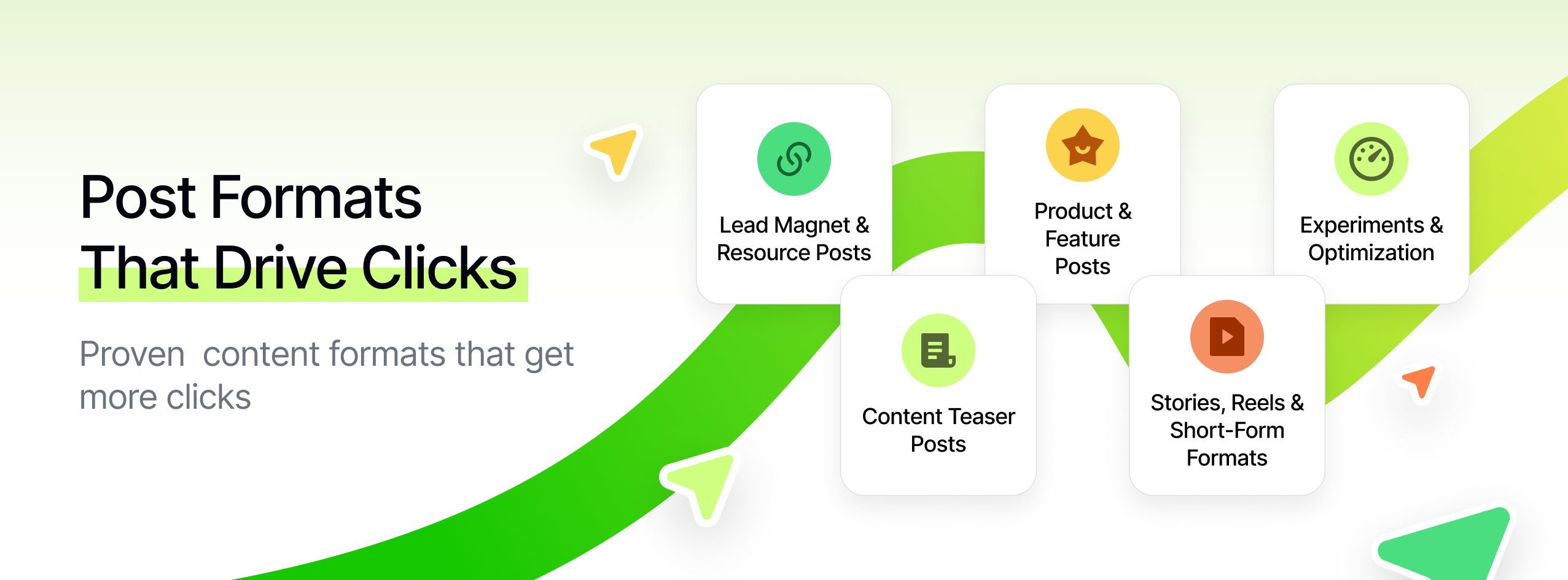
A. Content Teaser Posts That Practically Force a Click
These ideas are for driving clicks to content links-blog posts, YouTube videos, long-form guides, or docs. The post is the trailer, the link is the full movie.
1. "Trailer Post, Full Movie Behind the Link"
Goal: Use your social post as a trailer so people want to click for the full story.
How to do it:
- In the post, reveal:
- The core problem
- 1-2 key insights
- A clear statement of what the full piece covers
- Don't paste the entire article into the caption.
- End with a direct, benefit-led CTA:
- "Full breakdown with screenshots is here → [link]"
- "Read the complete step-by-step playbook → [link]"
Example caption:
"We used to publish randomly and hope for the best. Last quarter we switched to a simple 3-part content system and our CTR doubled. Here's the high-level overview 👇 - Part 1: How we choose topics - Part 2: How we structure 'clickable' posts - Part 3: How we track CTR We wrote the complete step-by-step guide (with templates) here → [link]"
Platform tips:
- Instagram / LinkedIn: Great as a carousel or text post with the link in bio / first comment.
- TikTok / Shorts: Use the hook in the first 2 seconds, then mention "full breakdown linked" on-screen and in the caption.
With Socialmon: Search for hooks like "full breakdown in comments", "complete guide here", "longer version on the blog" and save high-engagement posts to your High CTR Posts board. Note:
- How much detail they give away in the post
- Exactly how they word the "go read it" CTA
Use those as starting patterns for your own trailers.
2. "3 of 10" Post (Partial List → Full List via Link)
Goal: Prove value with a sample, then make the rest available only via the link.
How to do it:
- Create a full list in your content (e.g. "10 tactics to increase CTR").
- In your social post, share only 3 really good ones.
- Explicitly state there are more in the linked guide/video.
Example caption:
"10 ways to get more link clicks from your posts. Here are 3 that work stupidly well: 1️⃣ Use one clear CTA, not three. 2️⃣ Put the benefit before the link ('Fix your CTR → [link]'). 3️⃣ Link to a focused page, not your generic homepage. The other 7 (with examples + screenshots) are in the full guide → [link]"
Implementation notes:
- Make the 3 in-post tips strong enough that people trust you.
- Use the link as: "if you liked these, you'll love the rest."
With Socialmon: Save "X of Y" style carousels (e.g. "3 of 15 hooks we use") where the creator sends you to a full resource. Study:
- How often they mention the total number (10, 21, 50, etc.)
- How they frame the "rest of the list" behind the link
3. "Mistakes Post With Fixes Behind the Link"
Goal: Trigger loss aversion-people click to avoid doing something wrong.
How to do it:
- In the post:
- Highlight 2-3 big mistakes your audience is making
- Explain briefly why each mistake kills link clicks
- In the linked content:
- Full list of mistakes
- Detailed fixes, scripts, or templates
Example caption:
"If your posts get likes but no link clicks, you might be making one of these mistakes: ❌ Your CTA is vague ('link in bio'... but why click?) ❌ You're dropping links without context ❌ You're trying to promote 3 things in one post We wrote a full breakdown of each mistake + how to fix them (with examples) here → [link]"
Why it works:
- People see themselves in the mistake.
- The link becomes "the fix," not just "extra reading."
Pro tip: If you're targeting multiple segments (e.g. SaaS, creators, agencies), you can:
- Run the same mistakes post,
- But send each segment to a slightly tailored version of the article.
4. "Story Post With the Turning Point Hidden in the Link"
Goal: Use narrative tension-people click to find out what changed.
How to do it:
- In the post:
- Tell a short story about struggling to get link clicks
- Mention the things you tried that didn't work
- Hint at a turning point ("then we changed X")
- In the linked content:
- Full breakdown of what changed, step-by-step
Example caption:
"For 6 months straight, our posts got likes and comments... and almost zero link clicks. We tried: - posting more often - adding 'link in bio' everywhere - boosting posts Nothing moved. Then we changed how we structured posts around the link. We documented everything we did (with screenshots and numbers) in this case study → [link]"
Tips:
- Keep the story short-3-6 lines is enough.
- Make the pain and stakes clear (e.g. wasted ad spend, lost leads).
5. Side-by-Side "Before vs After CTR" Breakdown
Goal: Use numbers as proof that what's behind the link is worth clicking.
How to do it:
- Visual:
- Simple graphic or screenshot:
- Before: CTR 0.5%
- After: CTR 2.1%
- Simple graphic or screenshot:
- Caption:
- Briefly explain what changed ("We stopped doing X, started doing Y")
- Link to the full explanation of the change
Example caption:
"Same audience. Same product. Different post structure → CTR 4x'd. Left: random 'new blog post' announcements (0.4% CTR). Right: problem-first teaser posts with one clear link (1.7-2.3% CTR). We broke down the exact copy and examples in this guide → [link]"
Why it works:
- Numbers = credibility.
- The click is positioned as: "learn how to get this outcome."
With Socialmon: Save posts where creators share dashboards, graphs, or "before vs after" screenshots and link to a deeper breakdown. Notice:
- How early they show the result
- How quickly they move to: "we explained how we did it here → ..."
6. "Quote Carousel From the Article" With Click CTA
Goal: Warm people up with resonate-y lines, then point them to the full article.
How to do it:
- From your article, pull 5-7 strong lines that:
- Stand alone
- Hint at a deeper concept
- Put each line on its own slide.
- Last slide: clear CTA:
- "If these hit, read the full article here → [link]".
Example caption:
"We pulled a few lines from our new guide on increasing link clicks. If any of these feel too real, the full breakdown is here → [link]"
Tips:
- Keep the lines short enough to screenshot / share in DMs.
- Make at least one line very specific to your niche ("If your SaaS posts get likes but your trial page is empty...").
7. Document / PDF Post That Links to the Extended Version
Goal: Use platform-native doc posts for reach, then send the most interested people to a deeper asset.
How to do it:
- Create a short PDF (5-8 pages) with:
- A framework
- A checklist
- A short "how we did X"
- Upload it as a document post (especially on LinkedIn).
- In the caption:
- Explain that there's an extended version on your site with:
- Case studies
- Extra examples
- Templates or downloads
- CTA: "Extended version with examples is here → [link]"
- Explain that there's an extended version on your site with:
Example caption:
"This PDF walks you through our 5-step process for writing CTAs that get clicks. If you want real post examples + copy-paste templates, we put an extended version on our site → [link]"
Platform tips:
- LinkedIn: Documents often get more reach than link posts. Let the doc warm people up, then turn the link into the "next level."
- Instagram: Turn the PDF into a carousel and add the link in bio / comments.
With Socialmon:Create a mini board called "Doc → Link Plays" and save LinkedIn document posts that clearly send traffic off-platform. Use them as patterns when you create your own PDFs.
B. Lead Magnet & Free Resource Posts That Drive Clicks on Purpose
These ideas are for when your main goal is to get people to click a link to opt in-for a checklist, template pack, swipe file, or download hosted on your site/email platform.
8. "One Problem, One Free Fix" Lead Magnet Post
Goal: Make the click feel like the obvious fix for one painful problem.
How to do it:
- Pick a single, high-friction problem, e.g.:
- "Nobody clicks my links."
- "My CTAs feel awkward and salesy."
- "I don't know which posts to promote."
- Create a focused resource that tackles only that:
- CTA script cheatsheet
- "Click-boost" hook bank
- Link-placement mini playbook
- In the post:
- Call out the problem clearly
- Briefly explain what's inside
- Use a strong, specific CTA
Example caption:
"If your posts get attention but nobody clicks the link, this is for you. I made a 1-page Click-Boost Cheatsheet with: - 10 CTA lines you can copy - 5 post structures that get more clicks - examples from real posts Grab it free here → [link]"
Tips:
- Keep the resource small and fast to consume (1-3 pages, not a 60-page ebook).
- Name it clearly: "cheatsheet", "checklist", "scripts", "template".
With Socialmon: Create a tag like lead_magnet_single_problem and save posts where people offer one specific resource (e.g. "Hook Bank", "DM Script Pack") and clearly push to a link. Use them to pattern your own "one problem, one fix" promos.
9. "Peek Inside the Resource" Post
Goal: Reduce friction by showing exactly what they're getting before they click.
How to do it:
- Take screenshots or crops of your resource:
- Notion template
- Google Sheet
- PDF / Figma file
- Make parts of it slightly blurred or cropped so it's teasing, not giving away everything.
- In the caption, describe specific elements they'll get.
Example caption:
"Here's a peek at the Notion database we use to store high-CTR post ideas: - Page 1: tested hooks - Page 2: post examples with metrics - Page 3: copy-and-paste CTA lines You can duplicate our template for free here → [link]"
Tips:
- Add arrows or highlights on the screenshot: "Hooks", "Examples", "CTAs".
- Mention how you use it weekly ("We use this every Monday to plan link-first content").
With Socialmon: Save posts where creators show part of a Notion / Sheet / PDF and say "link in bio to get the full template". Tag them preview_template and reuse their visual patterns for your own "peek inside" posts.
10. "This Came From My Own Workflow" Resource Post
Goal: Increase perceived value by framing the resource as an internal tool you actually use, not a random freebie.
How to do it:
- Explain where the resource came from:
- "We built this to stop guessing which posts drive clicks."
- "Our team used this sheet long before we made it public."
- Emphasize that it's battle-tested in your own workflow.
- Link to the download page with a clear "copy it" CTA.
Example caption:
"This spreadsheet started as something we used internally to track CTR across Instagram, LinkedIn, and email... Now we've cleaned it up so you can copy it. It tracks: - link clicks by post - CTR by format - which hooks actually work Get the template free here → [link]"
Why it works:
- People trust tools that clearly came from real use, not something you whipped up just to collect emails.
With Socialmon: Look for posts mentioning "we use this internally", "our team dashboard", "our personal Notion" and save them. Those are high-trust resource promos. Use their framing to present your own assets as "from our actual workflow".
11. "Breakdown + Opt-In Combo" Post
Goal: Teach in the post; give the implementation tool behind the link.
How to do it:
- In the post:
- Teach a concept that helps increase link clicks (e.g. a 4-part caption framework).
- In the link:
- Provide a worksheet / template / fill-in-the-blanks doc to apply it.
Example caption:
"Here's the 4-part caption structure we use to increase link clicks: 1️⃣ Pain - call out the problem 2️⃣ Pattern - show why it keeps happening 3️⃣ Promise - what they'll get if they click 4️⃣ Path - the link itself I broke this down with examples and a fill-in-the-blanks worksheet you can grab here → [link]"
Tips:
- The post should be genuinely useful on its own.
- The resource should make the "how" faster (copy-paste, not theory).
With Socialmon: Tag posts that both teach a framework and push a worksheet / template behind a link. When planning, open that subset and mirror their flow: teach → "if you want to implement this faster, grab the worksheet here...".
12. "Mini-Challenge Opt-In"
Goal: Use time-bound participation to make clicking feel urgent and communal.
How to do it:
- Choose a specific outcome:
- "5-day click-boost challenge"
- "3-day landing page CTR sprint"
- In the post:
- Spell out what they'll get each day (small, tangible changes).
- Link to:
- A simple signup / registration page (even if it's just tagging a segment in your ESP).
Example caption:
"If your posts look good but nobody taps the link, join us for 5 days. Each day you'll get: - one tiny change to make in your posts - a real example to copy - a prompt to try it yourself It's free. Sign up here → [link]"
Tips:
- Add start date/time to the creative: "Starts Monday".
- Mention replays or recaps if relevant ("We'll send recaps to everyone who signs up").
With Socialmon: Save posts promoting "bootcamps", "challenges", "sprints" that clearly lead to a link. Many of them are built to maximize clicks. Use them as inspiration for your own mini-challenge structure and copy.
C. Product, Feature & Offer Posts Optimized for Clicks
Now we move to posts whose main job is to get people to click to a product, feature, or offer page-not just "learn more", but actually visit a sales/feature page.
Think: pricing pages, feature overviews, demos, free trials, lifetime deals, offer pages.
13. "One Pain, One Promise, One Link" Post
Goal: Strip away noise and give people one clear reason to click one specific link.
How to do it:
- Start with one painful scenario your audience recognizes.
- Offer one primary outcome your product delivers.
- Include one link and one action (no mixing "DM us" / "click here" / "email us").
Example caption:
"You wrote a great post, got nice comments... and 3 people clicked the link. If that sounds like last week, this is for you. We built [product] to: - turn your posts into clickable, trackable campaigns - show which hooks actually drive link taps - help you stop posting blind If you want posts that actually move people off-platform, see how it works → [link]"
Tips:
- Don't list every feature. Anchor on one outcome.
- Keep the CTA consistent across platforms for this specific campaign.
With Socialmon: Create a tag like one_pain_one_promise and save posts that follow this pattern. They're often your best blueprints for "click-to-product" posts that don't feel like noisy ads.
14. "Who This Is For / Not For" Post With Link
Goal: Pre-qualify visitors before they click so the traffic is warmer and more likely to convert.
How to do it:
- Use a single-image post or carousel:
- Slide 1: "This is for you if..."
- Slide 2: "This is not for you if..."
- End with:
- "If you're in the 'for you' column, details here → [link]."
Example caption:
"[Product] is for you if: ✅ You post regularly on at least one platform ✅ You care about link clicks, not just likes ✅ You want to know which posts send people to your site It's not for you if: ❌ You post once a month ❌ You don't really care about website traffic ❌ You're looking for a done-for-you agency If you're in the first column, take a 3-minute tour → [link]"
Why it works:
- People self-identify.
- Those who click are more serious and conversion-ready.
15. "Feature in Action" Short Demo Post
Goal: Show one feature solving one real problem, then link to the full context/demo.
How to do it:
- Record a 15-30 second screen capture or over-the-shoulder video:
- Start with the messy before state.
- Show your feature in action.
- End on the "ah, that's better" moment.
- Caption:
- Simple explanation: "Here's how we do X in under 30 seconds."
- CTA: "Full walkthrough + free trial here → [link]."
Example script:
"Here's how we see exactly which post drove last night's spike in link clicks 👇 [screen recording of dashboard] - pick a date range - sort by CTR - drill into the winning posts If you want this instead of guessing, the full demo is on our site → [link]"
Platform tips:
- Reels / TikTok / Shorts: Overlay text "Full demo → link in bio" and pin a comment.
- LinkedIn: Native video with link in the first comment.
With Socialmon: Make a feature_demo tag and save bite-sized product demos where creators show just enough to hook you, then send to a product page. Copy their structure and pacing for your own demos.
16. "Before/After Day-in-the-Life" Product Post
Goal: Make the link feel like the door to a better week, not just another tool.
How to do it:
- Frame "A week before [product]" vs "A week after [product]":
- 3-5 bullets each.
- Connect each "after" bullet to what your product enables.
- Link to a page that explains how to get that "after" state.
Example caption:
"What your week looks like before vs after [product]: Before - guessing which posts drive clicks - screenshotting analytics from 4 different tools - hoping your link-in-bio is doing something After - one dashboard showing clicks by post - clear winners and losers - easy decisions on what to double down on If you want week B, see the full walkthrough → [link]"
Tips:
- Keep it realistic, not magical.
- Bonus: add an image or carousel showing both "weeks" side-by-side.
17. "3 Use Cases, 1 Link" Post
Goal: Help different segments see themselves in your product and click the same landing page.
How to do it:
- Identify 3 major user types:
- e.g. freelancers, in-house marketers, founders.
- For each, write a "If you're X, we help you do Y" line.
- Link to a page where those use cases are explained in more detail.
Example caption:
"3 ways people use [product] to get more link clicks: 1️⃣ Freelancers - track which client content actually sends traffic 2️⃣ In-house marketers - compare CTR across platforms and campaigns 3️⃣ Founders - see if your 'launch posts' are actually bringing people to the page We put live examples for each use case on this page → [link]"
Tips:
- Carousel format works great: each slide = one use case.
- You can re-share the same post and change the first line to target each segment separately.
18. "Micro-FAQ + Link to Full FAQ / Product Page"
Goal: Remove the most common objections before someone clicks.
How to do it:
- Pick top 3 questions:
- "Does this work if I'm small?"
- "Does it integrate with X?"
- "Is it hard to set up?"
- Answer each in 1-2 lines.
- Then link to:
- Full FAQ, product page, or "How it works" page.
Example caption:
"Quick answers before you click: ❓ Does this work if I'm under 1k followers? ✅ Yes. We actually built it with small accounts in mind. ❓ Do I have to change all my links? ✅ No. You can start tracking new posts only. ❓ What if I cancel? ✅ You keep your data exports. We answered 15+ more questions (with screenshots) on this page → [link]"
Why it works:
- People who are on the fence get enough reassurance that the click is "worth it".
19. "Limited-Time Offer With Specific Link Outcome"
Goal: Add time pressure + clarity so the link feels urgent and safe to click.
How to do it:
- Tie the click to a time-bound benefit:
- Early-bird pricing
- Extra resource / bonus
- Extended trial / credit
- In the caption:
- Explain what happens after they click:
- "You'll see the offer", "Choose your plan", "Get the bonus automatically".
- Explain what happens after they click:
Example caption:
"Until Friday, anyone who joins [product] gets our High-CTR Swipe File as a bonus. Click the link and you'll: - see the new offer (it's short) - choose your plan - get the swipe file link instantly after checkout All the details are here → [link]"
Tips:
- Put the deadline in text + visual ("Ends Friday, 11:59pm").
- When the promo ends, update the post or remove the link to avoid confusion.
With Socialmon: Save "launch" and "offer" posts that clearly describe what happens after clicking (especially ones with bonuses). Tag them offer_click and use them as swipe when planning future promos.
D. Stories, Reels & Short-Form Formats That Boost Link Taps
Some formats are naturally better at getting people to tap-especially Stories and short-form vertical video. These ideas are tuned for link stickers, profile links, and pinned comments.
20. Story Sequence That Builds to a Single Link
Goal: Warm people up across several Story slides so tapping your link feels like the obvious next step.
How to do it:
- Use a 4-slide sequence:
- Pain / hook - call out the problem.
- Insight - what you learned or changed.
- Proof - a mini result or screenshot.
- Link slide - link sticker + clear CTA.
Example sequence:
- Slide 1: "Our posts used to get 3-5 link clicks. Total. 😬"
- Slide 2: "We changed 2 things: how we write CTAs, and what we link to."
- Slide 3: "Last week, this post alone sent 187 people to the site." (analytics screenshot)
- Slide 4: "We broke down the exact changes here → [link sticker: See breakdown]"
Tips:
- Put the link sticker on a clean, high-contrast slide.
- Use very short text; Stories are skimmed quickly.
- Add a "Tap here" arrow pointing at the sticker.
21. Poll → Link Reveal Story
Goal: Use a poll to create interaction, then present your link as the tailored solution.
How to do it:
- Story 1: Poll "Be honest: do your posts actually get link clicks?" Options: "Yes, consistently" / "Not really"
- Story 2: Follow-up for "Not really" (the majority):
- One quick insight or mistake.
- Link sticker to a deeper guide or tool.
Example follow-up:
"Most of you voted 'Not really' 👀 We wrote a short guide on fixing that-real examples, no fluff. Tap here to read it now → [link sticker]"
Why it works:
- People feel the guide exists because of their answers, not random promotion.
- The poll boosts Story engagement, which often improves reach.
22. Behind-the-Scenes of the Linked Page
Goal: Reduce friction by previewing the page people will land on.
How to do it:
- Record a screen recording scrolling through:
- A blog post
- A landing page
- A resource hub
- Add simple overlay text explaining what's inside.
- Final Story: link sticker with a straightforward CTA.
Example script:
[Screen recording of your article] "Here's what's inside our guide on writing CTAs that actually get clicks: - real examples - 5 frameworks - a troubleshooting checklist Read the full guide here → [link sticker]"
Tips:
- Use a cursor highlight or circles to draw attention to sections.
- Mention approximate reading time ("5-minute read") to lower the barrier.
With Socialmon: Save Stories/Reels where people show their own blog or product page ("Here's what's on the page") and then link out. Tag them bts_destination. These are great visual patterns to copy when you want to show "inside" before asking for a click.
23. Short-Form Video With a Pinned Comment Link
Goal: Use a high-performing Reel/TikTok/Short to earn reach, then convert interest via a pinned comment.
How to do it:
- In the video:
- Deliver one strong tip or mini-framework for getting more clicks.
- In the caption:
- Mention that the full resource is linked in the comments.
- In the pinned comment:
- Use a clear, benefit-led CTA + link (or "link in bio").
Example script:
"If your posts get views but your CTR is below 1%, try this: - Stop saying 'link in bio'. - Start saying what they'll get when they tap. I put 10 tested CTA lines you can copy in a short article-grab it, link is pinned in the comments."
Tips:
- Keep the video under 30 seconds.
- Add on-screen text: "Full guide → pinned comment" near the end.
24. B-Roll + On-Screen Text + Simple Link CTA
Goal: Low-effort, repeatable video that still drives clicks.
How to do it:
- Film simple B-roll: typing, walking, whiteboard, coffee shop, etc.
- Overlay text that:
- Calls out the problem.
- Promises a solution in the linked content.
- Mention the destination in the caption.
Example text:
On-screen: "Your posts get likes. Your links get ignored. We wrote the fix." Final frame: "Fix your link clicks → link in bio"
Caption:
"If your link CTR is stuck below 1%, we wrote a short guide with real examples. Get it here → [link]"
Why it works:
- Very quick to produce.
- Easy to reuse weekly with different angles.
25. "Start Here" Story Highlight as a Persistent Click Driver
Goal: Turn your Stories into a permanent traffic asset, not just a 24-hour spike.
How to do it:
- Create a Highlight called:
- "Start Here" / "Free Guides" / "Click These"
- Add Stories that:
- Promote your best guides
- Point to resource hubs
- Introduce your main link destinations
- Occasionally post:
- "If you're new here, everything worth clicking is in this Highlight → [screenshot of Highlight]"
Tips:
- Keep the Highlight cover text clear: "Start", "Guides", "Free".
- Refresh older Stories if links or offers change.
26. Q&A Sticker → Link Roundup Story
Goal: Use audience questions to justify a more comprehensive, linked resource.
How to do it:
- Story 1: Q&A sticker "Ask me anything about getting more link clicks."
- Story 2-4: Answer a few common questions directly in Stories.
- Final Story:
- "We answered more of these in a full guide-tap to read it."
- Add link sticker.
Example:
"Lots of you asked about where to put links and how often to promote them. I covered all of that + scripts + examples in this post → [link sticker]"
27. Content Recap Reel With One Destination Link
Goal: Consolidate multiple pieces of content into a single, highly clickable hub.
How to do it:
- Create a short Reel/Short that:
- Recaps 3-5 posts from the week/month.
- Uses quick clips or screenshots.
- On-screen text:
- "Missed these? Here's where to find them."
- Caption:
- "We turned all of these into one click-friendly hub page. You can find every guide + resource here → [link]"
Why it works:
- People don't have to hunt for individual links.
- One click gets them access to a curated, high-value page.
With Socialmon: Save Reels/Shorts that recap "what we posted this month" and direct to a hub. Tag them recap_hub. These are perfect inspiration when you want one post to drive a big batch of clicks to a single URL.
Experiments & Optimization Moves to Get More Link Clicks
Once you're publishing click-focused content, the next step is to systematically improve CTR. You don't need fancy CRO tools-just simple experiments and basic tracking.
28. Hook vs CTA Test (Same Content, Different Ending)
Goal: Discover whether your audience responds better to soft or direct CTAs.
How to run it:
- Pick one strong idea (e.g. "3 mistakes killing your CTR").
- Create two near-identical posts:
- Version A (soft): "We wrote the full guide if you want to go deeper."
- Version B (direct): "Read the full 7-step guide here → [link]"
- Post on different days at similar times.
- Compare:
- Link clicks
- CTR (clicks ÷ reach)
What to look for:
- Does your audience prefer a more curious, "if you want this..." tone or a clear "go here now" instruction?
- Which verbs win: "read", "download", "try", "see"?
29. Destination Test: Generic Homepage vs Focused Page
Goal: Increase link clicks and on-page engagement by sending people to a more relevant destination.
How to run it:
- For 1-2 weeks, promote the same topic:
- Version A: link to your general homepage.
- Version B: link to a focused guide or landing page.
- Tag URLs with different UTMs (e.g. ...&dest=homepage vs ...&dest=guide).
- Compare:
- CTR from social
- Time on page
- Scroll depth / bounce rate
- Conversions (signups, demo requests, etc.)
Expected pattern:
- Focused "this page solves X" destinations almost always outperform a generic homepage.
Action: For big recurring topics (e.g. "link clicks", "website traffic"), create one strong destination page and use it as your go-to link.
30. Link Placement Test (Bio vs Caption vs Comment vs Story)
Goal: Find where your specific audience actually prefers to click.
How to run it:
Choose one asset to promote (e.g. a guide). Over 1-2 weeks test:
- Instagram / TikTok / Shorts
- Post + "link in bio"
- Story with link sticker
- High-performing Reel + pinned comment pointing to link in bio
- LinkedIn / X
- Post with link in the main body
- Post with link in first comment
Use slightly different UTM tags for each placement:
- utm_content=bio
- utm_content=story
- utm_content=comment
Compare:
- Total clicks
- CTR
- Downstream behavior (time on page, conversions)
31. Visual Cue Test (Button Look vs Plain Text)
Goal: See if visual cues around your CTA meaningfully increase clicks.
How to do it:
- Test posts where the last slide or frame:
- Version A: plain text ("Read more on our site").
- Version B: faux button or card ("[ Read the full guide → yourdomain.com ]").
- Also try:
- Arrows pointing to the URL.
- Underlines or highlight shapes around the CTA.
Example:
- Slide 5: "Full guide + templates: yourdomain.com/ctaguide (works on mobile)"
Track whether posts with stronger visual CTAs have higher CTR.
32. "One Link Per Post" vs "Multiple Options" Test
Goal: Validate whether fewer choices = more clicks for your audience.
How to run it:
- Week 1:
- Posts with multiple CTAs:
- "Read the guide, join the newsletter, and check out our tool."
- Posts with multiple CTAs:
- Week 2:
- Similar topics but only one clear CTA:
- "Read the full guide here → [link]."
- Similar topics but only one clear CTA:
Compare:
- CTR per post
- Total link clicks per week
You'll usually see:
"One problem, one promise, one link" → more clicks per post.
33. Micro-Copy Experiments on the Link Text
Goal: Improve clicks by refining the exact words near your link.
Things to test:
- Generic vs specific:
- "Click here → [link]"
- "Read the full guide here → [link]"
- "Fix your CTR with the full guide → [link]"
- Outcome-first vs action-first:
- "Get the full checklist → [link]"
- "[link] → our full checklist"
Run small variations across similar posts and watch for patterns. You might find your audience clicks more when the benefit is named right before the link.
34. Cadence Test: How Many "Click Posts" Per Week?
Goal: Find a posting rhythm that balances engagement and link clicks.
Starter cadence to test (over 4 weeks):
- 2-3 pure value posts/week (no links).
- 2 click-focused posts/week (teaser → guide, template, product).
- 1 recap / hub post every 1-2 weeks.
Track:
- Average reach per post type
- Link clicks from click-focused posts
- Engagement on non-link posts (to ensure you're not burning out the audience)
Adjust:
- If engagement tanks → fewer hard CTAs.
- If clicks are low → stronger CTAs, better destinations, or more explicit benefit.
35. "Pre-Click Commit" Test (Comment to Get Link vs Direct Link)
Goal: See whether asking for a comment before sending the link improves click quality and conversation.
How to run it:
- Post A (direct): "The guide is here → [link]."
- Post B (comment-first): "Comment CTR and I'll DM you the guide link."
Compare:
- Total link clicks
- Time on page
- Signups or conversions
- Number of conversations (DMs, replies)
Use this sparingly:
- It's best for high-value resources or when you want more 1:1 interaction, not mass clicks.
- Make sure your DM process respects platform policies.
36. Minimal "CTR Lab" Sheet to Track What Works
Goal: Turn your experiments into a repeatable click-through playbook.
Set up a simple spreadsheet with columns:
- Date
- Platform
- Post URL
- Format (carousel, video, thread, story)
- Topic
- CTA style (soft, direct, comment-for-link, etc.)
- Link placement (bio, caption, comment, story)
- Destination (guide, lead magnet, product page, hub)
- Reach
- Link clicks (from analytics)
- CTR (clicks ÷ reach)
Every month:
- Sort by highest CTR.
- Note patterns in:
- Hooks
- Formats
- CTA wording
- Destinations
Turn your top-performing patterns into internal templates your team can reuse.
With Socialmon: Save your own top-performing creatives into a private board (e.g. High CTR - Our Account) with tags like top_performer. Now you can see them right next to competitors and niche leaders and spot what you have in common with high-CTR posts.
Using Socialmon as Your CTR Pattern Lab
You don't want to guess your way to better CTR forever. Socialmon can act as your "lab" for link-click patterns.
Instead of random screenshots in your camera roll, you build a structured swipe file of real posts that clearly drive clicks.
Step 1: Create a "More Link Clicks" Board
Name it something obvious:
- More Link Clicks
- High CTR Posts
- Click-Through Wins
This is your central home for everything related to getting more link clicks.
Step 2: Capture Only Posts That Clearly Push a Click
When you're browsing with the Socialmon Chrome capture tool:
- Save posts where you see strong evidence of click intent:
- Phrases like:
- "Full guide in bio / comments"
- "Download the template here"
- "Sign up at this link"
- Comments like:
- "Just signed up!"
- "Downloading now"
- "Reading this tonight."
- Phrases like:
Don't save generic "nice" content here-only click-focused creatives.
Step 3: Tag Each Creative by Click Pattern
Use tags so you can later filter by destination, format, and CTA style.
Useful examples:
- Destination type
- blog_guide
- lead_magnet
- product_page
- webinar_event
- tool_calculator
- Format
- carousel
- short_form_video
- story_capture
- thread
- pdf_doc
- CTA style
- soft_teaser (e.g. "we wrote about it on the blog")
- direct_click ("read it here →")
- comment_to_get_link
- limited_time_offer
Now you can filter for things like:
"Show me lead magnet carousels with direct CTAs."
and get an instant wall of proven examples.
Step 4: Analyze Hooks, CTAs & Visuals in Batches
Spend an hour every few weeks reviewing 10-20 saved posts side by side:
- Hooks
- Do they start with a problem, result, question, or strong statement?
- Are they niche-specific ("for SaaS founders") or broad?
- CTAs
- Where in the post do they mention the link (start, middle, end, multiple times)?
- What verbs do they use ("read", "download", "try", "see")?
- Do they restate the benefit right before the link?
- Visuals
- Do they show a snippet of the landing page, template, or dashboard?
- Is the URL visible on the last slide/frame?
- Are there arrows, buttons, or "tap here" elements?
Document your observations in a simple internal doc-this becomes your Click Patterns Doc.
Step 5: Turn Patterns Into Reusable Templates
From your Socialmon analysis, create a few internal templates, such as:
- Article teaser carousel
- Lead magnet preview carousel
- Short product demo script
- Story sequence for link stickers
- Limited-time offer post
Example template you might pull out:
"Teaser to Guide" Carousel Template Slide 1: "If [pain], read this before you [action]." Slides 2-4: 2-3 "what/why" points. Last slide: "We turned this into a full guide with examples → [URL]."
Now, instead of reinventing the wheel, your team just:
- Chooses a template.
- Swaps in your topic and landing page.
- Publishes, tracks, and iterates.
Step 6: Add Your Own Winners Back Into Socialmon
Don't just study others-treat your own account like a case study.
When one of your posts:
- Sends an unusually high number of clicks, or
- Delivers outstanding CTR, or
- Drives significant signups/sales,
do this:
- Save it into your More Link Clicks board.
- Tag it with something like:
- own_account
- top_performer
- plus the usual format/destination tags.
Over time, your board becomes a hybrid swipe file:
- The best click-driving posts from your niche.
- The best click-driving posts from your own brand.
That's as close as you'll get to a personalized CTR "cheat sheet" without spending a fortune on trial and error.
FAQ: Getting More Link Clicks from Social Media Posts
You can tweak the heading to match your SEO style, for example:
FAQ: How to Get More Link Clicks from Social Media
1. What actually makes someone click a link from a social post?
In most cases, link clicks happen when three things line up:
- Clear problem or desire The post makes them think: "This is exactly what I'm dealing with" or "I really want that outcome."
- Specific promise behind the link Not "check out my website," but:
- "Get the full 7-step checklist"
- "See the template we use"
- "Read the case study with numbers"
- One obvious next step One link, one action, clearly labeled:
- "Read the full guide here → [link]"
- "Download the template here → [link]"
If your post feels complete on its own, people will like or save and move on. If it clearly signals "the rest is over here," you create a strong reason to click.
How Socialmon helps: You can collect real posts across platforms that obviously push a click (guide teasers, template previews, product demos) and study how they structure the problem, promise, and CTA-then adapt those patterns for your brand.
2. How do I write CTAs that actually get more link clicks?
Good CTAs tend to be:
- Specific: "Read the full guide" > "Click here".
- Benefit-led: "Fix your welcome email sequence" > "Visit my website".
- Singular: One main action, not three.
You can start with simple formulas:
- "Read the full [X] here → [link]"
- "Get the complete checklist as a PDF → [link]"
- "See real examples with screenshots → [link]"
- "Try the calculator in 2 minutes → [link]"
Then test variations and see what your audience prefers.
With Socialmon: Tag saved posts by CTA style (e.g. soft_teaser, direct_click, comment_to_get_link). Over time, you'll see which CTA patterns show up again and again in high-performing creatives.
3. Will posting links hurt my reach and engagement?
If every post is hard-selling a link, your engagement will usually drop. But links themselves aren't the problem-low-value posts are.
A healthier mix that works for many accounts:
- 60-70%: Pure value (no link, or very soft CTA).
- 20-30%: Value + clear link (teasers to guides, tools, templates).
- 10-20%: Stronger promotional posts (launches, offers, events).
Your link posts should still:
- Teach something.
- Spark a realization.
- Show a mini result.
The link is just the natural "go deeper here" step.
With Socialmon: Use separate boards for pure_education, traffic_plays, and promo. Studying how mature brands balance these three buckets will help you design your own content mix.
4. Where should I place links to get the most clicks?
It varies by platform and audience, but some starting points:
- Instagram / TikTok / Shorts
- Link in bio (pointed to a focused page or hub, not generic homepage).
- Story link stickers.
- Pinned comments on high-performing Reels/Shorts.
- LinkedIn / X
- Link in the main post or in the first comment-test both.
- For longer content, document posts (LinkedIn PDFs) that point to a full guide.
- YouTube
- Description links + pinned comment with a benefit-led CTA.
Wherever you put the link, surround it with context:
"Read the full 5-step guide here → [URL]" "Grab the Notion template here → [URL]"
And track performance with UTM tags to see which placement actually wins.
5. How do I measure which posts get the most link clicks?
You'll need both analytics and some light manual tracking:
- Use UTM parameters Add tracking to your URLs, for example: ?utm_source=instagram&utm_medium=social&utm_campaign=carousel_cta_guide.
- Check your analytics tool (GA4, Plausible, Fathom, etc.):
- Sessions by source/medium
- Sessions by campaign
- Top landing pages from social
- Time on page, bounce rate, conversions
- Log post-level data in a sheet:
- Platform, post URL, format
- Topic, CTA style, link placement, destination
- Reach, link clicks, CTR
After a month or two, patterns will jump out.
With Socialmon: Save your own best-performing posts into a private board, tag them top_performer, and review them regularly alongside your analytics. This makes it easier to spot which structures and CTAs actually drive clicks for your specific audience.
6. Do I need a big following to get meaningful link clicks?
No. You need a relevant following more than a big one.
Small accounts can drive valuable traffic if:
- Posts speak to a very specific problem.
- Links lead to genuinely useful, focused pages.
- CTAs are clear about what's behind the click.
For many businesses, 50-200 highly relevant visitors from one post is more valuable than 10,000 random impressions.
With Socialmon: Filter for smaller accounts in your niche and look at their click-focused posts. You'll often see comments like "just downloaded", "signing up now", "reading this tonight". These are gold for understanding how small but focused creators drive clicks.
7. How often should I post "click-focused" content?
There's no single perfect rule, but a good starting cadence:
- 2-3 non-link posts per week (education, stories, opinions).
- 1-2 link-focused posts per week (guide teasers, resources, product pages).
- 1 recap or hub post every 1-2 weeks that drives to a single, strong page.
Adjust based on your analytics:
- If reach/engagement drop, you might be pushing links too often.
- If clicks are low, strengthen the promises and CTAs, or improve destination pages.
8. How is "getting more link clicks" different from "driving website traffic"?
They're related but distinct:
- Getting more link clicks = improving CTR on individual posts (more clicks per impression).
- Driving website traffic = total volume of visitors from all posts and channels.
Some formats get:
- High reach but average CTR.
- Lower reach but very high CTR.
You want a mix of:
- Posts designed to reach new people.
- Posts designed to convert attention into clicks.
This article focuses on the second part: engineering posts that make people tap.
9. How can Socialmon specifically help me get more link clicks?
Socialmon becomes your pattern library for CTR:
- While browsing, you save real posts that clearly send people to:
- Guides and articles
- Templates and resources
- Product and pricing pages
- Webinars and launches
- You organize them into boards such as:
- More Link Clicks
- Traffic Plays - Blog
- Traffic Plays - Lead Magnets
- Traffic Plays - Product Pages
- You tag them by:
- Platform and format
- Destination type
- CTA style
Then, when planning a post:
- Open the board that matches your goal (e.g. Traffic Plays - Lead Magnets).
- Scan 3-5 proven examples.
- Borrow the structure (hook → value → CTA → link placement) and adapt it to your brand.
Over time, you also add your own top performers, so Socialmon becomes a living archive of what consistently gets people to click in your space.
Turn Link Clicks Into a System, Not a Lucky Spike
Getting more link clicks from social media isn't about stumbling onto one magic CTA.
It's about building a simple, repeatable system where:
- You know which pages matter most (pillar guides, tools, signups, product pages).
- Your posts are designed with those pages in mind (one problem, one promise, one link).
- You test hooks, CTAs, visuals, and link placements and track what actually moves CTR.
- You reuse your winners instead of treating every post like a one-off.
Do that consistently and three things happen:
- More of your existing audience starts clicking through.
- New people who discover you have a clear, valuable next step off-platform.
- Your website becomes the natural home base for your best content and offers-not an afterthought.
Use this article as your idea engine. Use Socialmon as your pattern library.
Every time you see a post that clearly drives clicks, capture it, tag it, and add it to your "More Link Clicks" board. In a few weeks, you'll have something most marketers never build: a real, data-backed playbook for turning attention into traffic, signups, and revenue-on purpose, not by accident.



Get 50 viral posts for your niche (free)