63 Diwali Instagram post ideas with examples for 2027

This article cannot tell you what Diwali means. It was not written by a priest, a historian or a family that has lit the same lamps for fifty years, and a blog post is a poor stand-in for any of them. What it can do is help you decide what your business should say, what to ask before you say it, and which mistakes to skip.
The best Diwali Instagram post ideas are specific, checked with someone who celebrates, and tied to something your business really does. That might be late opening hours, a gift box, a table for a family of ten or a plain thank you to the customers who keep you going. A rangoli clip-art border and a stock photo of a lamp are not on that list.
Below you get 63 Diwali Instagram post ideas in eight goal groups, the dates for all five days in 2027, a note on how those days change by region and community, a posting timeline from early September to mid November, and guidance on wording, photos, fireworks, food, offers and staff. Every example business is made up. To see how real accounts word hours and gift boxes, search "Diwali gift box" or "open late for Diwali" in Socialmon and look at which posts got saves and replies.
What Diwali is, and who observes it
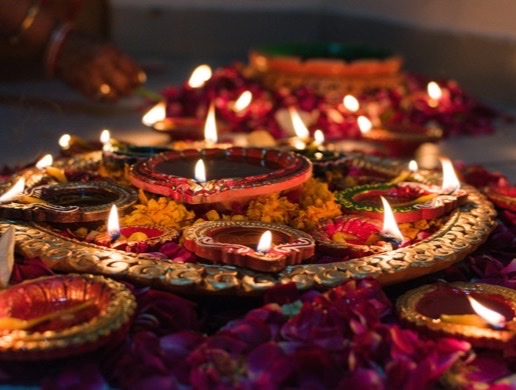
The name comes from the Sanskrit word Dipavali, which means a row or series of lights. Diwali is the festival of lights for many Hindus, and it is usually described as a five-day festival, though some regions count five or six days. Families clean and decorate their homes, light oil lamps called diyas, make floor designs called rangoli, share sweets and gifts, and gather as a family.
It is not only a Hindu festival. Jains observe their own Diwali, which marks the final liberation (nirvana) of Mahavira. Sikhs observe Bandi Chhor Divas, which commemorates the release of Guru Hargobind, the sixth Sikh Guru, from imprisonment in Gwalior Fort. It often falls on the same night as Diwali, but Sikhs treat it as their own day, not as a version of Diwali.
Some Buddhist communities also mark the festival. In Nepal it is called Tihar by Hindus and Swanti by Newar Buddhists. Buddhist observance differs by community, so do not assume.
It is not the same as other winter lights festivals
Diwali falls in autumn in the Northern Hemisphere, and it often gets lumped in with "the festival season" along with Christmas, Hanukkah and Lunar New Year. Those festivals have different meanings, different dates and different customs. A "festival of lights" collage that mixes them flattens all of them.
Say Diwali when you mean Diwali. If you run a December campaign, give it its own post. Diwali is also not "Indian Christmas", and describing it that way tells your South Asian customers you have not looked.
Where it is a public holiday
The main day, Lakshmi Puja, is an official holiday in several countries, including India, Singapore, Malaysia, Nepal, Sri Lanka, Fiji, Mauritius and Trinidad and Tobago. In the United States, New York State law requires New York City public schools to close for Diwali. In many other places it is a normal working day, which matters for your hours and for your staff.
The five days in 2027, and how they change by region
Diwali follows the Hindu lunisolar calendar, so the dates move each year. In 2027, the main day is expected on Friday 29 October, based on a New Delhi calendar. The five days then run from Wednesday 27 October to Sunday 31 October.
These dates are not the same everywhere. Singapore's Ministry of Manpower lists Deepavali as a public holiday on Thursday 28 October 2027. Some overseas calculations also place Lakshmi Puja on 28 October in cities such as London, New York and Toronto, because the new moon timing differs by location. Treat every date here as "expected" and confirm with a local temple, a community calendar or, best of all, your own customers.
Day one: Dhanteras (Wednesday 27 October)
Dhanteras opens the festival in most of India. Homes and shops are cleaned, small lamps are lit, and it is a major shopping day for gold, silver, utensils and home goods. For jewellers, home goods stores and kitchenware shops, this is the busiest day of the week.
If you sell any of those things, your Diwali posts need to start well before this day. Customers buy for Dhanteras in the days before, not on the day.
Day two: Naraka Chaturdashi, or Choti Diwali (Thursday 28 October)
The second day is also called Choti Diwali, meaning small Diwali. It is linked to the story of Krishna defeating the demon Narakasura. In some places it is a day for buying sweets, exchanging gifts and visiting friends and business associates.
In parts of southern India, this is the day many families treat as the heart of the festival, with an early morning oil bath. In Gujarat it is tied to Kali Chaudas and Hanuman Puja. So the same day can look quite different depending on a family's roots.
Day three: Lakshmi Puja, or Diwali itself (Friday 29 October)
Lakshmi Puja is the main day, centred on worship of Lakshmi, the goddess of wealth and prosperity. Families light many lamps, wear new clothes, pray at home or at a temple, and share a meal. Fireworks are common in many places.
Not everyone worships Lakshmi on this night. Hindus in eastern India, including Bengal, generally worship Kali, a day known as Kali Puja. Merchant families often pray for a good business year, which is why shops and traders matter to this day.
Day four: Govardhan Puja, or Annakut (Saturday 30 October)
Govardhan Puja remembers the story of Krishna lifting Govardhan Hill to shelter the people of Vrindavan from a storm sent by Indra. The day is also called Annakut, meaning mountain of food. Communities offer a large spread of vegetarian dishes and sweets, then share it as prasad.
Sources differ on the exact day and on how Govardhan Puja and Annakut relate, so ask before you name it on a post. In Gujarat and some northern communities, the new year begins around this time, so some customers may be greeting each other with a New Year wish, not a Diwali one.
Day five: Bhai Dooj (Sunday 31 October)
The last day honours the bond between brothers and sisters, with sisters blessing their brothers and families sharing a meal and gifts. It goes by many names, including Bhai Tika, Bhai Bij, Bhau Beej and Bhai Phonta, depending on region. Some craft and trade communities mark Vishwakarma Puja around this time instead.
Bhai Dooj is a natural fit for gift ideas, but it is a family day first. Plain, warm posts work better than anything that sounds like a sales push.
Three business situations and what is honest to post in each
What you can say depends on where you start. Almost every business falls into one of these three.
You are South Asian owned, or Diwali is your own festival
You do not owe anyone a campaign. Many owners feel pressure to turn every festival into content, and some would rather close, rest and celebrate with their families. You decide how much of your story to share and how public to be.
If you do post, you have the most real material: your recipes, your supplier relationships, your family's way of marking the days and your staff's own plans. You can also use the week to point customers to other South Asian owned businesses you admire. That costs you a caption and helps your neighbours.
You serve many customers who celebrate
The biggest group includes restaurants, sweet shops, salons, jewellers, boutiques, florists, gyms, dentists and home goods stores in places like Leicester, Toronto, Edison, Dubai, Singapore and Parramatta. Your honest material is practical: what you offer for the week, when you are open and how to order. Customers who celebrate are mostly looking for that.
Ask staff and regular customers what they would find useful, then post that. The guide to Ramadan and Eid Instagram post ideas follows the same approach for a different festival, and the same rule applies here: your account is a guest, not the host.
You have no obvious link to the festival
You can still take part, but the bar is higher. The honest version is learning in public and helping real customers. That means you thank the people who celebrate, you make life easier for them with hours or orders, and you ask rather than guess.
What a non-South-Asian business can do honestly is learn, ask, thank and support. Learn the five days and the dates, and ask a customer or staff member what would help.
Then thank people, and support a local South Asian owned business with an order or a referral. What to skip is anything that borrows the look of the festival to sell something you cannot explain.
If you have nothing real to offer yet, staying quiet this year and building a relationship for next October is a respectable choice.
Diwali greetings for business: the words to use
Diwali greetings for business can be short. "Happy Diwali" is the most common English greeting and works for almost every audience. "Shubh Deepavali" and "Shubh Diwali" are also widely used, and many families use greetings in Gujarati, Punjabi, Tamil, Bengali, Marathi and other languages.
Use a greeting in another language only if someone on your team speaks it or a speaker has checked your spelling. A wrong word reads worse than no word. Write the festival as Diwali or Deepavali, and stay consistent within a post.
Some customers will say "Happy New Year" in the days after Lakshmi Puja, because their community marks a new year then. Sikh customers may greet each other for Bandi Chhor Divas instead. If you are unsure, "Happy Diwali to everyone celebrating" is warm, accurate and safe. Avoid "Happy Holidays", which hides the festival, and do not write the greeting as a pun.
Photos, imagery and consent
Photos of real people, real food and real lamps in your own space will beat a stock graphic. They are also easier to defend, because you know where they came from.
Ask before you post a person
Get a clear yes before you photograph or post a customer, staff member or family, and tell them where it will appear. Do not post children without a parent's agreement. Crop out guests in the background unless you have asked. A customer who arrived in a sari or kurta for an appointment did not agree to be your campaign photo.
Do not use religious imagery as decoration
Images of Lakshmi, Ganesha and other deities are sacred to many Hindus. They are not clip-art. Do not put a deity on a sale banner, a discount graphic, a price tag, a flyer or a shopping bag.
The Hindu American Foundation publishes guidance on commercial use of Hindu images. It says images on footwear, swimwear, underwear, bathmats and door mats are likely to cause offence, and that shirts, tote bags and wall hangings are less likely to. Not every Hindu agrees with every line, but the plain rule is simple: if the image will be stepped on, thrown away or used to sell a discount, leave it out.
Avoid the "exotic" look
Gold borders, paisley, mandala fills, a fake script font and a woman in a sari holding a lamp make a stock-photo version of India that many South Asian customers find tired. The festival is lived in kitchens, living rooms, shops and temples. Show those, or use plain design and let your words carry it. Never use Om or a deity's outline as a logo or pattern.
Why Diwali Instagram post ideas need a different plan
Most holiday windows work on a countdown. You post, you sell, you move on. Diwali does not behave like that for three reasons.
First, there is no single date. The days differ by calendar, by region and by family, so a post written for "Diwali day" can be wrong for half your audience. Second, the festival is family-first and often private, so heavy selling can feel out of place. Third, the customers who celebrate are watching for whether you understand the basics, such as that Diwali is five days and that it is not a sale.
For Diwali social media post ideas, the practical answer is to plan for the whole span, pick your dates openly, and build around things customers actually need: hours, orders, bookings and gifts.
The Diwali posting timeline, from early September to mid November
The dates below are for 2027 and assume the main day is Friday 29 October. Move everything by a day or two if your community or country marks it differently.
Phase 1: decide and ask (Monday 6 to Friday 17 September)
Decide whether you will post and what you can honestly offer. Talk to staff, in private, about who celebrates and who needs time off. Ask two or three regular customers what would help them, and write it down. Nothing is posted yet.
Phase 2: build and check (Monday 20 September to Friday 1 October)
Order stock, confirm suppliers and set your order cut-off dates. Write the ingredient list, allergen details and any vegetarian or onion and garlic notes now. Have a speaker check any greeting in another language, and ask a customer who celebrates to read your hours post.
Phase 3: open orders and bookings (Monday 4 to Friday 15 October)
Your practical posts go out now. Open gift box orders, festive menus, appointment slots and hamper pre-orders. State every cut-off date clearly, with the day of the week.
In the US and Canada, remember Canadian Thanksgiving falls on Monday 11 October 2027, so some Canadian customers are busy that weekend. Keep posts light and useful that week.
Phase 4: the last order window (Monday 18 to Sunday 24 October)
Remind customers of cut-offs, delivery times and last appointments. This is the week most gift and food orders land, so post fewer, clearer messages. A short Story each day about slots left is worth more than a polished post.
Phase 5: the five days (Wednesday 27 to Sunday 31 October)
Post your hours daily, and keep one pinned post updated. On the main day, post a short greeting with one real detail, such as your shop's late closing time. Do not run a sale tied to the day itself.
Halloween falls on Sunday 31 October 2027, the same day as Bhai Dooj. Customers will see Halloween posts and Diwali posts side by side, so keep them clearly separate, with no pumpkin and lamp mash-ups. Our guide to Halloween social media post ideas covers that weekend from the other side.
Phase 6: the thank-you week (Monday 1 to Sunday 7 November)
Thank customers plainly. Share what people ordered most, or a photo of the shop after the rush. If you have leftover stock, say so honestly.
Phase 7: the Thanksgiving and Black Friday run (Monday 8 to Friday 26 November)
In the US, Thanksgiving is Thursday 25 November 2027 and Black Friday is Friday 26 November. Do not tie a Black Friday offer to Diwali, and do not call it a "Diwali sale". Switch your messages to the next job and keep any Diwali gift orders separate from that campaign.
If a customer asked for Diwali gift boxes that ship in November, say the date they will arrive. Plain delivery dates are respectful and useful.
The 63 Diwali Instagram post ideas, grouped by goal
Use this as a menu. Pick a few Diwali Instagram post ideas from each group that your business can honestly do, rather than trying to post everything. The groups run from planning and hours through gifts, food, appearance, safety, community and the weeks after.
Tell people your hours and your plan before the week starts
- A post with your Diwali week hours, one line per day from Wednesday 27 to Sunday 31 October
- A pinned post saying which days you are closed or open late, with the dates written out
- A Story countdown to your last order date for gift boxes, hampers or bookings
- A post that names the date your area marks Diwali, with a note that some customers may celebrate a day earlier or later
- A Story asking customers which day they celebrate on, so you can plan stock and staff
- A "how to order" carousel for hampers, trays and gift boxes, with cut-off dates
- A Highlight called "Diwali 2027" that holds hours, ordering steps and delivery details
- A reminder post the day before your busiest day, with parking, delivery or queue details
Welcome customers who celebrate without speaking for them
- A plain greeting on the day, such as "Happy Diwali to everyone celebrating", with one real detail about your shop
- A Story thanking regular customers who celebrate, in your own voice and with no stock graphics
- A post about how your owner or staff mark Diwali, written or approved by them and shared only if they want it shared
- A caption in English plus a language your team actually speaks, checked by a speaker
- A post inviting customers to share their family traditions in the comments, with replies read and thanked
- A Story that explains the five days in two sentences each, with the source named
- A short note that you know Jain, Sikh and other customers may mark the days in their own way
- A thank-you to a customer who corrected or helped you, with their permission
Sell gifts, sweets and festive stock honestly
- A Dhanteras post for gold, silver, kitchenware or home goods, with prices shown
- A gift box post showing exactly what is inside, with weights and allergens
- A "gifts for hosts" post with three clear price points
- A Reel packing a hamper from first item to ribbon, with hands only and no faces
- A last-day-to-order post with the cut-off time and the delivery date
- A bundle post for a multi-generation household, with something for elders, adults and children
- A restock Story during the week, showing what sold out and when it returns
- A post for workplace gifting, with minimum orders and lead time
Fill tables and calendars for family gatherings
- A festive menu post with a clearly marked vegetarian section
- A label graphic that marks vegetarian, vegan, no onion or garlic, Jain-friendly and contains nuts
- A booking post for large family tables, with group size and time slots
- A set sharing menu for the five days, with dates
- A kitchen Story showing a sweet or snack you make in batches, with the real recipe credited
- A Saturday 30 October post for a shared vegetarian spread, if your menu fits and you have asked someone who observes Annakut
- A takeaway or catering post for home gatherings, with pickup slots
- A post asking guests to mention allergies and dietary needs when they book
Help customers look and feel ready for the celebration
- A salon or barber booking-window post for the week before Lakshmi Puja, with times
- A mehndi or henna slot post, if you offer it, with prices and duration
- A jewellery post for Dhanteras with the metal, the purity details and your return policy
- A boutique post for festive outfits, with sizing and alteration turnaround
- A florist post for marigold garlands and table arrangements, with the order cut-off
- A dentist post for a pre-festival check-up and clean, with plain claims and slot times
- A gym or studio post for a short festive-season routine that does not shame anyone for eating sweets
- A tailoring or alterations post with the last day to drop off garments
Keep celebrations safe for people, pets and neighbours
- A diya and candle safety reminder in plain words
- A Story suggesting LED tea lights as an alternative to open flames
- A post about keeping pets calm if fireworks go off near you
- A post stating local rules on fireworks and noise, with the council or city source
- A Story about how you close up your own space safely each night
- A post asking customers to tell their neighbours before they set off fireworks
- A post on keeping fabric, curtains and saris away from flames
- A note on how your shop handles open flames, if you display diyas
Support South Asian owned businesses and local groups
- A thank-you to a South Asian owned supplier, named with their permission
- A post pointing to a local temple, gurdwara or community group's event, with their details and approval
- A spotlight on a customer's Diwali tradition, with consent and credit
- A post that shares the date, place and organiser of a local Diwali event
- A Story about a donation or hamper to a food bank or charity, with the real amount if you share it
- A post about a hiring or buying change, written only if it has happened
- A post thanking staff who covered shifts so colleagues could celebrate
- A post recommending another business's sweets or services, with their agreement
Close the week and keep the relationship going
- A thank-you post on Monday 1 November
- A post sharing what customers ordered most this year
- A transparent post about leftover or short-dated stock and how it will be handled
- A post asking customers what they wished you had offered
- A Highlight that archives your Diwali week for next year
- A Story with customers' photos of your product in their celebration, shared with permission
- A post that points from Diwali to the next real date, such as Thanksgiving, Black Friday or the December holidays
How to use each group of Diwali Instagram post ideas
You cannot post all 63, and you should not try. Each group does a job, so choose the groups that match what you sell.
Hours and plans come first
The hours group is the least glamorous and the most useful. A customer buying sweets for a family of twelve wants to know if you are open on Choti Diwali and when the last order is. A caption such as "Open 10 to 9 Wednesday to Saturday, 10 to 6 on Sunday. Gift box orders close Friday 22 October at 5 pm" does more than any greeting.
Write the day of the week as well as the date. Customers plan around weekdays, and a missing weekday invites mistakes.
Gifts and food need exact details
Gift posts convert when they are exact. Show what is inside, how much it weighs, what it costs and when it can arrive. Put allergens in the caption, not only on the box, with a line such as "Contains almonds, pistachios and milk."
Menus need clear labels too. "Vegetarian" is not the same as "Jain", and "no onion or garlic" is not a promise about root vegetables. When a customer asks, answer exactly, even if the answer is "we cannot guarantee that."
Diwali Instagram captions you can adapt
Good Diwali Instagram captions are short, include one real detail and avoid explaining the festival. Use these as starting points and swap in your own facts. All names are made up.
Hours and order captions
- "Open late for Diwali week. Wednesday to Friday until 9 pm, Saturday until 7 pm, Sunday 10 to 4. Gift box orders close Friday 22 October at 5 pm."
- "We are closed on Friday 29 October so our team can be home with their families. Orders placed before Wednesday 27 October at noon will be ready on Tuesday."
- "Last orders for Diwali delivery are Thursday 21 October. After that we will have boxes ready for pickup only."
Greeting and thank-you captions
- "Happy Diwali to everyone celebrating. We are glad you shop with us, and we will be open until 9 on Friday."
- "Shubh Deepavali to our customers who celebrate. Thank you for letting us be part of your week."
- "Thank you to everyone who ordered, collected or called this week. We packed 300 boxes and it was a pleasure."
Safety and care captions
- "Lamps and candles on a steady surface, away from curtains and loose clothing. If you have pets, LED tea lights are a safe swap."
- "If fireworks are planned on your street, tell your neighbours first. Pets and little ones will thank you."
- "Allergy note for our festive boxes: they contain almonds, pistachios and milk. Ask us if you want a nut-free option."
Never include a claim you cannot support, such as "authentic" or "the best" with no proof. If you quote a tradition or story, say where you learned it.
Diwali ideas for small business: pick by business type
A small team cannot post every one of these Diwali social media post ideas, or every one of these Diwali ideas for small business, and should not. Pick one or two that fit what you sell and the customers you serve.
- Restaurants and cafes: a clear festive menu with vegetarian, vegan and no onion or garlic labels, a booking window for family tables, and hours for each of the five days.
- Sweet shops and bakeries: gift boxes with exact contents, weights and allergens, a clear order cut-off, and a delivery or pickup plan.
- Salons, barbers and beauty studios: a booking window before Lakshmi Puja, henna or mehndi slots if you offer them, and a note on late opening.
- Jewellery brands: Dhanteras posts that show prices, metal and purity details, and your return policy, with no pressure language.
- Boutiques and tailors: festive outfits, size ranges and alteration turnaround, with a last drop-off date.
- Gyms and studios: a short festive routine, a schedule change post and a gentle note that sweets are part of the festival.
- Dentists: a pre-festival check-up window with real slots, a plain price or insurance note, and no body-shaming copy.
- Home goods stores: Dhanteras kitchenware and decor, safe lamp holders, LED options and a gift guide for hosts.
- Florists: marigold garlands and table arrangements, with the order cut-off and delivery slots.
A note for each country you may serve
Dates and customs differ, so check locally. These notes are only a starting point.
In the United States, Diwali is a normal working day in most places, although New York City public schools close. Thanksgiving and Black Friday follow within weeks, so plan gift orders early. In Canada, Thanksgiving falls earlier, on 11 October 2027.
In the United Kingdom, big public events can draw very large crowds. Leicester City Council changed its Diwali celebrations in 2025 because of crowd safety concerns, so check what your own council has published. In Singapore, Deepavali is a public holiday on Thursday 28 October 2027, a day earlier than the New Delhi date, so use your own local date.
For India, the UAE, Australia and anywhere else, ask your customers and staff which days they mark and what hours suit them.
Fireworks, diyas, noise and pets
Safety content works best when it is practical and local. Do not scare customers, and do not copy another country's rules.
Fireworks and local rules
Rules vary by country, state and city. In England, Scotland and Wales, fireworks cannot be set off between 11 pm and 7 am, but on Diwali the cut-off moves to 1 am, according to government guidance. Councils may add rules, and some places restrict fireworks entirely. If you are unsure of the law, name the official source or ask people to check with their council or city.
Diyas, candles and fabric
UK fire services give the same advice each year.
Put lamps and candles in proper holders on stable, heat-resistant surfaces, away from curtains. Keep flames away from hair and loose clothing, because saris, dupattas and chunis can catch fire easily. Never leave a flame unattended. LED tea lights are a simple alternative, especially with children or pets in the home.
Noise and pets
Fireworks frighten many animals, and animal charities report more lost pets during celebrations. They suggest keeping cats and dogs indoors when fireworks are likely, closing curtains and windows, giving pets a place to hide and making sure they wear a collar and ID tag. Telling neighbours before you set off fireworks is an easy, kind step.
Food, allergens and dietary points
Food is central to Diwali, so this is where a small mistake can matter most. Ask, label and keep your promises small.
Vegetarian, no onion or garlic, and Jain
Many Hindu families keep festival meals vegetarian, and some avoid onion and garlic, particularly for food offered in a puja. Jain food rules are stricter, and they also exclude root vegetables such as potato. Practices vary by household, so do not assume that one label covers every family.
Be careful with the word "vegetarian". Many Hindus do not consider eggs vegetarian, so an item with egg is not a safe vegetarian item for them. If you offer a Jain option, check every ingredient, including stock, sauces and spice blends.
Sweets and allergens
Many sweets use nuts, milk, ghee, flour, sesame and food colouring. Put the ingredients and allergens in the caption and on the packaging. If you sell hampers, state what is in each one.
Some sweets are topped with edible silver leaf, called vark. It was traditionally made using animal material, and India's food regulator has said silver leaf must not be made using animal-origin material. If you buy or sell it, ask your supplier how it is made, and tell vegetarian customers plainly.
Alcohol
Customs vary. Some families serve alcohol at Diwali gatherings and some never do, particularly at ceremonies. Do not make alcohol the offer or the pairing for a Diwali post. If you are a bar or restaurant, list drinks as you normally would, and do not mix drinks with religious imagery.
Offers, hours and gifting without making a religion a sales gimmick
Selling during Diwali is normal. Many customers shop for the festival, and gifts are part of the tradition. The line is between serving a real need and using the festival as a hook.
An honest offer helps with a real cost, such as a gift box at a fixed price, free delivery above a stated amount or a bundle for a family table. A dishonest one puts the word "Diwali" on a discount that would run anyway. If the offer would run in any other month, leave the festival out of its name.
How to word an offer
Keep wording plain. "Gift boxes from 25 pounds, order by Friday 22 October" is clear. "Light up your Diwali with massive savings" treats a festival as a slogan. Avoid wording that ties prosperity or blessings to buying, and do not time a discount to Lakshmi Puja itself.
Hours and gifting posts
A gifting post should state when the order closes, when it will be delivered and what happens if it is late. If your Diwali hours are shorter or longer than normal, put them in the first line. Do not tell customers what they ought to give, and do not suggest an amount that is "expected".
Staff who celebrate, and time off
Some of your team will want time off, and some will want to work. Ask early, in private, and keep the rules the same for everyone. Do not assume that a staff member of South Asian background celebrates, or that anyone else will cover for them.
Plan the rota by early October. Where the main day is a public holiday, follow local employment law, and elsewhere check your leave policy.
Never ask a staff member to represent a community or pose for a post. If someone wants to share their own tradition, let them write it and approve the photo. A thank-you to staff who covered shifts is a good alternative.
A worked Diwali week for two made-up businesses
Here is an illustration of Diwali Instagram post ideas working together. Both businesses are imaginary, and no real shop is meant.
Kesar Lane Mithai is a made-up family sweet shop. In September the owner decides on three gift boxes, writes the ingredient and allergen list, and asks two regular customers to read the order post. On 4 October she posts the box contents, weights, prices and the cut-off, Friday 22 October at 5 pm, then a Story each day showing slots left.
On 27 October she posts hours for the five days. On 29 October she posts one line: "Happy Diwali to everyone celebrating. We are open until 9 tonight." On 1 November she thanks customers and shares what sold most. She runs no discount at all.
Fennel and Fig Florist is a made-up flower shop with no family link to the festival. The owner asks a regular customer what would help, and learns that marigold garlands are in demand for the main day.
She orders from a South Asian owned wholesaler, names them with permission, and posts the order cut-off. On 29 October she posts: "Orders for today are ready for collection until 5 pm. Thank you for trusting us with your table." The posts are modest, and the customers who celebrate got what they needed.
What drives reach, engagement and conversion during Diwali
Do not judge your Diwali week by reach alone. The posts that get the most views are rarely the ones that bring orders.
Short Reels of real preparation, such as packing a box or stringing a garland, tend to travel furthest, because they show craft. Practical posts such as hours, menus and cut-off dates tend to be saved, and "which day do you celebrate" Stories tend to get replies. Posts that convert are clear and plain: a price, a contents list, a pickup slot and a way to order.
What not to post
The list below matters more than any idea above. Most of the damage comes from a post that should not have gone out.
- A deity on a sale banner. Do not put Lakshmi, Ganesha or any other deity on a discount, flyer or price tag.
- A "Diwali sale" with no change to your offer. If the discount would run anyway, leave the festival out of it.
- A stock-photo collage of "Indian" symbols. Paisley, mandalas, a woman holding a lamp and a fake script font read as lazy.
- Mixing festivals. Do not blend Diwali, Christmas, Hanukkah and Lunar New Year into one "festival of lights" post.
- A wrong date stated as fact. Say "expected" and ask a local source.
- Jokes, puns and accents. Never mock a name, a food, an accent or a custom.
- Photos of people without consent. This includes children and guests in the background.
- A pledge with no action. If you will not do it, do not say it.
- A campaign that appears once a year and then vanishes. If Diwali is the only time you speak to these customers, they will notice.
Diwali Instagram post ideas: your questions answered
What are the dates for Diwali in 2027?
Based on a New Delhi calendar, the five days run from Wednesday 27 October to Sunday 31 October 2027, with Lakshmi Puja on Friday 29 October. Some places differ. Singapore's public holiday is Thursday 28 October, and some overseas calculations put Lakshmi Puja on 28 October in cities such as London, New York and Toronto. Confirm with a local source.
Can I post about Diwali if my business is not South Asian owned?
Yes, if you have something true and useful to say. Share hours, orders, gifts or a thank you to customers who celebrate, and ask someone who celebrates to read your draft. If you have nothing to offer yet, building a relationship for next year is a good choice.
Is it okay to run a Diwali sale?
Safer not to. A real offer, such as a gift box at a stated price, is fine. A discount that uses the festival as a banner, or ties blessings and prosperity to buying, treats a religious festival as a sales hook.
Can I use images of Lakshmi or Ganesha in my posts?
Avoid them. These images are sacred to many Hindus, and they should not appear on sale banners, price tags, packaging or anything that will be thrown away. A real photo of your own shop or product is a better choice.
How do I stay safe with fireworks and diyas?
Check local fireworks rules, keep lamps on stable, heat-proof surfaces, and keep flames away from fabric. Consider LED tea lights, and remind customers to look after their pets. In the UK, the usual fireworks curfew is extended to 1 am on Diwali, but check with your council.
Find real Diwali examples before you post
The ideas above are a starting point, and real accounts show how they land. Search "Diwali gift box", "open late for Diwali" or "Diwali sweets order" in Socialmon to see which Diwali Instagram post ideas earned saves and replies, and which fell flat.
Do this in early September, while you still have time to change your plan. Note what accounts near you are posting, then do the practical thing they missed, such as stating the cut-off date, labelling allergens or saying what you are open. The Diwali Instagram post ideas that last are the ones that help a real customer plan a real week.
Related articles


Get 50 viral posts for your niche (free)