73 Social Media Post Ideas for Nonprofits That Convert
Nonprofits rarely struggle to post. They struggle to post content that:
- Makes a specific supporter think, "This is exactly the issue I care about - and I trust these people to work on it."
- Turns vague concern into clear next steps: donate, volunteer, share, show up, advocate.
- Bridges the gap between emotional stories and concrete, credible impact.
What follows is a reusable library of post formats you can plug into Instagram, LinkedIn, TikTok, Facebook, X, email, and your own site - without staring at a blank content calendar every week.
How to use this guide for your nonprofit
1. Pick one primary goal for the next 30-90 days
Most nonprofit comms teams are focused on one of:
- Growing awareness among a specific audience (not "everyone")
- Turning existing attention into donations or recurring giving
- Recruiting and retaining volunteers or members
- Deepening trust and transparency with current supporters
- Driving participation in a specific campaign, event, or policy moment
Choose your goal first. Every format becomes more powerful when it points to a specific next step: donate, sign up, attend, share, or advocate.
2. Get very specific about who you're talking to
These formats perform far better the more specific you get:
- Audience: first-time small donors, major donors, monthly givers, local community, policymakers, teachers, parents, students, healthcare workers, faith communities
- Issue area: climate, education, health, housing, youth, mental health, animal welfare, arts, disability, justice, gender, migration, etc.
- Relationship to your org: brand-new, occasional donor, long-time supporter, lapsed volunteer, peer org, partner, journalist
Rewrite every idea using the exact phrases your supporters and beneficiaries use in conversations, emails, intakes, and town halls.
3. Choose 2-3 content pillars from the categories below
Examples:
- Climate justice nonprofit: Awareness & Education, Policy & Advocacy, Data & Transparency
- Youth mentoring org: Programs & Impact, Volunteer & Community, Leadership & Culture
- Health clinic foundation: Programs & Impact, Donor Stories & Fundraising, Events & Campaigns
- Grassroots mutual aid group: Volunteer & Community, Behind the Scenes, Seasonal & Rapid Response
Stick to those pillars for at least a quarter so your content feels like a coherent narrative, not random updates.
4. Turn winning formats into named series
One great volunteer spotlight is nice.A weekly "Volunteer Voices Friday" becomes a habit.
Name your series, keep the structure consistent, and treat each format like a product: test, iterate, and retire what no longer serves your mission.
5. Pair this list with real examples
Search your niche in Socialmon - "animal shelter fundraiser", "youth mental health nonprofit", "climate justice campaign", "mutual aid drive" - to see how strong organizations execute similar concepts. Save what clearly works, tag by format and goal, and adapt instead of guessing.
Master list of high-performing nonprofit post ideas (by category)
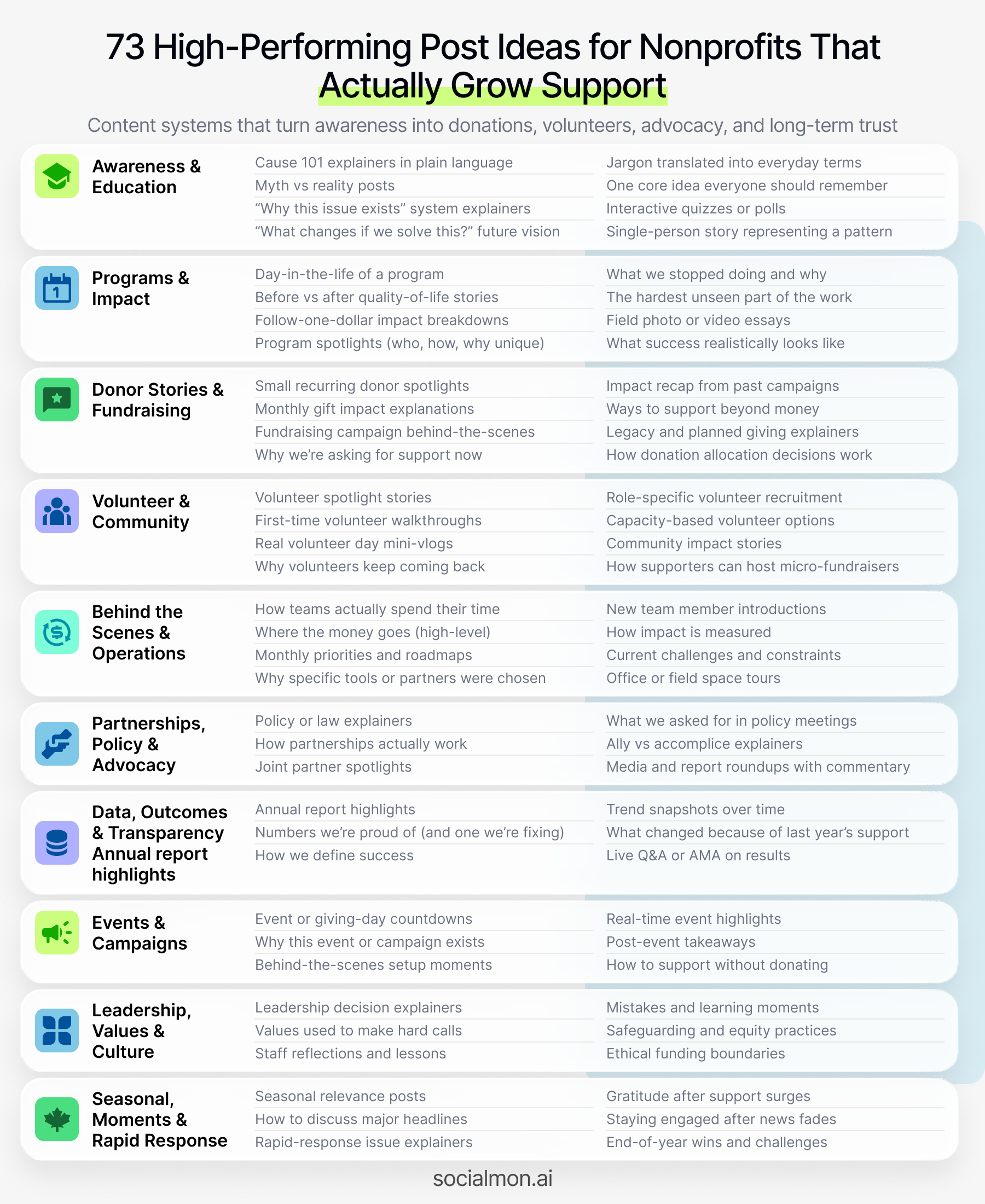
A. Awareness & Education
- Cause 101 explainer thread or carousel in plain language
- "Myth vs reality" post about a common misconception in your issue area
- "Why this issue exists" historical or systemic context explainer
- "What would actually change if we solved this?" future-casting post
- Glossary of jargon in your field translated into everyday terms
- "If you only remember one thing about our cause, let it be this" post
- Interactive quiz or poll testing assumptions about your issue
- Short "story of one person" that represents a bigger pattern (anonymized as needed)
- "Where your city / country stands on this issue right now" snapshot
B. Programs & Impact
- "A day in the life" inside one specific program
- Before/after story focused on quality of life, not just numbers
- "Follow one dollar" breakdown from donation to on-the-ground impact
- Program spotlight showing who it serves, how it works, and what's unique
- "What we no longer do (and why)" evolution of your programs over time
- "The hardest part of this work that most people never see" honesty post
- Photo essay or reel from the field with short, impactful captions
- "Here's what success looks like in this program" with realistic milestones
- Longer-form case study packaged into a social-friendly carousel or thread
C. Donor Stories & Fundraising
- Spotlight on a small recurring donor and why they give
- "What your monthly gift actually makes possible" breakdown
- Behind-the-scenes of a fundraising campaign in progress
- "Why we're asking for support right now" context post for a specific drive
- Portfolio of impact from the last campaign with gratitude message
- "Ways to support beyond money" post highlighting advocacy, skills, and networks
- Explainer on legacy / planned giving in friendly, non-jargony language
- "How we decide where your donation goes" allocation explainer
D. Volunteer & Community
- Volunteer spotlight with their story and what they've learned
- "What to expect at your first volunteer shift" step-by-step guide
- Mini-vlog of a real volunteer day or shift
- "We asked our volunteers: why do you keep coming back?" roundup
- Volunteer recruitment post targeted to a specific skill or role
- "Different ways to volunteer depending on your capacity" ladder of engagement
- Community story highlighting someone served or impacted (consent-aware)
- "How to host your own micro-fundraiser or awareness event" guide
E. Behind the Scenes & Operations
- "How we actually spend our week" staff day-in-the-life or time breakdown
- "Where the money goes" pie chart with clear, simple categories
- "What's on our plate this month" roadmap of priorities
- "Why we chose this tool / partner / approach" operations explainer
- Introducing a new team member and their role in the mission
- "How we measure impact" overview of metrics and learning loops
- "What we're struggling with right now" transparent leadership note
- Office / field tour showing the real spaces where work happens
F. Partnerships, Policy & Advocacy
- Explainer on a key policy or law related to your cause and why it matters
- "How we work with government / schools / hospitals / partners" post
- Joint spotlight with another org or grassroots group you collaborate with
- Call-to-action explainer: how to contact representatives or decision-makers
- "What we asked for in our last meeting with policymakers" recap
- "Ally vs accomplice" style post on what real support looks like in your cause
- Roundup of media features or reports with your commentary
G. Data, Outcomes & Transparency
- Infographic turning your annual report into digestible visuals
- "Five numbers we're proud of (and one we're still working on)" post
- "How we define success in our work" with examples and nuance
- Trend snapshot: what's getting better, worse, or stuck in your issue area
- "What changed because of last year's support" year-over-year comparison
- Live Q&A or AMA about your latest results or report
H. Events & Campaigns
- Countdown series leading up to a big event or giving day
- "Why this event exists" story anchored in one person or moment
- Behind-the-scenes of setting up an event or campaign HQ
- Real-time event highlights with quotes and micro-stories
- "Couldn't attend? Here are the three takeaways that matter" recap
- "How to support the campaign even if you can't donate" ladder of actions
I. Leadership, Values & Culture
- Message from your executive director about a key decision or shift
- "The values we actually use to make hard decisions" post with examples
- Staff reflections on what working in this cause has taught them
- "Mistakes we've made and how we're learning from them" accountability note
- Equity, inclusion, or safeguarding commitments explained in practice
- "What we will and won't do for funding" ethical fundraising stance
J. Seasonal, Moments & Rapid Response
- Seasonal relevance post tying your cause to a current moment (with nuance)
- "How to talk about this headline with your kids / community" guide
- Rapid-response explainer when news breaks in your issue area
- Gratitude post after a surge of support during a crisis or campaign
- "How to stay engaged after the news cycle moves on" post
- End-of-year "wins & work still to do" reflection
Category A: Awareness & Education
Cause 101 explainer thread or carousel in plain language
What to post
A simple "start here" breakdown of your cause for someone who's vaguely supportive but confused. Think: "What is food insecurity really?", "What does 'harm reduction' mean?", "What is a shelter actually allowed to do?"
How to angle it
- Use everyday language, not internal program jargon. Write it like you'd explain it to a friend over coffee.
- Structure it around a few key questions: what, who, why it matters, how change happens, how people can help.
- End with one very low-friction next step: follow, share, sign up for updates, or save the post.
Where it fits
Instagram carousels, LinkedIn posts, Twitter/X threads, a pinned explainer on your profile, and as the "start here" block on your site.
"Myth vs reality" post about a common misconception
What to post
A side-by-side format busting 3-5 myths you hear constantly about your issue, the people you serve, or nonprofits in general.
How to angle it
- Pick myths that actually show up in donor emails, comments, or media, not straw men.
- Keep the tone firm but respectful - you're inviting people closer, not shaming them away.
- Add "What to do instead" under each reality so people feel guided, not just corrected.
Where it fits
Instagram carousels, LinkedIn, Facebook, TikTok voiceovers, and as evergreen content you resurface whenever the myth trends again.
"Why this issue exists" historical or systemic context explainer
What to post
A contextual post that shows your cause isn't about individual failures, but systems: policy, history, economics, culture.
How to angle it
- Anchor the story in a concrete example: one neighborhood, one law, one generation.
- Use simple timelines, diagrams, or metaphors to explain complex systems.
- End by connecting the dots: where your organization fits into this bigger picture - and what it can't do alone.
Where it fits
Blog posts condensed into carousels, LinkedIn thought leadership, YouTube explainers, and donor education emails.
"What would actually change if we solved this?" future-casting post
What to post
A short, hopeful vision of what a world with your mission achieved actually looks like in daily life.
How to angle it
- Focus on tangible changes: fewer eviction notices, more kids graduating, cleaner rivers, safer streets.
- Show impacts for different groups: the people you serve, neighbors, businesses, public services.
- Avoid utopian fantasy; keep it grounded in plausible shifts your work contributes to.
Where it fits
Instagram, LinkedIn, supporter newsletters, and as a rallying slide in campaign decks.
Glossary of jargon translated into everyday terms
What to post
A "no stupid questions" glossary translating 10-20 terms you use internally into plain language.
How to angle it
- Include both sector jargon ("food insecurity") and internal acronyms ("CBO", "M&E").
- For each term, answer: "What it really means for people's lives."
- Invite supporters to save the post and ask for more terms in the comments.
Where it fits
Carousels, static posts you can link in bios, onboarding emails for new donors or volunteers.
"If you only remember one thing about our cause, let it be this"
What to post
A single, sharp message that encapsulates your whole mission in one idea.
How to angle it
- Strip away internal complexity. Aim for one sentence a 12-year-old can repeat.
- Support it with 2-3 micro-stories or stats that drive it home.
- Make sure this aligns with how you speak in proposals, grants, and media.
Where it fits
Pinned social posts, your homepage hero, the closing slide of every deck.
Interactive quiz or poll testing assumptions
What to post
A short quiz: "Can you guess which of these statements is true?" or polls about people's perceptions of the issue.
How to angle it
- Use 3-5 questions max; reveal answers with context, not "gotchas."
- Treat wrong answers as an education opportunity, not a dunk.
- Include a "share this with a friend who'd be surprised by the answers" CTA.
Where it fits
Instagram Stories, TikTok, Twitter/X, LinkedIn polls, and email where readers can click choices.
Short "story of one person" representing a bigger pattern
What to post
A single person's story that illustrates the broader reality of your issue, shared in a consent-aware, dignity-first way.
How to angle it
- Avoid trauma porn and savior narratives. Focus on agency, systems, and partnership.
- Add a brief note explaining how this story reflects a larger pattern or statistic.
- Where needed, anonymize details while keeping the core intact.
Where it fits
Instagram, Facebook, newsletters, donation pages, and case-study sections of your site.
"Where your city / country stands on this issue right now" snapshot
What to post
A simple snapshot of the current state of your issue in your geography.
How to angle it
- Use 3-7 key data points with short captions; avoid overwhelming dashboards.
- Contrast "what people think" vs "what's actually happening" where relevant.
- Highlight one trend you're particularly focused on this year.
Where it fits
Annual or quarterly updates, LinkedIn, blog, reports repurposed for social.
Category B: Programs & Impact
"A day in the life" inside one specific program
What to post
A story following one program, location, or team through a typical day.
How to angle it
- Show time stamps: morning prep, core activities, follow-up, admin, debrief.
- Balance emotional moments with unglamorous reality (paperwork, logistics, travel).
- Add 2-3 quotes from staff or participants about what the program means to them.
Where it fits
Instagram Reels, TikTok, YouTube vlogs, blog posts, and grant reports repurposed for supporters.
Before/after story focused on quality of life, not just numbers
What to post
A transformation story that talks about how someone's life feels different now, not just a numeric change.
How to angle it
- Focus on everyday moments: getting to work safely, kids doing homework at a desk, fewer panic attacks, easier access to care.
- Be honest about what hasn't magically disappeared; nuance builds trust.
- Add a simple "this was made possible by..." line connecting the dots to your program and supporters.
Where it fits
Donation pages, newsletters, appeals, case-study carousels.
"Follow one dollar" breakdown from donation to on-the-ground impact
What to post
A visual and narrative journey showing what happens after someone gives.
How to angle it
- Show each step: donation → processing → allocation → program → specific output.
- Use round numbers and percentages for clarity, not forensic accounting.
- Emphasize safeguards and checks without drowning people in policy.
Where it fits
Fundraising landing pages, appeals, donor reports, and evergreen "why give" content.
Program spotlight: who it serves, how it works, what's unique
What to post
A focused overview of one program written for non-experts.
How to angle it
- Answer: who it's for, what it does, what makes it different, how people access it.
- Explain the problem it solves in one or two short, vivid scenarios.
- Include one story or quote plus one stat - not a laundry list.
Where it fits
Your website's program pages, Instagram carousels, LinkedIn posts, partner decks.
"What we no longer do (and why)" evolution over time
What to post
An honest post about activities your org has intentionally stopped or changed.
How to angle it
- Explain what you tried, what you learned, and why you shifted.
- Connect the change to impact: better outcomes, less duplication, more equity.
- This is a powerful trust-builder when you show learning, not spin.
Where it fits
Leadership updates, blogs, LinkedIn, donor emails, and "Our Approach" sections.
"The hardest part of this work that most people never see"
What to post
A candid look at the emotionally or logistically tough parts of your mission.
How to angle it
- Keep confidentiality and dignity front and centre; no voyeurism.
- Share what keeps staff going despite the hard bits: community wins, small changes, solidarity.
- Invite supporters to reflect on how they can lighten the load (advocacy, long-term support, patience).
Where it fits
Executive director letters, Instagram captions, newsletters, internal culture content.
Photo essay or reel from the field with short captions
What to post
A series of photos or clips from one location, program day, or community event.
How to angle it
- Use short, specific captions: names (where consented), places, small moments, textures.
- Avoid centering your org logo in every frame; center people and context.
- End with a reflection: what this day shows about your broader mission.
Where it fits
Instagram, Facebook, your blog, donor reports, and annual report highlights.
"Here's what success looks like in this program" with realistic milestones
What to post
An expectations-reset post defining what "good outcomes" actually are for your work.
How to angle it
- Break down stages: first contact, first small win, medium-term change, long-term aspiration.
- Explain why some indicators matter more than others - and what "partial success" looks like.
- This helps donors understand why your metrics look different from "quick fix" narratives.
Where it fits
Impact pages, grant decks, supporter education emails, carousels.
Longer-form case study, repackaged for social
What to post
A condensed version of a program evaluation or report turned into a narrative thread or carousel.
How to angle it
- Pull 3-5 key moments or findings instead of dumping data.
- Mix story, quotes, and one or two charts or visuals.
- Link to the full report for those who want to go deep.
Where it fits
LinkedIn, Twitter/X, Instagram carousels, blog, and email "deep dive" editions.
Category C: Donor Stories & Fundraising
Spotlight on a small recurring donor and why they give
What to post
A short profile of a monthly donor: who they are, how they heard of you, why they choose ongoing support.
How to angle it
- Choose relatable donors: teachers, nurses, students, parents - not just VIPs.
- Focus on their values and the story behind their decision, not the amount.
- Use consented photos or tasteful illustration if they prefer anonymity.
Where it fits
Instagram, Facebook, newsletters, your donation page, and stewardship emails.
"What your monthly gift actually makes possible"
What to post
A breakdown linking recurring gifts to concrete, ongoing activities.
How to angle it
- Use ranges instead of fixed "$X = one child" oversimplifications where possible.
- Show continuity: "keeps our helpline staffed", "funds weekly tutoring sessions", "covers monthly meds."
- Invite one-time donors to convert by showing stability and long-term planning.
Where it fits
Recurring giving pages, appeals, email automation after a first gift.
Behind-the-scenes of a fundraising campaign in progress
What to post
Live snippets from your fundraising push: planning, wall of sticky notes, answering calls, small celebrations.
How to angle it
- Show the humans doing the work, not just thermometer graphics.
- Share real emotions: nerves, excitement, gratitude, fatigue - in a grounded way.
- Add micro-updates: "We just crossed the point where we can fully fund X", "We're this close to Y."
Where it fits
Instagram Stories, TikTok, live streams, email updates during campaigns.
"Why we're asking for support right now" context post
What to post
A focused explanation of why this moment matters for giving.
How to angle it
- Anchor it in something concrete: seasonal spike in need, policy change, match funds, program expansion, crisis response.
- Make the stakes clear but avoid panic or doom; urgency + agency beats guilt.
- Clarify what happens whether you meet, exceed, or fall short of your goal.
Where it fits
Appeals, social posts linking to your campaign page, donor letters.
Portfolio of impact from last campaign with gratitude
What to post
A visual recap of what a previous fundraiser actually made possible.
How to angle it
- Mix numbers and stories: people served, locations, new services, improved quality.
- Repeat "You helped do this" in different ways; center the community, not just the org.
- Use this as a trust and retention piece, not a sneaky segue into another ask (unless you're explicit).
Where it fits
Post-campaign emails, carousels, your site, annual report teasers.
"Ways to support beyond money"
What to post
A ladder of engagement for people who can't give financially right now.
How to angle it
- Include actions at different levels: sharing, volunteering, advocacy, introductions, in-kind support, peer fundraising.
- Be explicit that non-monetary support is genuinely valuable, not consolation.
- Great way to engage younger audiences, local communities, and lapsed donors.
Where it fits
Instagram, Facebook, your "Get Involved" page, onboarding flows.
Explainer on legacy / planned giving in non-jargony language
What to post
An introduction to leaving gifts in wills, stocks, or other non-cash giving options.
How to angle it
- Keep it calm and respectful; acknowledge that these are big, personal decisions.
- Explain a few simple mechanisms and the kinds of impact they can create.
- Always direct people to seek independent legal/financial advice; stay within your remit.
Where it fits
Website giving pages, email nurturing mid- and major-donors, LinkedIn.
"How we decide where your donation goes"
What to post
A clear explanation of how you allocate unrestricted vs restricted funds.
How to angle it
- Show categories, not line items: programs, staff, operations, reserves, advocacy.
- Explain why flexible funding matters and how you safeguard against waste.
- This is especially important if you've ever been asked "How much goes to overhead?"
Where it fits
FAQ, appeals, transparency pages, and any time you talk about financial stewardship.
Category D: Volunteer & Community
Volunteer spotlight with their story and what they've learned
What to post
A focused profile of one volunteer: who they are, what they do with you, and what the experience has changed for them.
How to angle it
- Ask them to share in their own words why they started and why they stayed.
- Include one specific story or moment from their time volunteering.
- Show their humanity outside volunteering: job, hobbies, family, passions.
Where it fits
Instagram, Facebook, newsletters, volunteer recruitment pages, and internal morale-boosting Slack/Teams posts.
"What to expect at your first volunteer shift"
What to post
A step-by-step guide for nervous first-timers so they know exactly what's going to happen.
How to angle it
- Walk through arrival, check-in, orientation, tasks, breaks, closing, and debrief.
- Name the small details: what to wear, where to store bags, who to ask for help.
- Include friendly photos or short clips of real volunteers and staff.
Where it fits
Onboarding emails, website volunteer pages, Instagram carousels, and as a link in confirmation texts.
Mini-vlog of a real volunteer day or shift
What to post
A short, honest video following one volunteer through a shift.
How to angle it
- Capture tiny, real moments: putting on a name tag, packing boxes, greeting someone, cleaning up.
- Overlay text or narration explaining what's happening and why it matters.
- Show how staff support volunteers and check in on how they're doing.
Where it fits
TikTok, Instagram Reels, YouTube Shorts, and Stories highlights.
"We asked our volunteers: why do you keep coming back?"
What to post
A compilation of short quotes from different volunteers answering the same question.
How to angle it
- Keep each quote short and specific: "I see my neighbors differently now," "This was the first time I felt useful after retiring."
- Spread representation: ages, backgrounds, roles, lengths of service.
- Close with a simple invitation: "If you see yourself in any of these, we'd love to meet you."
Where it fits
Carousels, static quote graphics, newsletters, volunteer recruitment campaigns.
Volunteer recruitment post targeted to a specific skill or role
What to post
A role-specific call: grant writer, driver, translator, social media helper, board committee member.
How to angle it
- Describe the problem this role helps solve, not just the tasks.
- Specify time commitment, location, and any training you provide.
- Make it easy to raise a hand: short form, clear contact, low-friction "interested?" step.
Where it fits
LinkedIn (for skilled roles), Instagram, Facebook, volunteer platforms, email lists.
"Different ways to volunteer depending on your capacity"
What to post
A menu of options from one-off, low-commitment actions to deeper, ongoing roles.
How to angle it
- Use time-based sections: 10 minutes, 1 hour a month, 3 hours a week, etc.
- Include remote-friendly options where possible.
- Make it clear that capacity fluctuates and people are welcome to move between levels.
Where it fits
Website "Get Involved" page, carousels, volunteer onboarding, new supporter welcome emails.
Community story highlighting someone served or impacted
What to post
A story centered on someone who has been directly impacted by your work, shared with care and consent.
How to angle it
- Ask them what parts of their story they're comfortable sharing and what they want people to understand.
- Focus on agency and partnership, not just hardship.
- Add a short note about how supporters made this work possible.
Where it fits
Appeals, social posts, newsletters, events, annual reports.
"How to host your own micro-fundraiser or awareness event"
What to post
A how-to guide for supporters who want to mobilize their own communities.
How to angle it
- Offer a few clear formats: birthday fundraiser, community potluck, run/walk, workplace awareness talk.
- Include a simple checklist: pick a date, set a goal, get a link, share, thank.
- Provide branded assets or a "starter kit" they can request or download.
Where it fits
Website resources, email to engaged supporters, carousels, LinkedIn.
Category E: Behind the Scenes & Operations
"How we actually spend our week"
What to post
A realistic breakdown of how your team spends its time across programs, admin, fundraising, and learning.
How to angle it
- Use simple charts or time-block visuals instead of dense schedules.
- Highlight tasks people rarely see: reporting, safeguarding checks, training, coordination.
- This helps donors understand why "overhead" is part of doing good work safely.
Where it fits
Annual report content, LinkedIn, carousels, donor education emails.
"Where the money goes" pie chart
What to post
A clean visualization of how funds are used across your main categories.
How to angle it
- Keep category labels intuitive: "Direct support," "Community organizing," "Team & operations," "Fundraising & outreach."
- Pair the chart with short explanations and one example per category.
- Consider showing trends over time (e.g., increasing investment in community leadership).
Where it fits
Donation pages, transparency sections, appeals, annual reports.
"What's on our plate this month"
What to post
A snapshot of the key projects, deadlines, and priorities you're juggling.
How to angle it
- Keep it to 5-10 items max, grouped by theme (programs, advocacy, internal).
- Mention both visible activities (events) and invisible ones (training, evaluation).
- This makes your org feel alive and focused, not abstract.
Where it fits
Monthly newsletter, Instagram or LinkedIn post, internal updates repurposed for supporters.
"Why we chose this tool / partner / approach"
What to post
An explainer of a strategic choice - for example, moving to case management software, partnering with a local cooperative, or adopting a specific model.
How to angle it
- Describe the problem you were trying to solve and options you considered.
- Explain how this choice will help the community and your team, not just your efficiency.
- Acknowledge trade-offs and what you'll keep watching as you implement.
Where it fits
LinkedIn, blog, transparency stories, updates to major donors and partners.
Introducing a new team member and their role
What to post
A warm introduction to someone joining your staff, board, or advisory group.
How to angle it
- Share their background, what they'll focus on, and what excites them about the mission.
- Include a fun fact or personal detail to humanize them.
- Show how their role connects to supporter impact.
Where it fits
Instagram, LinkedIn, newsletters, your website's team page.
"How we measure impact"
What to post
An approachable overview of your monitoring, evaluation, and learning approach.
How to angle it
- Explain what you track and why: outputs, outcomes, community feedback, long-term signals.
- Talk about how you collect data ethically and avoid extractive practices.
- Share one example where data led you to change something.
Where it fits
Impact pages, donor reports, grant decks, explainer carousels.
"What we're struggling with right now"
What to post
An honest note about a challenge - capacity, policy, funding gap, community need - and how you're navigating it.
How to angle it
- Be specific and solution-oriented, not hopeless.
- Share what you're trying, what you're unsure about, and where supporters can help.
- This kind of vulnerability builds deep trust when done thoughtfully.
Where it fits
Executive letters, newsletters, LinkedIn, major donor conversations.
Office / field tour showing real spaces
What to post
A visual tour of your office, clinic, shelter, warehouse, or field sites.
How to angle it
- Show the spaces where people gather, work, rest, store supplies, and meet clients.
- Use captions to explain what happens in each space and why it matters.
- Don't over-polish; authenticity beats glossy stock aesthetics.
Where it fits
Instagram Reels, TikTok, Stories highlights, website "About" pages.
Category F: Partnerships, Policy & Advocacy
Explainer on a key policy or law related to your cause
What to post
A clear, non-partisan breakdown of one policy, bill, or regulation and its real-life implications.
How to angle it
- Answer: What is it? Who does it affect? What would change if it passes or doesn't?
- Avoid partisan jabs; stick to impacts aligned with your mission.
- Offer a simple "What you can do" section (calls, emails, staying informed, joining events).
Where it fits
LinkedIn, Twitter/X, Instagram carousels, long-form blog posts, advocacy emails.
"How we work with government / schools / hospitals / partners"
What to post
An overview of how you collaborate with institutions and other organizations.
How to angle it
- Clarify roles: what you do, what they do, and what you do together.
- Share one story where a partnership led to better outcomes than you could have achieved alone.
- Mention how you choose partners and protect your values.
Where it fits
Website partnership pages, LinkedIn, proposals, onboarding decks for new partners.
Joint spotlight with another org or grassroots group
What to post
A shared post featuring a partner org, especially those closer to the community or with complementary strengths.
How to angle it
- Highlight what they do exceptionally well and how supporters can follow or support them too.
- Reflect on what you're learning from the partnership.
- This demonstrates humility and ecosystem thinking, not empire-building.
Where it fits
Instagram, Twitter/X, LinkedIn, newsletters, joint campaigns.
Call-to-action explainer: how to contact decision-makers
What to post
A step-by-step guide for contacting representatives, school boards, city councils, or other decision-makers.
How to angle it
- Provide simple scripts and key points in accessible language.
- Explain what staffers look for in messages and how volume matters.
- Clarify any rules you must follow as a nonprofit in your jurisdiction around lobbying; stay compliant.
Where it fits
Action alerts, Stories, email blasts, campaign landing pages.
"What we asked for in our last meeting with policymakers"
What to post
A recap of a recent advocacy meeting and what you requested.
How to angle it
- Share who was in the room, at a high level, and what you raised.
- Explain how community voices informed your asks.
- Outline next steps and how you'll follow up or keep pressure on.
Where it fits
LinkedIn, blog, advocacy emails, updates to coalition partners and donors.
"Ally vs accomplice" style post on real support
What to post
A values-driven post differentiating symbolic support from meaningful action in your cause.
How to angle it
- Offer concrete examples of performative vs substantive actions.
- Keep the tone inviting but clear about what's needed.
- Point to 2-3 specific behaviors your community can adopt.
Where it fits
Instagram, LinkedIn, education-focused newsletters, internal culture workshops repurposed outward.
Roundup of media features or reports with your commentary
What to post
A curated list of recent articles, reports, or news where your issue shows up.
How to angle it
- Add 1-2 lines of commentary per link: what it gets right, what's missing, why it matters.
- Center your community's perspective, not just institutional voices.
- This positions you as a go-to explainer and curator.
Where it fits
Newsletters, LinkedIn posts, Twitter/X threads, website "In the news" pages.
Category G: Data, Outcomes & Transparency
Infographic turning your annual report into digestible visuals
What to post
A set of visuals summarizing key highlights from your annual or impact report.
How to angle it
- Select 5-10 metrics that best illustrate reach, depth, and equity, not just big numbers.
- Mix numbers with tiny human stories or quotes.
- Invite people to read the full report and share one surprise.
Where it fits
Instagram, LinkedIn, your website, donor updates, print materials.
"Five numbers we're proud of (and one we're still working on)"
What to post
A candid look at progress with one area where you're not yet where you want to be.
How to angle it
- Choose numbers that connect to real outcomes, not vanity metrics.
- For the "still working on" number, explain what you're trying and why it's hard.
- This blend of celebration and humility is powerful for long-term trust.
Where it fits
Annual reflections, mid-year updates, LinkedIn, newsletters.
"How we define success in our work"
What to post
A values and metrics post that explains what "winning" looks like from your perspective.
How to angle it
- Include qualitative indicators: community leadership, policy shifts, lived experience feedback.
- Be explicit about what you don't count as success - e.g., superficial numbers without depth or equity.
- This helps align expectations with funders and supporters.
Where it fits
Impact pages, strategic plan announcements, grant decks repurposed for public audiences.
Trend snapshot: what's getting better, worse, or stuck
What to post
A simple trend analysis over a few years or seasons.
How to angle it
- Group into "better", "worse", and "unchanged" with 1-2 data points each.
- Explain why you think each trend is happening and what you're doing in response.
- Encourage supporters to see their role in accelerating the good trends.
Where it fits
Blog, LinkedIn, carousels, annual meetings, supporter briefings.
"What changed because of last year's support"
What to post
A year-on-year comparison focused on change, not just activity.
How to angle it
- Use a "last year vs this year" format: reach, depth, quality, infrastructure.
- Tie major shifts directly to supporter actions: donations, advocacy, volunteering.
- Include one story that embodies the change.
Where it fits
Annual emails, thank-you campaigns, social posts around giving seasons.
Live Q&A or AMA about your latest results or report
What to post
An interactive session where leadership or program staff answer questions about your impact.
How to angle it
- Invite questions ahead of time to seed the conversation.
- Be ready to answer tough ones about trade-offs, failures, and equity.
- Record and repurpose clips as short videos, reels, or FAQs.
Where it fits
Instagram Live, Facebook Live, YouTube, Zoom town halls, followed by cutdowns on other channels.
Category H: Events & Campaigns
Countdown series leading up to a big event or giving day
What to post
A short series of posts building anticipation and explaining why the event matters.
How to angle it
- Each piece should add something new: a story, a speaker, a goal, a behind-the-scenes glimpse.
- Include practical details repeatedly: when, where, how to join, access needs.
- Use simple, consistent visual branding so people recognize the series.
Where it fits
Instagram, Facebook, X, LinkedIn, email sequences.
"Why this event exists" story anchored in a moment or person
What to post
A narrative about the origin and purpose of your event or campaign.
How to angle it
- Anchor it in a vivid anecdote: a community meeting, a crisis, a gap you noticed.
- Connect the story to what you hope this year's event will achieve.
- Invite people to see themselves in the story as participants, not just spectators.
Where it fits
Event landing pages, carousels, launch emails, pitch decks to sponsors.
Behind-the-scenes of setting up an event or campaign HQ
What to post
Short clips of staff and volunteers preparing: packing materials, rehearsing, setting up rooms, testing tech.
How to angle it
- Lean into the human chaos and care: last-minute fixes, checklists, coffee runs.
- Use captions to show the scale of work supporters rarely see.
- Thank volunteers and partners by name (with consent).
Where it fits
Stories, Reels, TikTok, LinkedIn "inside the org" posts.
Real-time event highlights with quotes and micro-stories
What to post
Live coverage during the event: photos, short videos, quotes, small moments.
How to angle it
- Capture not just stages and speeches but audience reactions, hallway conversations, quiet corners.
- Share quick reflections from participants about why they came and what they're taking away.
- These posts also act as social proof for future events.
Where it fits
Stories, live-tweeting / live-posting, Facebook, LinkedIn, recap reels.
"Couldn't attend? Here are the takeaways that matter"
What to post
A concise recap focused on insights and outcomes, not FOMO.
How to angle it
- Share 3-7 key ideas, decisions, or next steps that emerged.
- Link to replays or materials where relevant.
- Invite people to the next opportunity to join or contribute.
Where it fits
Email, LinkedIn, carousels, blog posts.
"How to support the campaign even if you can't donate"
What to post
A list of non-monetary ways to boost your campaign while it's running.
How to angle it
- Include actions like sharing, starting a peer fundraiser, volunteering, inviting friends, offering pro bono skills.
- Give specific templates or prompts people can copy.
- Emphasize that generosity looks different for everyone and all forms matter.
Where it fits
Mid-campaign posts, Stories, email, pinned posts on your fundraiser pages.
Category I: Leadership, Values & Culture
Message from your executive director about a key decision or shift
What to post
A personal, accountable message explaining a major change: new strategy, program pivot, leadership transition.
How to angle it
- Be transparent about the "why," including constraints and listening you've done.
- Address likely supporter questions directly.
- Share how you'll know if the change is working and how people can give feedback.
Where it fits
Email, blog, LinkedIn, your website's news section, town hall follow-up posts.
"The values we actually use to make hard decisions"
What to post
A values-in-action post, not just a list of words.
How to angle it
- Share 3-5 values and one real decision each value shaped.
- Be honest about tensions between values (e.g., speed vs participation).
- Invite your community to hold you to these standards.
Where it fits
Website, strategic plan launches, Instagram, internal culture docs repurposed for external audiences.
Staff reflections on what the work has taught them
What to post
Short reflections from staff at different levels and roles.
How to angle it
- Ask them: "What has surprised you?" "What have you learned from the community?"
- Keep reflections short and thoughtful; avoid centering staff as heroes.
- This humanizes your team and shows a culture of learning.
Where it fits
Instagram carousels, LinkedIn, newsletters, staff appreciation campaigns.
"Mistakes we've made and how we're learning from them"
What to post
A carefully considered accountability post about missteps and course corrections.
How to angle it
- Choose examples where you have made concrete changes, not open wounds you're still processing.
- Center those affected and what you heard from them, where appropriate.
- Share new policies or practices you've implemented.
Where it fits
Blogs, leadership emails, LinkedIn, community forums.
Equity, inclusion, or safeguarding commitments explained in practice
What to post
A practical breakdown of how you protect participants, staff, and volunteers.
How to angle it
- Explain key policies in plain language: consent, privacy, reporting, anti-harassment.
- Share how people can raise concerns and what happens when they do.
- Make it clear that these commitments are ongoing, not one-time declarations.
Where it fits
Website, onboarding materials, carousels, pinned posts in community spaces.
"What we will and won't do for funding"
What to post
Your stance on ethical fundraising, sponsorship, and partnerships.
How to angle it
- Name sectors, conditions, or activities you avoid and why.
- Explain the types of restrictions you will accept and those you won't.
- This helps supporters understand trade-offs and trust your judgment.
Where it fits
Funding pages, grant decks, donor conversations, LinkedIn thought leadership.
Category J: Seasonal, Moments & Rapid Response
Seasonal relevance post tying your cause to a current moment
What to post
A post explaining how your issue intersects with a season, holiday, or recurring moment.
How to angle it
- Avoid opportunistic leaps; choose genuinely relevant connections (heat waves, school year, elections, holidays that strain families).
- Offer both education and practical steps tailored to the season.
- Be sensitive to communities for whom this season is especially hard.
Where it fits
Instagram, Facebook, Twitter/X, email, blog.
"How to talk about this headline with your kids / community"
What to post
A conversation guide for supporters grappling with difficult news related to your cause.
How to angle it
- Provide simple, age-appropriate language and questions.
- Emphasize listening and validation over having all the answers.
- Suggest small actions families or groups can take together.
Where it fits
Blog posts repurposed as carousels, email, Instagram, Facebook.
Rapid-response explainer when news breaks
What to post
A concise, calm explainer in response to major developments impacting your community.
How to angle it
- Clarify what happened, what's known/unknown, and what it means for your context.
- Avoid speculation; link to trusted sources.
- Share how your org is responding and how supporters can act or stay informed.
Where it fits
Twitter/X, LinkedIn, Instagram, email alerts, website banners.
Gratitude post after a surge of support during a crisis or campaign
What to post
A heartfelt thank-you after a wave of donations, volunteers, or attention.
How to angle it
- Name what people did and how it felt on your side (relief, hope, capacity).
- Share how you're being careful and strategic with the resources received.
- Set expectations for future updates so people know the story continues.
Where it fits
All major channels, especially where the surge came from (platform-specific thanks).
"How to stay engaged after the news cycle moves on"
What to post
A guide for long-term engagement once headlines fade.
How to angle it
- Suggest commitments over time: recurring gifts, local organizing, policy follow-up, ongoing learning.
- Explain how your work continues between crisis spikes.
- This is where you invite people into deeper relationship, not just momentary reaction.
Where it fits
Newsletters, blog, Instagram, LinkedIn, Twitter/X.
End-of-year "wins & work still to do" reflection
What to post
A yearly reflection mixing celebration with realism.
How to angle it
- Group into: things that changed, things that held steady, and things that worry you.
- Thank specific groups (donors, volunteers, partners, staff, community leaders).
- Offer one clear invitation for the coming year.
Where it fits
December / fiscal year-end emails, blog, social posts, annual meetings.
Turning these ideas into a repeatable nonprofit content engine
You don't need to execute every format above. You need a simple system that:
- Keeps your mission visible and understandable
- Builds trust through honesty and specificity
- Makes it easy for the right people to take the next step
1. Choose 3-5 pillars for the next quarter
For example:
- Awareness & Education: Awareness & Education, Partnerships & Policy
- Programs & Trust: Programs & Impact, Data & Transparency, Behind the Scenes & Operations
- Support & Community: Donor Stories & Fundraising, Volunteer & Community, Events & Campaigns, Leadership & Culture
Make those your "lanes" and plan most posts inside them, instead of chasing every trend.
2. Turn 5-7 formats into named series
For example:
- "Program Tuesday" - a weekly look at one aspect of your programs or impact
- "Volunteer Voices" - regular volunteer quotes or mini-stories
- "Impact in Numbers" - recurring data snapshots with context
- "Behind the Work" - ops, decisions, and learning in public
- "Action This Week" - a single, clear action your community can take
Naming these series makes planning easier for you and more predictable for your audience.
3. Attach each post to one clear next step
Before you hit publish, ask:
"If someone cares about this, what is the most natural next step?"
Examples:
- Follow or subscribe
- Share with a friend or colleague
- Sign up to volunteer or attend an event
- Start or increase a recurring gift
- Join a campaign action or advocacy moment
Tiny, consistent calls to action compound into donations, volunteers, partnerships, and policy wins.
When you're ready to move from generic formats to proven posts in your exact space - animal welfare, climate justice, youth development, mental health, housing, arts, disability, or anything else - use Socialmon to search your niche, your peers, and leading nonprofits. You'll see real posts that already work across Instagram, LinkedIn, TikTok, Facebook, email, and more, so you can adapt what's effective instead of guessing from scratch.



Get 50 viral posts for your niche (free)