60 Ecommerce Social Media Post Ideas That Drive Sales

Ecommerce brands don't struggle with posting. They struggle with posting things that reliably turn scrollers into shoppers, and first-time buyers into repeat customers.
Looking across thousands of high-performing posts, the content that actually moves revenue for ecommerce brands tends to do three things:
- Make a very specific customer feel seen in their everyday context
- Show the product solving a real, concrete problem or desire
- Back that up with credible proof so buying feels like the obvious next step
This guide gives you a structured library of formats you can plug into your content calendar, brief agencies or creators on, and adapt across Instagram, TikTok, Facebook, email, and your own site-without starting from a blank page every week.
How to use this guide (so it actually drives revenue)
1. Pick your primary objective for the next 30-90 days
Most ecommerce brands are focused on one of these at any given time:
- Driving new customer acquisition
- Improving onsite conversion and AOV
- Increasing repeat purchase rate and subscription retention
- Launching a new product, collection, or market
Anchor your use of this guide on that objective.
2. Get painfully specific about who you're talking to
The more specific you are, the better these formats perform:
- Role or identity: new mom, college student, sneakerhead, cyclist, home cook
- Context: tiny apartment, busy commute, sensitive skin, plus-size fashion
- Constraints: budget, time, storage, shipping region
Rewrite each idea in the language and situations your best customers actually use.
3. Choose 2-3 content "pillars" from the categories below
Examples:
- DTC beauty brand: Product Story & Education, Social Proof & UGC, Offers & Urgency
- Premium homeware brand: Lifestyle & Content Marketing, Brand & Founder, Social Proof
- Subscription snack box: Acquisition & Awareness, Retention & Post-purchase, Email & SMS
Stick to those pillars for a few months so your content feels coherent, not random.
4. Turn winning formats into named series
A single "how to style this" reel is noise. A weekly "Ways To Wear It Wednesday" is a habit.
Name your series, design a consistent visual treatment, and treat it like a product: review performance, iterate, and retire what's not working.
5. Pair these formats with real-world inspiration
Use Socialmon to search your niche (e.g. "jewelry brand", "gut health supplements", "pet supplies") and see how top brands execute similar formats. Save, tag, and adapt what's clearly working instead of guessing.
Master list of high-performing ecommerce post ideas (by category)
Below is the full library of post formats, grouped into meaningful buckets. You can adapt these across social, email, ads, and even your PDPs and onsite content.
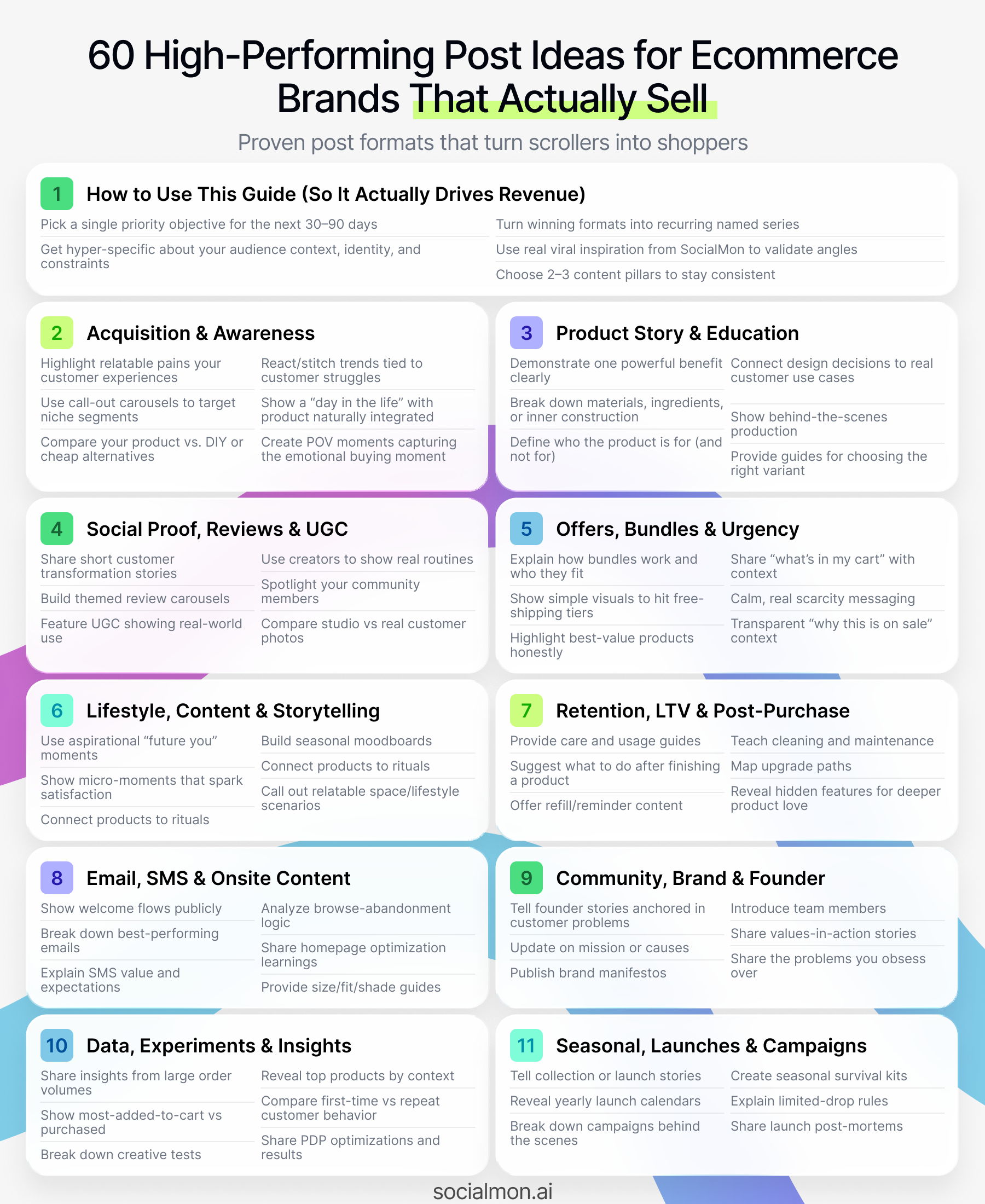
A. Acquisition & Awareness
- Problem-aware "relatable pain" reel about life before your product
- "If you are X, this is for you" call-out carousel targeting a niche customer
- Side-by-side comparison: your product vs common DIY or cheap alternative
- Reaction or stitch to a trending sound that perfectly fits your customer's struggle
- "Day in the life" with your product woven into real routines
- "Things I wish I knew earlier" list that naturally leads to your product
- POV / first-person skit showing the exact moment someone decides to buy
- "You've probably seen this all over your feed, here's why" meta explainer about your hero product
B. Product Story & Education
- Deep-dive product demo video focused on one hero feature or benefit
- "What's actually inside" breakdown (ingredients, materials, craftsmanship)
- "Who this product is and isn't for" honest fit guide
- "Designed for..." post that connects design choices to specific use cases
- "How it's made" behind-the-scenes of production or sourcing
- "How to choose the right one" guide across variants, sizes, or flavors
- "From unboxing to first use" onboarding walkthrough
- "Most common questions about this product" FAQ carousel or reel
C. Social Proof, Reviews & UGC
- Short customer story with a clear before/after outcome
- Review highlight carousel sorted by theme (quality, comfort, customer service)
- UGC roundup of customers using the product in the wild
- Creator or influencer "how I actually use this" breakdown
- "Customer of the week" or "community spotlight" feature
- Side-by-side of studio photo vs real customer photo to build trust
- "We asked our customers to describe us in 3 words" collage post
- "Screenshots that made our day" compilation of DMs, emails, and mentions
D. Offers, Bundles & Urgency (Without Feeling Spammy)
- "Build your own bundle" explainer with best-performing combos
- Simple visual breakdown of how to hit free shipping or discount tiers
- "Best value in the store right now" honest recommendation post
- "What's in my cart" transparent breakdown from founder or team member
- "Last chance / almost gone" low-inventory spotlight (with real stock)
- "Why this is on sale" context post that explains clearance or promos
- "Bundle vs buying separately" value comparison
- "Subscriber-only perks" teaser that nudges toward subscription or loyalty
E. Lifestyle, Content & Storytelling
- "Your future self will thank you" aspirational lifestyle vignette
- "Micro-moments" series showing tiny, satisfying uses of your product
- "If your [room/closet/fridge] looks like this..." call-out post
- Seasonal moodboard featuring your products in context
- "How it fits into your rituals" morning, evening, weekend series
- "Starter kit for people who love..." curated set across your catalog
- "What our team is currently obsessed with" authentic recommendations
- "How to style / pair / serve this" content that makes usage feel easy
F. Retention, LTV & Post-Purchase
- "You bought X, here's how to get the most from it" care/use guide
- "What to do once you've finished this" re-order or next-step suggestions
- "Refill or repurchase reminder" framed as a helpful checklist
- "How to store, clean, or maintain this so it lasts longer" tutorial
- "Upgrade path" content showing good → better → best options
- "What our long-time customers do differently" habits that increase value
- "Milestone" celebration posts for loyalty tiers or number of orders
- "You might not know this yet..." hidden features or uses that deepen love
G. Email, SMS & Onsite Content
- "Welcome flow in public" series showing what new subscribers receive
- "Anatomy of our best-performing email" breakdown
- "Here's what you'll get if you join text updates" preview post
- "Browse abandonment" email explained and shown (with redactions)
- "Our homepage before and after optimization" story
- "Quiz or finder flow" walkthrough that matches people to products
- "Size / fit / shade guide" that reduces returns and hesitation
- "Live shopping or drop page" behind-the-scenes and replay recaps
H. Community, Brand & Founder
- Founder origin story anchored in a specific customer problem
- "Problems we obsess over solving" brand point-of-view post
- "What we believe about [category]" manifesto
- "Meet the team" profiles that connect faces to the brand
- "Values in action" story where you made a hard call (e.g. pulled a product)
- Cause or mission update showing impact of donations or initiatives
- "How we handle customer mistakes" (wrong address, late changes)
- "Open inbox" AMA where founder answers questions from comments
I. Data, Experiments & Insights
- "What we learned from shipping to X customers" insights
- "Most-added-to-cart but not purchased" items and what you changed
- "We tested these 3 creatives, here's what won and why"
- "Top products by season / climate / region" data visualization
- "What first-time vs repeat customers buy differently" breakdown
- "We changed this one thing on our PDP..." experiment recap
- "The story behind our returns data and what we fixed"
- "Our packaging tests" (unboxing time, damage, experience) recap
J. Seasonal, Launches & Campaigns
- "Collection story" for a new drop tied to a theme or season
- "Behind this launch calendar" peek at how you plan promos in a year
- "How we built this campaign" creative and strategy breakdown
- "Holiday survival kit" style bundles and content
- "Limited drop rules" explainer (how to access, how many, when)
- "Customer planning guide" for big retail moments (BFCM, Mother's Day)
- "Collab story" with another brand or creator
- "Post-mortem" on a big launch: what worked, what didn't, what's next
Category A: Acquisition & Awareness
Problem-aware "relatable pain" reel
Use this when your audience feels the frustration your product solves but isn't actively shopping yet.
What to post: A short, punchy reel showing a painfully familiar scenario: overflowing closet but "nothing to wear", tangled charging cables, leaky meal prep containers, etc.
How to angle it:
- Open on an ultra-specific moment: "You're already late and your favorite shirt is still damp..."
- Exaggerate the pain just enough to be funny, not dramatic.
- Reveal your product as the "of course" solution in the last 2-3 seconds, without over-explaining.
Where it fits: Top-of-funnel paid and organic on TikTok, Reels, Shorts, and as hooks for cold ad audiences.
"If you are X, this is for you" call-out carousel
This is your segmentation work turned into content.
What to post: A bold first slide calling out a very specific customer ("If you're a size-inclusive shopper who hates returns...") followed by slides that map your product directly to their reality.
How to angle it:
- Use the language your customers use about themselves ("tall girl problems", "curly hair gang").
- Show 2-3 scenarios that prove you understand their life, then show the product woven naturally in.
- Close with a simple nudge: "Save this for later" or "Tap to see all options in your size."
Where it fits: Instagram feed, LinkedIn for B2B-ish products, Pinterest pins.
Side-by-side comparison vs DIY or cheap alternative
Your real competition is usually "what they're already doing".
What to post: A visual comparison between your product and the common workaround: drugstore version, fast fashion, Amazon basics, or a hack.
How to angle it:
- Compare on outcomes: longevity, comfort, health, time saved-not only price.
- Be fair: acknowledge when the cheaper option is fine for some situations.
- Use clear icons for "wins" and "trade-offs" so it's skimmable.
Where it fits: PDP content, blog posts, LinkedIn, carousel ads.
Reaction or stitch to a trending sound
Great when you want reach without inventing a totally new concept.
What to post: A stitch or reaction where a trending sound or meme perfectly captures your buyer's struggle or transformation.
How to angle it:
- Start from the insight ("shopping for jeans is emotionally draining") and find trends that fit, not the other way around.
- Use on-screen text to connect the trend to your product's role.
- Keep branding subtle: logo, packaging, or product in hand is enough.
Where it fits: TikTok, Reels, Shorts; often becomes strong creative for top-of-funnel ads.
"Day in the life" with your product
Let people see themselves using what you sell.
What to post: A vlog-style video following a realistic customer archetype using your product throughout their day.
How to angle it:
- Focus on 3-5 small but meaningful moments: first coffee, commute, workout, desk setup, evening routine.
- Overlay text like "this mug keeps my coffee warm for 90 minutes" or "this planner helps me close my laptop at 7pm."
- Avoid overly polished influencer vibes unless that matches your brand; slightly raw tends to convert.
Where it fits: Organic social, whitelisted creator ads, PDP video sections.
"Things I wish I knew earlier" list
Perfect for products that fix annoying but accepted problems.
What to post: A reel or carousel with lines like "Things I wish I knew before buying cheap non-stick pans..." that naturally leads into your product as the better alternative.
How to angle it:
- Make each point a mini punch-in-the-gut insight ("You're supposed to replace pillows every 1-2 years").
- Share 1-2 tips that apply even if they don't buy today, to build trust.
- Introduce your product as the "shortcut" rather than the only way.
Where it fits: Instagram, TikTok, email content that warms up cold subscribers.
POV / first-person skit at the moment of purchase
You're dramatizing the decision, not just the product.
What to post: A POV video from the customer's perspective as they scroll, hesitate, compare, and then finally buy.
How to angle it:
- Use inner monologue captions ("Okay...but will this actually look good on me?").
- Address objections in the script ("Wait, free returns? Okay, add to cart").
- End on the emotional payoff: relief, excitement, feeling taken care of.
Where it fits: Reels, TikTok, ads aimed at warm audiences.
"You've probably seen this all over your feed, here's why" explainer
Great when you have a hero product or viral SKU.
What to post: A meta-style post acknowledging the buzz and explaining the real reason it resonates.
How to angle it:
- Share the original problem you set out to solve.
- Reveal design decisions or ingredients that aren't obvious in photos.
- Sprinkle in quick quotes or screenshots from real customers.
Where it fits: Social, blog, email launch sequences, advertorial-style landing pages.
Category B: Product Story & Education
Deep-dive product demo focused on one benefit
Avoid the "everything it can do" trap.
What to post: A short video or carousel that zeros in on one powerful benefit (e.g., "how our pan makes cleanup take 30 seconds").
How to angle it:
- Show the painful before, then the effortless after.
- Use close-up shots and real-time demos.
- End with a call to action tied to that benefit ("If you hate scrubbing, this was made for you").
"What's actually inside" breakdown
Especially strong for beauty, wellness, food, and home products.
What to post: A breakdown of ingredients, materials, or construction, with simple explanations.
How to angle it:
- Translate jargon into human outcomes ("Hyaluronic acid = plumper, more hydrated skin").
- Call out what's not inside as well (no fillers, no toxic dyes, etc.), if true.
- Use visuals (callouts, x-ray views, simple icons) so it's easy to grasp.
"Who this product is and isn't for" fit guide
Clarity reduces returns and increases trust.
What to post: A frank explainer of ideal-fit and bad-fit customers.
How to angle it:
- Describe real behaviors, not demographics ("If you air-dry everything and hate ironing, this fabric is for you").
- Be honest about where your product might disappoint.
- Suggest alternatives in your catalog if this isn't the best match.
"Designed for..." post connecting features to use cases
Turn features into stories.
What to post: A breakdown of key design decisions and which customer scenarios they were built for.
How to angle it:
- For each design choice, explain "we did X because customers told us Y."
- Use photos or diagrams that highlight the detail (stitching, zippers, compartments).
- Close with, "If you often [scenario], this will feel like a relief."
"How it's made" behind-the-scenes
Great for premium price points and ethical positioning.
What to post: A visual tour of your supply chain: factory shots, artisans, farms, labs.
How to angle it:
- Show the people and places behind the product.
- Explain trade-offs (why you chose slow production, more expensive materials, smaller batches).
- Tie it back to benefits: better fit, durability, safety, impact.
"How to choose the right one" guide
Perfect for catalogs with variants (sizes, scents, colors).
What to post: A decision helper that walks people through picking their variant.
How to angle it:
- Start with "If you are the type of person who..." and map to options.
- Use real customer language ("I want something subtle", "I'm always cold").
- Turn it into a saved resource you can link from PDPs and FAQs.
"From unboxing to first use" walkthrough
Reduce post-purchase friction and pre-purchase anxiety at once.
What to post: A step-by-step video or carousel showing exactly what happens from package arrival to first use.
How to angle it:
- Include realistic small frictions and how you've smoothed them out (easy-open packaging, quick-start guide).
- Call out any first-use quirks ("It may smell slightly of X at first, that fades in Y hours").
- Share this both pre-purchase (to reduce hesitation) and post-purchase (to ensure success).
"Most common questions about this product" FAQ
Turn support tickets into conversion assets.
What to post: A carousel or reel where each frame tackles a FAQ.
How to angle it:
- Pull directly from support emails and chat transcripts.
- Answer in a friendly, honest tone, not legalese.
- Pin or highlight this content on your product page or profile.
Category C: Social Proof, Reviews & UGC
Short customer story with clear outcome
Specific beats grandiose.
What to post: A tight narrative: who they are, what they bought, what changed.
How to angle it:
- Include numbers when you can ("sleeps 45 minutes longer", "cut food waste by 30%").
- Use their photos or videos, not just your own.
- Make it scannable: one quote in bold, one key image, one CTA.
Review highlight carousel
Your best reviews should live beyond the review widget.
What to post: A curated set of reviews arranged by theme.
How to angle it:
- Group slides like "Comfort", "Customer Service", "Fit & Sizing", etc.
- Add a small note under each review: which product, which variant, which size.
- Re-surface older but powerful reviews; most followers haven't seen them.
UGC roundup
Show your products in the real world.
What to post: A collage or multi-slide post featuring customer photos and videos.
How to angle it:
- Curate around a theme: pets, small spaces, travel, weddings, etc.
- Tag or credit customers (with permission); this drives more UGC.
- Invite followers to share their own photos for the next roundup.
Creator or influencer "how I actually use this" breakdown
Depth over pure reach.
What to post: A creator walking through the product's role in their routine.
How to angle it:
- Ask them to show specific use cases, not just hold the product up.
- Include any tweaks or "hacks" they discovered on their own.
- Repurpose snippets as ads, PDP video, and email content.
"Customer of the week" or "community spotlight"
Recognition is retention.
What to post: A simple spotlight on a customer's story and how they use your brand.
How to angle it:
- Share who they are and what they care about, beyond the purchase.
- Let them share one tip for other customers.
- Make it a recurring, branded series people look forward to.
Studio vs real customer photos
A trust-building contrast.
What to post: Side-by-side images of the same product in studio vs real life.
How to angle it:
- Show diversity in body types, homes, lighting, and styling.
- Make it clear that the real-life photos are from actual customers.
- Use captions to address "Will it look like this on me/in my home?" directly.
"We asked customers to describe us in 3 words"
Let your buyers do the positioning.
What to post: A collage of short phrases customers used to describe your brand.
How to angle it:
- Pull from reviews, NPS, surveys, and DMs.
- Highlight surprising or emotionally strong words.
- Tie those words back to the way you design products and policies.
"Screenshots that made our day"
Support and DMs are gold mines for content.
What to post: A collage of heartwarming or funny messages from customers.
How to angle it:
- Redact personal info but keep their voice intact.
- Add a human caption from your team reacting to each one.
- Use it to spotlight team members who resolved issues or went above and beyond.
Category D: Offers, Bundles & Urgency
"Build your own bundle" explainer
Bundles are confusing until someone spells them out.
What to post: A post that explains how your bundle builder or curated sets work.
How to angle it:
- Show 2-3 recommended bundles for different personas or budgets.
- Explain the savings plainly, without math gymnastics.
- Encourage experimentation: "Swap X for Y if you prefer..."
Simple visual to hit free shipping or discount tiers
Help people do what they already want: maximize value.
What to post: A visual ladder: "At $X you get..., at $Y you get..."
How to angle it:
- Use real product examples to show what adding one more thing looks like.
- Avoid pushing purely for AOV; emphasize sensible adds.
- Reuse it in cart pages, emails, and story highlights.
"Best value in the store right now"
Honesty here builds a lot of goodwill.
What to post: A clear recommendation on which products currently offer the best value (because of promo, bundle, or built-in use frequency).
How to angle it:
- Explain why, in simple terms.
- Don't only feature the highest price point; include at least one affordable pick.
- Use this when you run promos on truly high-value items you want more people to try.
"What's in my cart" breakdown
Familiar, but still effective when done with real taste.
What to post: A founder, team member, or creator showing what they personally would buy today and why.
How to angle it:
- Tie each item to a context ("hosting friends", "travel kit", "Sunday reset").
- Mix hero products with under-loved gems.
- Encourage viewers to comment with their own cart combos.
"Last chance / almost gone" spotlight
Scarcity works best when it's real and calm.
What to post: A post highlighting products that are genuinely low in stock or being discontinued.
How to angle it:
- Show actual remaining quantities or "few left in [sizes]".
- Explain whether/when it will be restocked.
- Use soft language ("If you've been eyeing this, now's the time") instead of panic.
"Why this is on sale" context post
Transparency beats random discounting.
What to post: A behind-the-scenes explanation for specific markdowns: end of season, over-ordered, slight packaging change, etc.
How to angle it:
- Reassure on quality and warranties.
- Mention if these items are ever coming back at full price or not.
- Use this to avoid cheapening your brand while still moving inventory.
"Bundle vs buying separately" comparison
Help shoppers feel clever, not tricked.
What to post: A simple breakdown of bundle vs individual pricing and benefits.
How to angle it:
- Include non-monetary benefits: coordinated colors, full routine, complete kit.
- Show both options so people feel in control, not railroaded.
- Make this shareable for people planning gifts together.
"Subscriber-only perks" teaser
Push subscription or loyalty in a value-led way.
What to post: A post detailing what members or subscribers get beyond a discount.
How to angle it:
- Focus on convenience and experience: early access, surprise items, priority support.
- Share real examples: member-only flavors, limited colors, secret drops.
- Use it alongside actual subscriber testimonials.
Category E: Lifestyle, Content & Storytelling
"Your future self will thank you" vignette
Anchor on identity and aspiration.
What to post: A short story or reel showing future-you enjoying the payoff of using your product consistently.
How to angle it:
- Focus on feelings: calmer mornings, more confident outfits, easier hosting.
- Show small, achievable changes rather than wild transformations.
- Close with "This is for the you who..." to make it personal.
"Micro-moments" series
Capture the small joys that build brand love.
What to post: A recurring series of tiny, satisfying uses: the first sip, perfect drawer organization, that one click of a clasp.
How to angle it:
- Keep clips under 3-5 seconds; lean into ASMR where relevant.
- Use consistent framing and music so the series is instantly recognizable.
- Make them extremely shareable-no hard sell needed.
"If your [space] looks like this..."
The call-out that feels like a friend, not a critique.
What to post: A visual of a messy/overstuffed/underutilized closet, pantry, desk, or shelf that your product helps fix.
How to angle it:
- Avoid shaming; keep the tone "same, I've been there".
- Show a realistic, achievable "after", not a Pinterest fantasy.
- Offer tips that are useful even without buying.
Seasonal moodboard with your products in context
Help people imagine your products in their world.
What to post: A moodboard-style collage of colors, textures, and scenes with your products integrated.
How to angle it:
- Build around occasions: cozy fall evenings, beach weekends, exam season.
- Mention how specific products play a role in that scene.
- Use as a visual anchor for seasonal campaigns across channels.
"How it fits into your rituals" series
Habits are where retention lives.
What to post: Posts mapping your products onto morning, evening, weekly, or monthly rituals.
How to angle it:
- Go beyond generic "morning routine"-make it niche (work-from-home Mondays, Sunday reset).
- Show the order of operations so it's easy to copy.
- Invite customers to share their own rituals for future features.
"Starter kit for people who love..."
Curate your own store.
What to post: A 3-6 item "starter kit" for personalities or interests (plant parents, home bar lovers, anxious sleepers).
How to angle it:
- Explain why each item earns its place in the kit.
- Offer a kit discount or bundle where it makes sense.
- Use kits to introduce new customers to your broader catalog.
"What our team is currently obsessed with"
Human recommendations sell.
What to post: A team-wide roundup of current favorite products or combos.
How to angle it:
- Include names, roles, and one real-life anecdote per pick.
- Mix evergreen staples with new/seasonal products.
- Keep it visually consistent so it can become a recurring monthly post.
"How to style / pair / serve this"
Remove friction between desire and use.
What to post: Short styling, pairing, or serving tutorials.
How to angle it:
- Offer easy and advanced options ("lazy version" vs "extra version").
- Include shoppable links or SKUs used in the example.
- Save these in story highlights and on PDPs to overcome "I wouldn't know how to wear/use it."
Category F: Retention, LTV & Post-Purchase
"You bought X, here's how to get the most from it"
Make sure first-time buyers become happy users.
What to post: A care and usage guide tailored to a specific product.
How to angle it:
- Cover what to do on day 1, week 1, and month 1.
- Include tips only insiders know ("don't do this, it shortens lifespan").
- Cross-link this from order confirmation pages and emails.
"What to do once you've finished this"
Turn endings into new beginnings.
What to post: A post about what happens when the product is used up or worn in.
How to angle it:
- Suggest a repurchase cadence ("Most customers re-order every 6 weeks").
- Introduce upgrades or complementary products.
- Include sustainability or reuse ideas where appropriate.
"Refill or repurchase reminder" content
Better than a generic "buy again" email.
What to post: A soft reminder framed as a helpful checklist ("If you're noticing X, Y, Z, it's time to restock").
How to angle it:
- Tie the reminder to observable signals, not just time.
- Mention any incentives for subscribers or bulk buys.
- Keep tone friendly, not pushy.
"How to store, clean, or maintain this"
Show you care about the product's full life.
What to post: Maintenance instructions that feel like insider tips, not chores.
How to angle it:
- Include dos and don'ts with visual examples.
- Explain how proper care preserves performance and appearance.
- Turn it into a resource link from PDPs and packaging.
"Upgrade path" content
Help loyal customers level up.
What to post: A guide that maps "you're here now → next step" across your catalog.
How to angle it:
- Show clear reasons to move up (capacity, performance, materials).
- Avoid making current purchases feel inadequate; frame it as evolution.
- Bundle upgrade recommendations into loyalty tier perks.
"What long-time customers do differently"
Turn retention behavior into advice.
What to post: A post summarizing the habits and setups of high-LTV customers.
How to angle it:
- Translate behaviors into simple tips ("Keep one at home and one in your bag").
- Back up with anonymized data where possible.
- Use this to encourage more engaged use of your product.
Loyalty milestone celebrations
Make repeat purchases feel special.
What to post: Templates for celebrating 3rd/5th/10th order, subscription anniversaries, or loyalty tiers.
How to angle it:
- Emphasize gratitude and shared journey.
- Offer a small perk or surprise where feasible.
- Encourage customers to share their milestone graphics.
"You might not know this yet..." hidden features or uses
Delight existing customers.
What to post: A reveal of lesser-known features, combos, or use cases.
How to angle it:
- Position it as "insider secrets" for people who already bought.
- Encourage experimentation and sharing of results.
- Use it when you see engagement plateau on core use cases.
Category G: Email, SMS & Onsite Content
"Welcome flow in public"
Show the value of joining your list.
What to post: A peek at the first few emails or texts a new subscriber gets.
How to angle it:
- Highlight useful content (guides, tips, early access) over discounts.
- Blur sensitive data but show real subject lines and previews.
- Use this to drive more sign-ups from social and onsite.
"Anatomy of our best-performing email"
Turn performance into authority.
What to post: A breakdown of a high-converting campaign email.
How to angle it:
- Call out subject line, hero image, offer framing, and CTA.
- Share the story behind it: why you sent it, who it went to.
- For B2B-ish brands, this doubles as content marketing; for consumers, it reassures that you respect inboxes.
"Here's what you'll get if you join text updates"
Reduce anxiety around SMS spam.
What to post: A simple preview of the types of texts you send and how often.
How to angle it:
- List message types: shipping updates, drop alerts, early access, helpful reminders.
- Clarify that they can opt out anytime and how.
- Share a screenshot of a favorite recent text.
"Browse abandonment" email explained
Make your lifecycle marketing feel thoughtful.
What to post: A semi-educational post showing a browse abandonment email and why it looks the way it does.
How to angle it:
- Emphasize the helpfulness: restocking info, size guidance, styling tips.
- Show what you deliberately don't do (spam, guilt).
- Use this in growth/brand content and with other founders too.
Homepage before-and-after optimization
Your store is content.
What to post: A comparison of your old vs new homepage with commentary.
How to angle it:
- Explain changes from the customer's POV: easier navigation, clearer value.
- Include rough performance metrics if available (CTR, time on site).
- Use to reintroduce your brand to lapsed followers.
Quiz or product finder flow
Matching is persuasion.
What to post: A walkthrough of a quiz or finder that pairs people with the right products.
How to angle it:
- Show 3-5 questions and the reasoning behind each.
- Highlight example results and the logic.
- Push people to "take the quiz in our bio" with a clear promise.
Size / fit / shade guide content
A major lever for reducing returns.
What to post: Visual guides that demystify fit or shade decisions.
How to angle it:
- Use real bodies and skin tones, not just illustrations.
- Give practical advice ("If you're between sizes and prefer looser, choose...").
- Make this highly shareable and easy to find from every relevant PDP.
Live shopping or drop page recap
Extend the life of your live campaigns.
What to post: Highlights from a live sale or special drop page.
How to angle it:
- Show best moments, top products, and how people interacted.
- Share quick stats (viewers, sell-outs, questions answered).
- Invite followers to join the next live with a calendar link or reminder.
Category H: Community, Brand & Founder
Founder origin story anchored in a customer problem
Emotion is a conversion lever.
What to post: A story about the moment you realized the brand needed to exist.
How to angle it:
- Describe a specific scene: the failed product experience, the conversation, the frustration.
- Tie that moment to design or policy choices today.
- Keep it focused on the customer's life, not your ego.
"Problems we obsess over solving"
Clarify your brand thesis.
What to post: A list of gnarly, specific problems you wake up thinking about.
How to angle it:
- Make each one vivid ("Your jeans fit in the thighs but dig into your waist").
- Show how your current product line does or doesn't fully solve them yet.
- Invite customers to share their versions in the comments.
"What we believe about [category]"
Your POV is brand gravity.
What to post: A short manifesto about your category (skincare, sleep, cookware, etc.).
How to angle it:
- Contrast your beliefs with common industry shortcuts.
- Avoid vague values; keep it concrete.
- Pin or highlight this so new followers see it early.
"Meet the team" profiles
People buy from people.
What to post: Short introductions to team members across functions.
How to angle it:
- Share what each person actually does for customers.
- Include a product they love and why.
- Keep tone casual and human.
"Values in action" story
Values matter most when they cost something.
What to post: A story where you made a non-obvious choice aligned with your values (e.g., recalling a product, refusing a cheap supplier).
How to angle it:
- Explain the decision, trade-off, and what you lost in the short term.
- Share the long-term benefits or relief you feel now.
- Use it to reinforce why your prices or policies are the way they are.
Cause or mission update
Especially relevant if you donate or partner with causes.
What to post: A transparent update about impact created so far.
How to angle it:
- Use numbers and stories, not just "% of profits" statements.
- Show photos or quotes from partners or communities impacted (with consent).
- Clarify your plans for the next phase, even if modest.
"How we handle customer mistakes"
Trust-building through empathy.
What to post: A policy explainer about mishaps: wrong address, wrong size, late returns.
How to angle it:
- Share your philosophy ("We assume good intent").
- Give examples of how you've helped customers in tricky situations.
- Be clear on limits so you don't over-promise.
"Open inbox" AMA with the founder
Turn curiosity into connection.
What to post: An open invitation to ask anything about the brand, products, or strategy.
How to angle it:
- Seed a few example questions for inspiration.
- Answer in public and save highlights.
- Use questions as prompts for future posts and product decisions.
Category I: Data, Experiments & Insights
"What we learned from shipping to X customers"
Your scale is a perspective advantage.
What to post: A roundup of patterns you've seen across orders.
How to angle it:
- Focus on practical insights customers can use.
- Example: storage tips, most-used combos, seasonality quirks.
- Respect privacy and keep everything aggregate.
"Most-added-to-cart but not purchased"
A peek at buyer hesitation.
What to post: A post about products that get carted but not bought.
How to angle it:
- Share what you suspect is causing hesitation (sizing, use case confusion, price).
- Explain changes you're making (photos, copy, bundles).
- Invite feedback from people who hesitated.
"We tested these creatives, here's what won"
Show you're learning, not guessing.
What to post: A breakdown of a creative test: hooks, angles, formats.
How to angle it:
- Share both the winner and loser and why you think it went that way.
- Highlight what this means for what followers will see more of.
- For other founders, this is growth content; for customers, it shows you listen to behavior.
"Top products by season / climate / region"
Help people copy others like them.
What to post: Lists or maps of bestsellers by context.
How to angle it:
- "Rainy climates love...", "City apartments buy...", "Summer bestsellers..."
- Explain why those patterns make sense.
- Suggest products based on where your follower lives or their lifestyle.
"First-time vs repeat customers buy differently"
Interesting for customers and other operators.
What to post: A comparison of what new vs returning customers gravitate toward.
How to angle it:
- Use this to recommend "next products" for existing buyers.
- Share how it influenced your merchandising or bundles.
- Keep it high-level; avoid sharing anything that feels invasive.
"We changed this one thing on our PDP..."
Micro-experiments make great stories.
What to post: An explanation of a single change you made to your PDPs or checkout and its impact.
How to angle it:
- Show before and after layouts or copy.
- Share high-level performance changes if you can.
- Tie it back to removing friction for the customer.
"The story behind our returns data"
Return patterns are opportunity maps.
What to post: A post about what your returns have taught you.
How to angle it:
- Share top reasons for returns and what you've done to address them.
- Explain any major policy shifts you made.
- Reinforce that you want people to genuinely love what they buy.
"Our packaging tests"
Unboxing as an experiment.
What to post: A recap of packaging experiments (sustainability, size, inserts, protection).
How to angle it:
- Show different versions and why you iterated.
- Share what customers said about unboxing and storage.
- Use it to reinforce your brand's priorities (eco, premium feel, reusability).
Category J: Seasonal, Launches & Campaigns
"Collection story" for a new drop
Turn launches into narratives, not just announcements.
What to post: The story behind a new collection tied to a season, mood, or cultural moment.
How to angle it:
- Explain the inspiration and constraints (fabric availability, production timelines).
- Show sketches, swatches, or early prototypes.
- Tie pieces to specific occasions to make them instantly usable.
"Behind this launch calendar"
Let people see how the sausage is made.
What to post: A high-level look at how you plan launches and promos across a year.
How to angle it:
- Share categories of drops (evergreen, seasonal, collabs).
- Explain why you avoid constant discounts or why you cluster launches.
- Invite followers to tell you which moments they'd love product for.
"How we built this campaign"
Great for standout campaigns you're proud of.
What to post: A deconstruction of a specific campaign's creative, messaging, and channels.
How to angle it:
- Show initial ideas, concepts you killed, and what you chose.
- Share how customers responded and what surprised you.
- Highlight collaborators (photographers, stylists, creators).
"Holiday survival kit" style bundles
Seasonal utility sells.
What to post: Bundles curated for specific seasonal needs (travel, gifting, hosting, exams).
How to angle it:
- Make the kit genuinely useful on its own.
- Provide usage ideas and checklists.
- Use this format to drive both AOV and discoverability across your catalog.
"Limited drop rules" explainer
Avoid chaos when things genuinely are scarce.
What to post: Clear guidelines on how a limited drop or restock will work.
How to angle it:
- Specify timing, quantity, and any limits per person.
- Share why it's limited (capacity, fairness, rarity).
- Encourage people to set reminders or join lists instead of refreshing endlessly.
"Customer planning guide" for retail moments
Build trust by planning with customers, not just at them.
What to post: A guide helping customers navigate big retail events like BFCM or Mother's Day.
How to angle it:
- Include your promos-but also general tips (budgeting, timelines, avoiding panic buys).
- Suggest shopping early for specific categories.
- Encourage thoughtful purchasing, even when it means buying less.
"Collab story" with another brand or creator
Explain why collabs make sense.
What to post: The narrative behind a collaboration: why them, why now, why this product.
How to angle it:
- Highlight overlapping values and audiences.
- Show the design process and any compromises.
- Share what each party brought to the table.
Launch post-mortem
Close the loop on big pushes.
What to post: A candid reflection on a major launch or season: what worked, what didn't.
How to angle it:
- Share a few metrics, but focus on learnings.
- Celebrate customers who participated (photos, stories).
- Hint at how you'll apply these insights to future drops.
Turning these ideas into a repeatable ecommerce content engine
You don't need to execute every format above. You need a small, reliable content engine that aligns with your goals.
A simple way to operationalize this:
- Choose 3-5 categories as your pillars for the next quarter.
- Turn 5-7 formats into named series (e.g., "Cart Confessions", "Future Self Fridays", "How We Actually Use It").
- Map formats to funnel stages:
- Awareness: Acquisition & Awareness, Lifestyle & Storytelling
- Consideration: Product Story & Education, Social Proof & UGC, Data & Insights
- Purchase & LTV: Offers & Bundles, Email & Onsite, Retention & Post-purchase
For each campaign, launch, or promo:
- Pick one awareness format to pull in new eyes
- Pick one consideration format to answer objections
- Pick one purchase/LTV format to nudge a clear next step
When you're ready to move from generic formats to proven posts in your exact niche, search your product category, price point, or competitors in Socialmon. You'll see how top ecommerce brands are already using these ideas across Instagram, TikTok, email, and more-so you can adapt what's winning instead of reinventing the wheel.



Get 50 viral posts for your niche (free)