58 Fintech Social Media Post Ideas That Actually Convert
Fintech lives in a tricky space: you're asking people to trust you with their money, data, and in many cases, their long-term financial wellbeing.
Your social content has to do a lot of heavy lifting at once:
- Clarify complex products in plain language (APYs, KYC, card networks, FX fees, custody, compliance).
- Build serious trust (security, regulation, licenses, partners) without sounding dry or bureaucratic.
- Differentiate your product in an increasingly crowded marketplace of wallets, neobanks, BNPLs, robo-advisors, and SaaS billing tools.
- Drive specific outcomes: app installs, funded accounts, card activation, deposits, portfolio creation, or product usage.
The fintech brands that win on social don't just post nice UI shots of their app. They:
- Explain how they actually make money-and where the catch isn't.
- Translate regulation and security into human-friendly confidence.
- Give real-life money scenarios, not just generic "financial literacy tips."
- Share customer wins and usage patterns in a way that feels relatable, not braggy.
- Align content tightly with funnel stages-from awareness ("what is this?") to activation ("how do I actually use this?") and retention ("how do I get more value out of this?").
Instead of guessing formats and topics, you can shortcut this by studying what's already working in your exact niche: card issuers, B2B payments, consumer investing, SaaS billing, payroll, crypto, insurtech, and more.
That's exactly what a marketing inspiration vault like Socialmon is built for: marketers can capture real, public, high-performing posts (carousels, LinkedIn threads, emails, landing pages), organize them into boards by niche and goal, and search them later with AI-powered search.
The rest of this article gives you a structured library of post ideas tailored for fintech companies, plus execution notes you can adapt to your own brand and channels.
Master list of high-performing post ideas for fintech companies
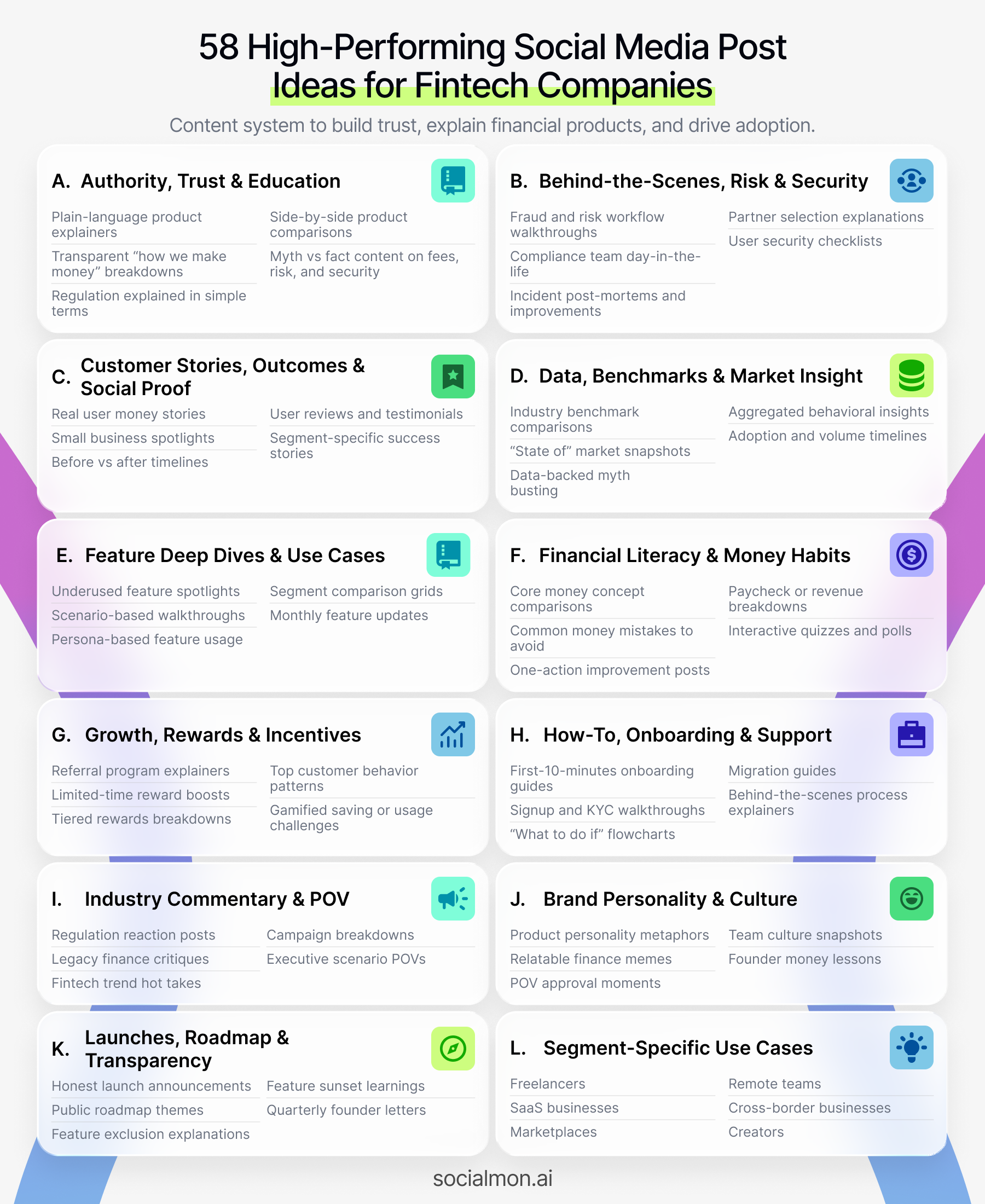
Below is the full list of 58 post ideas, grouped into meaningful themes. Category names are arranged alphabetically.
A. Authority, Trust & Education
- Plain-language explainer of a core product (e.g., "How our zero-fee card actually works")
- "How we make money" transparent revenue breakdown
- Side-by-side comparison of key products (you vs status quo vs competitor)
- "What this scary-sounding regulation actually means for you" breakdown
- Myth vs fact series on fees, interest, risk, or security
B. Behind-the-Scenes, Risk & Security
- Walkthrough of your fraud-detection or risk engine (non-technical)
- "A day in the life" of your compliance or risk team
- Incident post-mortem (minor issue, major transparency) and what you improved
- How you choose partners (banks, custodians, processors) and why it matters
- Security checklist for users (2FA, PIN, device hygiene) featuring your features
C. Customer Stories, Outcomes & Social Proof
- "Money story" from a real user (e.g., reduced FX fees, faster payouts)
- Small business customer spotlight with numbers and narrative
- Before/after timeline of a company that switched from legacy finance
- Screenshots of user love (tweets, reviews, emails) compiled into carousels
- "How we helped this segment" story (freelancers, creators, exporters, etc.)
D. Data, Benchmarks & Market Insight
- Industry benchmark post (fees, time-to-settle, churn, approval rates)
- "State of X" infographic (e.g., "State of SME payments in 2025")
- Data-driven busting of a common money misconception
- Behavioral insights from your user base (aggregated, anonymized)
- Timeline chart of adoption, volume, or money moved (with clear context)
E. Feature Deep Dives & Use Cases
- "This one feature you're underusing" spotlight with examples
- Scenario-based walkthrough ("Travelling abroad? Here's how to use us step by step")
- "3 ways to use [feature] depending on your situation" (beginner / intermediate / power user)
- Feature comparison grid for target segments (solo, SMB, enterprise)
- "What we shipped this month" feature changelog in human language
F. Financial Literacy & Money Habits
- Simple "X vs Y" money concept post (e.g., APR vs APY, interest vs inflation)
- "Money moves to avoid this year" list tailored to your audience
- "If you only do one thing this month..." tiny money action post
- Paycheck or revenue breakdown post with better allocation suggestions
- Interactive quiz or poll about money literacy with follow-up explanation
G. Growth, Rewards & Incentives
- Referral program explainer with real examples and math
- Limited-time boost (higher rewards, reduced fees) with clear terms
- Tiered rewards chart showing how to unlock better benefits
- "What our top customers do differently" retention-focused tips
- Gamified challenge (e.g., "No FX fee month" or "Savings streaks")
H. How-To, Onboarding & Support
- "First 10 minutes" guide for new users (swipeable checklist)
- Video walkthrough of signing up and passing KYC smoothly
- "What to do if..." flowcharts (card lost, transfer stuck, charge dispute)
- "How to switch from your old provider" migration step-by-step
- "What happens after you tap 'Submit'?" behind-the-scenes onboarding
I. Industry Commentary & Point of View
- Reaction to a new regulation or policy with practical implications
- "The real problem with legacy [banks/payments/expense tools]" POV post
- "Hot takes" carousel on trending fintech topics (BNPL, crypto, AI in finance)
- Breakdown of a popular fintech campaign and what you'd copy/adapt
- "If we were CFO/Head of Ops at X, here's what we'd fix first" scenario post
J. Just-for-Fun, Relatable & Brand Personality
- "If our products were money personalities" archetype post
- Relatable memes about dealing with banks, fees, or budgeting
- "POV: you just got approved in 60 seconds instead of 6 weeks" short video
- Office/remote culture snapshots with subtle product presence
- Founder's personal money mistake and what they'd do differently now
K. Launches, Roadmap & Transparency
- Honest launch announcement for a new feature with clear beta scope
- Public roadmap snapshot with themes (security, speed, usability)
- "Why we're not building X (yet)" transparency post
- "What we learned from shutting down / killing this feature" story
- Quarterly "letter" from the founder or CEO with product + business update
L. Segment-Specific & Vertical Use Cases
- "For freelancers: how to stop losing money to fees and delays"
- "For SaaS: how to reduce involuntary churn with better payments"
- "For marketplaces: making instant payouts work safely"
- "For remote teams: smarter payroll and expense control"
- "For cross-border businesses: real total cost of money movement"
- "For creators: separating business money from personal money without pain"
A. Authority, Trust & Education
Authority content helps prospects answer two questions fast: "Is this legit?" and "Do they know what they're doing?" For fintech, this is non-negotiable.
Plain-language explainer of a core product
Pick one product (card, wallet, account, line of credit, trading feature) and explain:
- Who it's for
- What problem it solves
- How it works in 3-5 plain-English bullets
- What it does not do (to avoid misaligned expectations)
Format it as a carousel, short LinkedIn post, or vertical video. Avoid jargon like "multi-tenant ledger" unless you unpack it. End with a small, specific CTA: "Try it on your next international trip" or "Turn it on in Settings in 30 seconds."
"How we make money" transparent revenue breakdown
Trust skyrockets when users feel like they know where your incentives are:
- Show all your revenue streams (interchange, subscription fees, FX spread, etc.).
- Highlight where you don't earn (no hidden overdraft, no penalty fees).
- Use diagrams (pie charts or flow diagrams) instead of walls of text.
This is especially powerful in consumer fintech, BNPL, and brokerage-spaces where users are skeptical about hidden catches.
Side-by-side comparison of key products
Comparisons work well if you:
- Choose a realistic "status quo" (traditional bank, manual process, spreadsheet + bank).
- Include you, a typical competitor, and/or the status quo.
- Compare on what matters: speed, transparency, total cost, support, control-not vanity metrics.
Make sure the comparison is fair and clearly labeled ("Example for a typical SME with $X monthly volume").
"What this scary-sounding regulation actually means for you"
Take a headline that's worrying your customers (e.g., new KYC rules, PSD2 changes, tax rules):
- Translate the headline into "what changes for you in real life."
- Clarify what you are doing to stay compliant.
- Explain what users need to do (if anything) and by when.
This type of content gets shared in internal channels (Slack, WhatsApp) by your users to reassure their stakeholders.
Myth vs fact series on fees, interest, risk, or security
Pick common misconceptions:
- "Zero-fee always means free."
- "Higher interest rate is always better."
- "Fintech apps are less safe than banks."
Present each as "Myth" vs "Fact" plus a one-line explanation and (if needed) a link to a deeper explainer. It's a good recurring series that cements your voice as a guide, not a hype machine.
B. Behind-the-Scenes, Risk & Security
Most users never see what's under the hood. Showing your rigor (without oversharing sensitive details) builds serious trust.
Walkthrough of your fraud-detection or risk engine
You don't need to show code or proprietary models. Instead:
- Explain inputs: what signals you look at (unusual device, location, transaction pattern).
- Explain actions: what happens when something looks off (temporary hold, notification, extra verification).
- Explain philosophy: how you balance "fast and smooth" with "safe and careful."
Visuals: flows, decision trees, or animated sequences walking through a suspicious transaction being caught and resolved.
"A day in the life" of compliance or risk team
Humanize the people protecting your users:
- Introduce 1-2 team members with name, role, and simple description of their day.
- Show them reviewing alerts, aligning with product, or discussing regulation updates.
- Emphasize the "care" aspect-not just policing.
This reassures both retail users and more sophisticated B2B buyers who care about governance.
Incident post-mortem and what you improved
If you had a minor incident (e.g., brief outage, delays, false positive fraud block), be transparent:
- What happened (in everyday language, no downplaying)
- Who was affected and for how long
- What you've already done and what you will do next to avoid repeat issues
Handled well, these posts increase trust rather than damage it. They also demonstrate maturity and strong operations.
How you choose partners (banks, custodians, processors)
Explain why your partner selection matters:
- Criteria you use (stability, capital, regulatory status, experience).
- What your bank/custodian actually does for the user behind the scenes.
- How this setup impacts user funds' safety and service reliability.
For B2B or institutional audiences, you can go a bit deeper (e.g., mentioning tier-1 partners, licensure).
Security checklist for users featuring your features
Create a checklist:
- Turn on 2FA / biometrics.
- Enable transaction alerts.
- Set card controls (limits, regions, categories).
- Keep your app and OS updated.
Show how each is done inside your product with annotated screenshots or short clips. This doubles as education and product usage content.
C. Customer Stories, Outcomes & Social Proof
Done well, customer stories show "people like me used this and it worked," which is much more persuasive than generic claims.
"Money story" from a real user
Focus on a specific outcome:
- A freelancer who stopped losing money to FX and ATM fees.
- An SME who shortened their cash conversion cycle.
- A marketplace that reduced payout delays and support tickets.
Structure:
- Who they are (segment, size, country; anonymize if needed).
- The "before": pain, process, metrics.
- The "after": what changed, quantified where possible.
- The journey: what features they used and in what order.
Avoid making yourself the sole hero-share credit with the customer's decisions and discipline.
Small business customer spotlight
Choose a compelling business from your niche:
- Explain what they do and where they're based.
- Show their money flows (incoming, outgoing, FX, payroll, etc.).
- Explain how your product fits into their workflow.
Include photos or short video of their business in action. This performs very well on LinkedIn and Instagram.
Before/after timeline of switching from legacy finance
Make a timeline:
- Month 0: manual workflows, delays, hidden fees.
- Month 1-2: implementation, teething issues, early wins.
- Month 3-6: steady-state results.
Plot metrics like time-to-close books, payment failure rates, or average time-to-cash. Context is crucial-don't just drop impressive percentages without baselines.
Screenshots of user love compiled into carousels
Collect:
- Tweets, LinkedIn comments, app store reviews, email snippets.
- Organize them into themes (support, speed, clarity, peace of mind).
- Pair each with a short "what this means" caption.
These are perfect for retargeting ads and top-of-funnel credibility.
"How we helped this segment" story
Pick one segment:
- Creators
- Exporters
- Remote-first teams
- Micro-SMEs
Tell a composite story (or anonymized real one) about how they use your product differently than others and what outcomes they get. This lets potential customers self-identify and see your tool as "for them."
D. Data, Benchmarks & Market Insight
Fintech has a natural advantage here: you sit on a lot of aggregated, anonymized data. Turn some of that into content (within legal and privacy limits).
Industry benchmark post
Share benchmarks relevant to your ICP, e.g.:
- Average payout time for similar businesses.
- Typical card acceptance rates by region.
- Typical SaaS churn for their category vs those who improve billing.
Present as:
- "Here's where most companies like you sit."
- "Here's where our best-performing customers sit."
- "Here are practical steps to move from A → B."
This makes your content screenshot-worthy and shareable in internal decks.
"State of X" infographic
Once or twice a year, produce a "State of..." post for:
- SMB cashflow.
- Cross-border transfer patterns.
- Retail investing behavior (by age, experience).
- Expense management trends.
Keep it high-level and visually clean. Reuse the same format annually so people start expecting it.
Data-driven busting of a common money misconception
Use your data to gently correct common beliefs, e.g.:
- "Most SMEs assume FX fees are their biggest leak. Data shows late payments are worse."
- "People think they 'splurge' once a month. Transaction data says otherwise."
Offer 2-3 practical moves to correct the issue.
Behavioral insights from your user base
Without being creepy:
- Aggregate and anonymize behavior patterns (e.g., "Users who set budgets in week 1 are X% more likely to still be active after 6 months.").
- Share what "healthy usage" looks like.
- Offer tips to move towards that pattern.
This type of content makes you feel like a financial partner, not just an app.
Timeline chart of adoption, volume, or money moved
Show a metric with context:
- "In the last 12 months, our customers collectively moved $X across Y countries."
- "Payment failure rates dropped from X% to Y% after we launched [feature]."
Always include:
- Timeframe.
- Conditions (e.g., sample size or segment).
- Why this matters to the user (faster payouts, fewer support tickets, better sleep).
E. Feature Deep Dives & Use Cases
These posts bridge the gap between "cool product" and "I know exactly how to use this for my situation."
"This one feature you're underusing"
Pick a feature your power users love but most users ignore:
- Virtual cards for subscriptions.
- Multi-currency accounts.
- Spending rules or budgets.
- Auto-savings or round-ups.
Show:
- Use cases for 2-3 different personas.
- How to enable it in <60 seconds.
- A mini before/after scenario ("Instead of manually cancelling forgotten subscriptions, just...").
Scenario-based walkthrough
Example: "Travelling abroad with us for the first time?"
- Step-by-step: add card to wallet, check FX rate, set ATM limit, freeze card if lost.
- Include screenshots of actual flows.
- Add small "pro tips" (turn on notifications, double-check fee-free ATM networks).
This kind of scenario content works as a saved post users will revisit at the airport.
"3 ways to use [feature] depending on your situation"
Segment by:
- Risk tolerance (conservative / balanced / aggressive).
- Business size (solo / small team / larger team).
- Tech level (non-technical / ops-savvy / data-heavy).
For each, show a simple, concrete setup using your feature.
Feature comparison grid for target segments
Instead of generic feature lists, show:
- Column = segment (e.g., "Solo founder", "10-50 person SME", "Enterprise finance team").
- Row = feature category (cards, controls, reporting, automation).
Highlight which features matter most to which segment. This helps prospects self-qualify and reduces "does this work for us?" friction.
"What we shipped this month" changelog in human language
Once a month:
- Show 3-7 updates.
- Summarize each in one sentence of plain English.
- Add a short "what this means for you" line.
This works well across email, LinkedIn, and in-app notifications and signals active improvement.
F. Financial Literacy & Money Habits
Fintech has a natural role as a teacher-if you keep it practical and tied to real decisions, not generic quotes.
Simple "X vs Y" money concept post
Pick fundamentals:
- APR vs APY.
- Fixed vs variable interest.
- Gross vs net returns.
- FX markup vs bank fee.
Use:
- 1-2 simple numeric examples.
- Visuals like small tables or bar charts.
- A short tie-in to your product ("Here's how we show you both clearly in the app.").
"Money moves to avoid this year"
List 3-5 pitfalls tailored to your users:
- "Leaving cash idle in a non-interest-bearing account."
- "Mixing personal and business expenses."
- "Not accounting for recurring SaaS in your budget."
Add a small checklist: "If you're doing any of these, here's a simple fix."
"If you only do one thing this month..."
Make it extremely small and doable:
- "Set up one automatic transfer to savings."
- "Turn on transaction alerts."
- "Review subscriptions and cancel one."
Tie it to a product feature, but keep the action human-centered.
Paycheck or revenue breakdown post
For consumers or solo businesses:
- Show a sample paycheck or monthly revenue.
- Break it into buckets (tax, essentials, wants, goals, buffer).
- Show how your product can help automate those allocations.
Be clear that it's an example, not advice-and that everyone's situation is different.
Interactive quiz or poll about money literacy
Example:
- "What happens to your FX costs when the rate moves from X to Y?"
- "Which of these is not a real fee you pay to banks?"
Run it as:
- Stories with polls.
- LinkedIn poll plus breakdown in comments.
- Carousel where slide 1 is the question and slide 2-3 explain the answer.
G. Growth, Rewards & Incentives
Incentive content, if explained clearly and honestly, can massively boost adoption and usage.
Referral program explainer with real examples and math
Explain:
- How many people you need to refer to unlock X.
- What the ceiling and deadlines are.
- What counts as a "successful" referral (sign up vs funded vs activated).
Include small real-world examples like:
- "Refer 3 friends who activate their cards and you could earn $X-enough to cover [relatable thing]."
Limited-time boost with clear terms
Whether it's:
- Higher cashback.
- Lower FX fees.
- Bonus interest.
Spell out:
- Start and end date.
- Which products and transactions are included.
- Limits and caps.
Use prominent visual emphasis for the most important terms to avoid confusion.
Tiered rewards chart
Show:
- Tier names.
- Requirements (spend, volume, balances).
- Benefits (rates, perks, priority support).
Use clear, non-misleading language. Encourage people to check the full T&Cs in-app or on your site.
"What our top customers do differently"
Aggregate behaviors of your happiest or most successful users:
- They turn on X feature.
- They set Y automations.
- They check Z dashboard weekly.
Turn that into a "playbook" style post that existing users will want to emulate.
Gamified challenge
Example:
- "No-fee foreign transaction month-track your savings."
- "30-day savings streak" with streak visuals.
Show how users can track progress in your app (if supported), or share templates for them to use externally.
H. How-To, Onboarding & Support
These posts remove friction and reduce support tickets while improving activation and retention.
"First 10 minutes" guide for new users
Create a checklist:
- Verify email/phone.
- Complete KYC.
- Add funding source.
- Turn on notifications and security.
- Try one real transaction (even a small one).
Make it swipeable and easy to follow. Link to it from your welcome email or in-app messages.
Video walkthrough of sign-up and KYC
Record:
- Screen capture of the app.
- Voiceover explaining each step and why it's needed.
- Tips for passing KYC smoothly (matching documents, good lighting for selfies, etc.).
Post it on your help center, YouTube, and embed snippets on social.
"What to do if..." flowcharts
Common scenarios:
- Card lost or stolen.
- Card declined.
- Transfer delayed.
- Suspicious transaction.
Turn each into a short flow:
- Step 1: Use in-app control (freeze, check status).
- Step 2: Check notifications or emails.
- Step 3: Contact support (linking to channels and typical response times).
These posts often get saved and shared internally by users.
"How to switch from your old provider"
Migration is scary. Simplify:
- Step-by-step: create account → test → partial switch → full switch.
- Provide an order-of-operations checklist (subscriptions, payroll, payouts, invoices).
- Suggest a time window (e.g., not at quarter-end).
You can even link to a migration template or spreadsheet that lives in an asset library or inspiration vault.
"What happens after you tap 'Submit'?"
Demystify back-office steps:
- Compliance checks.
- Partner bank interactions.
- Settlement or clearing.
- Notifications.
This makes your processes feel less opaque and helps users understand realistic timelines.
I. Industry Commentary & Point of View
Having a point of view turns you from "just another fintech" into a thought leader your audience wants to follow.
Reaction to a new regulation or policy
When important changes happen:
- Summarize the announcement in one paragraph.
- Spell out what changes for your users (if anything).
- Explain what you'll do (product and process changes).
- Offer a calm, practical perspective instead of alarmism.
This type of post gets bookmarked and cited in internal stakeholder discussions.
"The real problem with legacy [X]"
Pick a narrow area:
- Cross-border payments.
- Expense management.
- Corporate cards.
- SME loans.
Explain 2-3 real structural problems (misaligned incentives, outdated rails, lack of data visibility) and how your approach differs. Avoid direct competitor bashing-focus on systems.
"Hot takes" carousel on trending fintech topics
Examples:
- BNPL and responsible credit.
- AI in underwriting.
- "Instant" payouts and liquidity.
- "Super-apps" vs focused products.
Each slide: one opinion, one sentence of justification. Invite respectful debate in the comments.
Breakdown of a popular fintech campaign
Take a well-known campaign (or anonymized one):
- Show screenshots of key assets (ads, landing pages, email, social).
- Analyze what worked: messaging, targeting, timing, UX.
- Share 2-3 adaptable lessons for your audience's context.
For inspiration, you can use a screenshot-based vault of viral campaigns across niches and channels (social, ads, emails, landing pages) instead of manually hunting.
"If we were CFO/Head of Ops at X..."
Pick a fictional or anonymized company similar to your ICP:
- Outline 3 initiatives you'd prioritize around treasury, payments, or risk.
- Tie each to a principle, not just your product.
- Optionally, mention how your product could support those moves.
This showcases strategic thinking, not just features.
J. Just-for-Fun, Relatable & Brand Personality
Money is serious-but your brand doesn't have to be stiff. Light content done well makes you memorable.
"If our products were money personalities"
Assign each product or feature a persona:
- "The Quiet Protector" (fraud engine).
- "The Hyper-Organized CFO" (spend controls).
- "The Chill Traveller Friend" (FX features).
Include playful illustrations or simple icons and invite users to comment which one they rely on most.
Relatable memes about banks, fees, and budgeting
Use safe, universal frustrations:
- Waiting on hold with a bank.
- Unexpected foreign transaction fees.
- Losing track of subscriptions.
Tie memes subtly back to your solution in the caption without over-selling.
"POV: you just got approved in 60 seconds"
Create short POV videos:
- Opening email/app notification.
- Quick approval animation.
- User reaction (without showing real personal data).
These are especially effective on TikTok, Reels, and YouTube Shorts.
Office/remote culture snapshots
Share:
- Screens from whiteboard sessions.
- Remote setups from team members.
- Little rituals (demo day, "ship it" emojis, etc.).
Include subtle product touches on screens without exposing sensitive data. It reminds people you're real humans, not just a logo.
Founder's personal money mistake and lesson
Have the founder or leadership share:
- A past mistake (overleveraging, not tracking expenses, bad FX decisions).
- What they learned.
- How it informed the product or policies.
Handled humbly, this builds a strong emotional bridge with your audience.
K. Launches, Roadmap & Transparency
Especially in regulated spaces, clarity about what exists today vs what's "coming soon" builds serious credibility.
Honest launch announcement for a new feature
When you launch:
- Describe what it does and what it doesn't do yet.
- Spell out who should use it now (and who should wait).
- Start with a limited beta if appropriate and say so.
Include a clear CTA to join the beta or try it in a specific section of your app.
Public roadmap snapshot with themes
Rather than listing dozens of tickets:
- Organize into 3-5 themes: e.g., "Security & Reliability," "Speed & UX," "New Use Cases."
- Under each, a few example items.
- Label items as "Now," "Next," and "Later" instead of exact dates.
This gives customers confidence you're building in the right direction without overpromising.
"Why we're not building X (yet)"
Address popular feature requests:
- Explain why they're not on the roadmap (regulatory, focus, complexity, risk).
- Offer any workarounds.
- Invite ongoing feedback.
This level of candor is rare and can significantly deepen trust.
"What we learned from killing this feature"
If you sunset something:
- Explain why: usage, complexity, conflicting incentives.
- Share what you learned about user behavior or product focus.
- Outline what you're doing instead.
This signals you're willing to prune, not just add.
Quarterly "letter" from the founder or CEO
Summarize:
- Progress on mission.
- Key launches.
- Risk and compliance progress.
- What's next.
Make it feel like a letter to stakeholders, not a promo. These can double as investor and partner updates.
L. Segment-Specific & Vertical Use Cases
Fintech is incredibly segmented. Hyper-specific content often outperforms generic "for everyone" messaging.
"For freelancers: how to stop losing money to fees and delays"
Show:
- Typical flow for a freelancer now (platforms, invoices, FX).
- Where they lose the most (fees, bad rates, delays).
- How to re-route using your product.
Include a simple 3-step setup freelancers can follow over a weekend.
"For SaaS: how to reduce involuntary churn"
Focus on:
- Payment failures.
- Expiring cards.
- FX issues on global subscriptions.
Show how to:
- Set up dunning flows.
- Use card updater or alternative methods.
- Track health metrics in a dashboard.
Your post becomes both a mini playbook and a subtle pitch.
"For marketplaces: making instant payouts work safely"
Explain:
- Why instant payouts matter for liquidity and seller morale.
- The risk trade-offs (fraud, chargebacks, liquidity).
- How to structure limits, holds, and verification.
Tie it back to how your product supports such flows without users having to reinvent the wheel.
"For remote teams: smarter payroll and expense control"
Walk through:
- Paying people across countries.
- Managing per-diem, travel, and software spend.
- Getting real-time visibility vs month-end surprises.
Show a sample policy and how your product enforces it.
"For cross-border businesses: the real total cost of money movement"
Break down:
- Spread vs explicit fees.
- Intermediary bank charges.
- Time cost and uncertainty.
Give a simple framework: "When moving $X from Country A to B, here's what you should ask every provider."
"For creators: separating business and personal money without pain"
Creators often:
- Mix accounts.
- Forget tax allocations.
- Overspend on gear.
Show:
- A simple account structure using your product.
- Automations to set aside tax and savings.
- How to track sponsorship and payout income more clearly.
Turning these ideas into a repeatable content engine
You don't need to execute all 58 ideas at once. Treat them as raw material for a structured, compounding content system:
- Pick 3-4 content pillars that match your current goals
- Early-stage fintech: Authority & Education, How-To & Onboarding, Financial Literacy.
- Growth stage: Data & Benchmarks, Customer Stories, Growth & Rewards.
- Mature / enterprise-facing: Risk & Security, Industry POV, Segment-Specific Use Cases.
- Map ideas to funnel stages
- Awareness: myths, memes, industry POV, benchmark posts.
- Consideration: comparison grids, data-driven posts, customer stories.
- Activation: onboarding how-tos, scenario walkthroughs, "first 10 minutes" content.
- Retention & expansion: underused feature spotlights, "what our best users do," vertical playbooks.
- Systematize inspiration instead of starting from zero
- Use a centralized inspiration vault like Socialmon where your team can find high performing fintech posts instantly, rather than spending hours scrolling. You can also use Socialmon’s save tool to save posts you find in the wild, and organize them into visual moodboards for campaigns.
- Watch the right metrics for fintech
- Saves, shares, profile visits, and replies for top-of-funnel trust.
- Clicks to key flows: sign-up, "learn more," help center articles.
- In-app behaviors after content exposure: activation rate, feature usage, retention.
- Double down on winners
- When a specific angle-like "money stories" or "regulation explainers"-consistently moves the right metrics, turn it into a named series, build templates, and make it a recurring slot in your calendar.
Over time, your social presence stops being a random mix of product screenshots and campaign announcements. Instead, it becomes a visible proof-of-work engine: consistently educating, earning trust, and nudging the right users to sign up, activate, and stick with your fintech product as their default money partner.



Get 50 viral posts for your niche (free)